QUESTION IMAGE
Question
9)
10)
11)
12)
13)
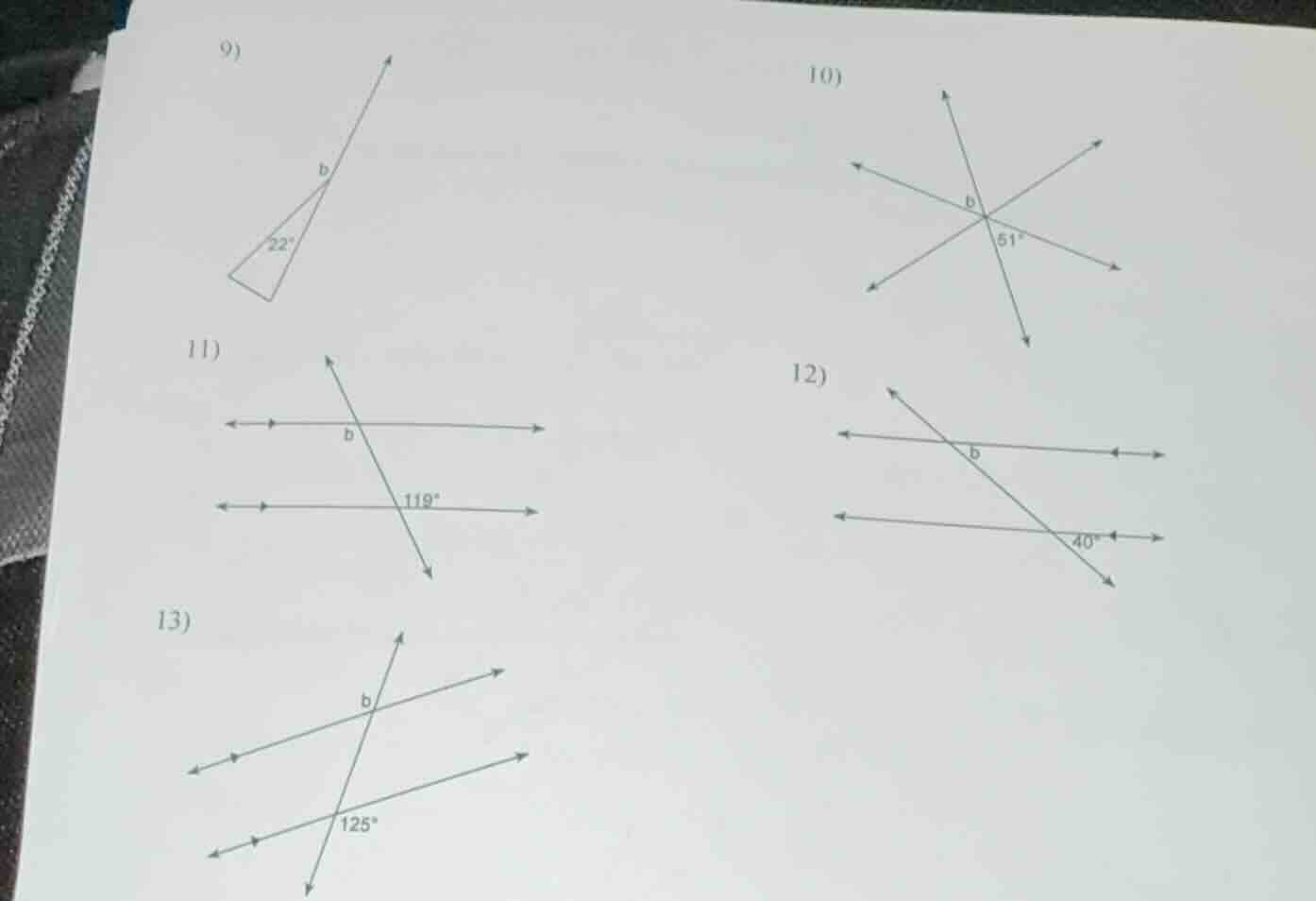
To solve for the unknown angle \( b \) in each problem, we analyze the geometric relationships (supplementary angles, vertical angles, corresponding angles, alternate interior angles) for each case:
Problem 9:
We have a right triangle (implied by the right angle symbol) and an angle of \( 22^\circ \). The angle \( b \) and \( 22^\circ \) are complementary to \( 90^\circ \)? Wait, no—actually, the triangle is a right triangle, so the two acute angles sum to \( 90^\circ \). Wait, the diagram shows a right triangle with one angle \( 22^\circ \), so the angle adjacent to \( b \) is \( 90^\circ - 22^\circ = 68^\circ \)? Wait, no—maybe \( b \) is the angle outside? Wait, the diagram: a right triangle with one angle \( 22^\circ \), and a ray forming angle \( b \). Wait, maybe \( b = 90^\circ - 22^\circ = 68^\circ \)? Wait, no—actually, the right angle is \( 90^\circ \), so \( b + 22^\circ = 90^\circ \)? Wait, no, maybe the triangle is a right triangle, so the angle \( b \) is \( 90^\circ - 22^\circ = 68^\circ \)? Wait, perhaps I misinterpret. Alternatively, if the triangle is a right triangle, the angle \( b \) is \( 90^\circ - 22^\circ = 68^\circ \). Wait, maybe the correct approach: the triangle has a right angle (\( 90^\circ \)), so \( b + 22^\circ = 90^\circ \), so \( b = 90^\circ - 22^\circ = 68^\circ \).
Problem 10:
We have intersecting lines, so vertical angles are equal, and supplementary angles sum to \( 180^\circ \). The angle \( 51^\circ \) and \( b \) are supplementary? Wait, no—if \( 51^\circ \) and \( b \) are adjacent and form a linear pair, then \( b + 51^\circ = 180^\circ \)? Wait, no—wait, the diagram shows multiple intersecting lines. Wait, the angle \( 51^\circ \) and \( b \) are vertical angles? No, wait, if \( 51^\circ \) and \( b \) are adjacent, maybe \( b = 180^\circ - 51^\circ = 129^\circ \)? Wait, no—wait, the lines intersect, so vertical angles are equal, and linear pairs sum to \( 180^\circ \). Wait, maybe \( b \) is vertical to an angle supplementary to \( 51^\circ \). Wait, no—let’s re-examine. If the angle given is \( 51^\circ \), and \( b \) is opposite to an angle that is supplementary to \( 51^\circ \)? No, maybe \( b = 180^\circ - 51^\circ = 129^\circ \)? Wait, no—wait, the diagram: multiple lines intersecting, so \( b \) and \( 51^\circ \) are adjacent, forming a linear pair? Then \( b = 180^\circ - 51^\circ = 129^\circ \).
Problem 11:
We have two parallel lines cut by a transversal. The angle \( 119^\circ \) and \( b \) are corresponding angles or alternate interior angles? Wait, the angle \( 119^\circ \) and \( b \) are supplementary (since they are same-side interior angles? No, wait—if the lines are parallel, consecutive interior angles are supplementary. Wait, the angle \( 119^\circ \) and \( b \) are same-side interior angles? Wait, no—let’s see: the transversal cuts the two parallel lines. The angle \( 119^\circ \) and \( b \) are vertical angles or supplementary? Wait, the angle \( 119^\circ \) and \( b \) are supplementary because they form a linear pair? No, wait—the angle \( 119^\circ \) and \( b \) are same-side interior angles, so \( b + 119^\circ = 180^\circ \), so \( b = 180^\circ - 119^\circ = 61^\circ \).
Problem 12:
Two parallel lines cut by a transversal. The angle \( 40^\circ \) and \( b \) are corresponding angles (since they are in the same position relative to the parallel lines and transversal). Thus, \( b = 40^\circ \) (corresponding angles are equal when lines are parallel).
Problem 13:
Two parallel lines cut by a transversal. The angle \( 125^\circ \) a…

Snap & solve any problem in the app
Get step-by-step solutions on Sovi AI
Photo-based solutions with guided steps
Explore more problems and detailed explanations
To solve for the unknown angle \( b \) in each problem, we analyze the geometric relationships (supplementary angles, vertical angles, corresponding angles, alternate interior angles) for each case:
Problem 9:
We have a right triangle (implied by the right angle symbol) and an angle of \( 22^\circ \). The angle \( b \) and \( 22^\circ \) are complementary to \( 90^\circ \)? Wait, no—actually, the triangle is a right triangle, so the two acute angles sum to \( 90^\circ \). Wait, the diagram shows a right triangle with one angle \( 22^\circ \), so the angle adjacent to \( b \) is \( 90^\circ - 22^\circ = 68^\circ \)? Wait, no—maybe \( b \) is the angle outside? Wait, the diagram: a right triangle with one angle \( 22^\circ \), and a ray forming angle \( b \). Wait, maybe \( b = 90^\circ - 22^\circ = 68^\circ \)? Wait, no—actually, the right angle is \( 90^\circ \), so \( b + 22^\circ = 90^\circ \)? Wait, no, maybe the triangle is a right triangle, so the angle \( b \) is \( 90^\circ - 22^\circ = 68^\circ \)? Wait, perhaps I misinterpret. Alternatively, if the triangle is a right triangle, the angle \( b \) is \( 90^\circ - 22^\circ = 68^\circ \). Wait, maybe the correct approach: the triangle has a right angle (\( 90^\circ \)), so \( b + 22^\circ = 90^\circ \), so \( b = 90^\circ - 22^\circ = 68^\circ \).
Problem 10:
We have intersecting lines, so vertical angles are equal, and supplementary angles sum to \( 180^\circ \). The angle \( 51^\circ \) and \( b \) are supplementary? Wait, no—if \( 51^\circ \) and \( b \) are adjacent and form a linear pair, then \( b + 51^\circ = 180^\circ \)? Wait, no—wait, the diagram shows multiple intersecting lines. Wait, the angle \( 51^\circ \) and \( b \) are vertical angles? No, wait, if \( 51^\circ \) and \( b \) are adjacent, maybe \( b = 180^\circ - 51^\circ = 129^\circ \)? Wait, no—wait, the lines intersect, so vertical angles are equal, and linear pairs sum to \( 180^\circ \). Wait, maybe \( b \) is vertical to an angle supplementary to \( 51^\circ \). Wait, no—let’s re-examine. If the angle given is \( 51^\circ \), and \( b \) is opposite to an angle that is supplementary to \( 51^\circ \)? No, maybe \( b = 180^\circ - 51^\circ = 129^\circ \)? Wait, no—wait, the diagram: multiple lines intersecting, so \( b \) and \( 51^\circ \) are adjacent, forming a linear pair? Then \( b = 180^\circ - 51^\circ = 129^\circ \).
Problem 11:
We have two parallel lines cut by a transversal. The angle \( 119^\circ \) and \( b \) are corresponding angles or alternate interior angles? Wait, the angle \( 119^\circ \) and \( b \) are supplementary (since they are same-side interior angles? No, wait—if the lines are parallel, consecutive interior angles are supplementary. Wait, the angle \( 119^\circ \) and \( b \) are same-side interior angles? Wait, no—let’s see: the transversal cuts the two parallel lines. The angle \( 119^\circ \) and \( b \) are vertical angles or supplementary? Wait, the angle \( 119^\circ \) and \( b \) are supplementary because they form a linear pair? No, wait—the angle \( 119^\circ \) and \( b \) are same-side interior angles, so \( b + 119^\circ = 180^\circ \), so \( b = 180^\circ - 119^\circ = 61^\circ \).
Problem 12:
Two parallel lines cut by a transversal. The angle \( 40^\circ \) and \( b \) are corresponding angles (since they are in the same position relative to the parallel lines and transversal). Thus, \( b = 40^\circ \) (corresponding angles are equal when lines are parallel).
Problem 13:
Two parallel lines cut by a transversal. The angle \( 125^\circ \) and \( b \) are supplementary (consecutive interior angles) or vertical angles? Wait, the angle \( 125^\circ \) and \( b \) are corresponding angles? No—wait, the angle \( 125^\circ \) and \( b \) are vertical angles? No, wait—if the transversal cuts the parallel lines, the angle \( 125^\circ \) and \( b \) are supplementary (consecutive interior angles), so \( b + 125^\circ = 180^\circ \), so \( b = 180^\circ - 125^\circ = 55^\circ \)? Wait, no—wait, the angle \( 125^\circ \) and \( b \) are corresponding angles? Wait, no—let’s see: the angle \( 125^\circ \) and \( b \) are vertical angles? No, the diagram: two parallel lines, transversal, angle \( 125^\circ \) and \( b \) are same-side interior angles? Wait, no—if the angle \( 125^\circ \) is on one line, \( b \) is on the other, so they are supplementary. Thus, \( b = 180^\circ - 125^\circ = 55^\circ \).
Final Answers:
- \( \boldsymbol{68^\circ} \) (assuming \( b + 22^\circ = 90^\circ \))
- \( \boldsymbol{129^\circ} \) (linear pair with \( 51^\circ \))
- \( \boldsymbol{61^\circ} \) (supplementary to \( 119^\circ \))
- \( \boldsymbol{40^\circ} \) (corresponding angles)
- \( \boldsymbol{55^\circ} \) (supplementary to \( 125^\circ \))
(Note: Diagrams are interpreted based on standard angle relationships in geometry. Adjustments may be needed if the diagram’s specific configuration differs.)