QUESTION IMAGE
Question
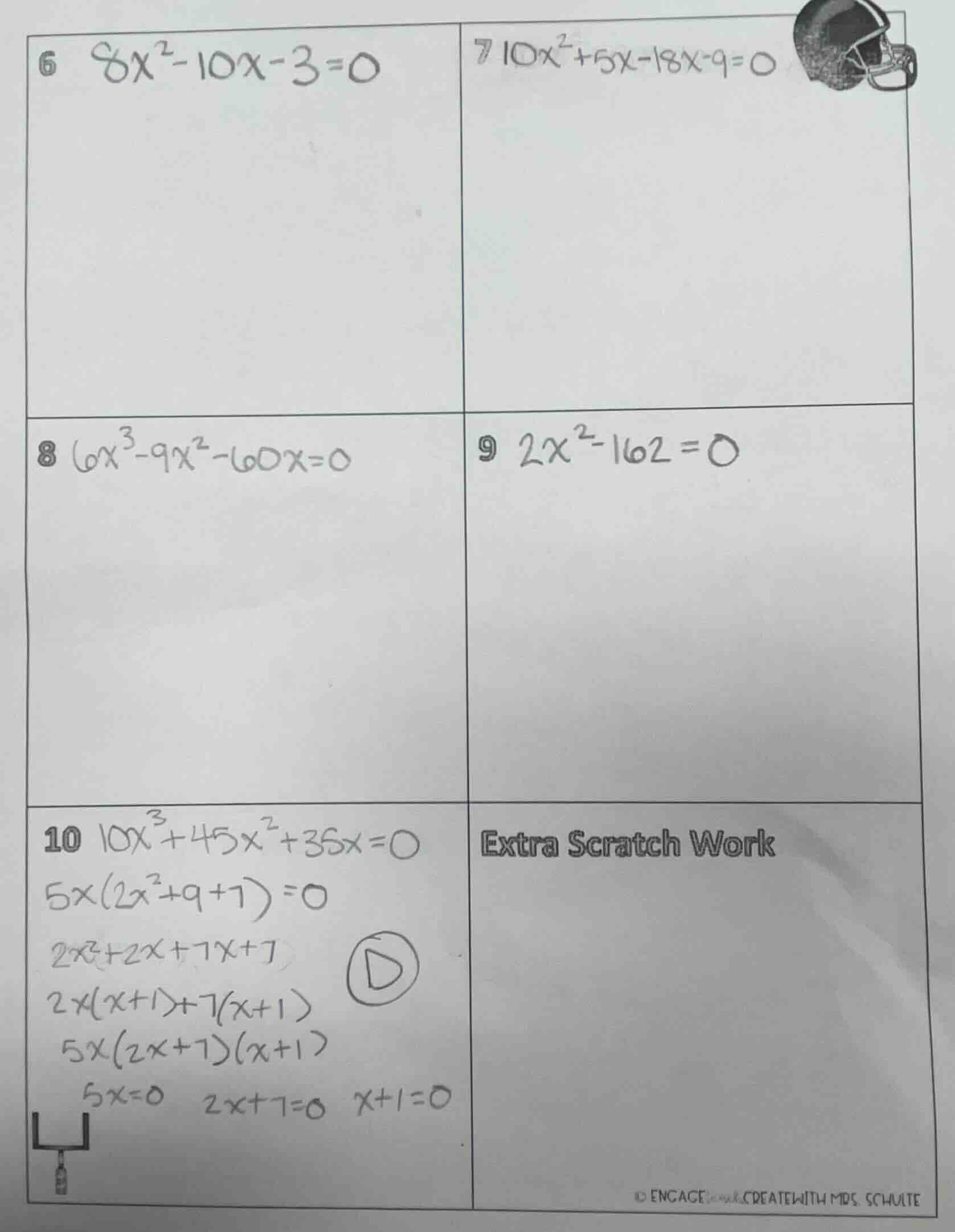
6 $8x^2 - 10x - 3 = 0$
7 $10x^2 + 5x - 18x - 9 = 0$
8 $6x^3 - 9x^2 - 60x = 0$
9 $2x^2 - 162 = 0$
10 $10x^3 + 45x^2 + 35x = 0$
$5x(2x^2 + 9 + 7) = 0$
$2x^3 + 2x + 7x + 7$
$2x(x + 1) + 7(x + 1)$
$5x(2x + 7)(x + 1)$
$5x = 0$ $2x + 7 = 0$ $x + 1 = 0$
extra scratch work
Let's solve each equation one by one.
Problem 6: Solve \(8x^2 - 10x - 3 = 0\)
Step 1: Factor the quadratic
We need to find two numbers that multiply to \(8\times(-3)= -24\) and add up to \(-10\). The numbers are \(-12\) and \(2\).
Rewrite the middle term: \(8x^2 - 12x + 2x - 3 = 0\)
Group the terms: \((8x^2 - 12x) + (2x - 3) = 0\)
Factor out the GCF from each group: \(4x(2x - 3) + 1(2x - 3) = 0\)
Factor out \((2x - 3)\): \((4x + 1)(2x - 3) = 0\)
Step 2: Set each factor equal to zero
\(4x + 1 = 0\) or \(2x - 3 = 0\)
For \(4x + 1 = 0\): \(4x = -1\) so \(x = -\frac{1}{4}\)
For \(2x - 3 = 0\): \(2x = 3\) so \(x = \frac{3}{2}\)
Step 1: Simplify and factor
First, combine like terms: \(10x^2 - 13x - 9 = 0\) (Wait, actually, let's factor by grouping as given: \(10x^2 + 5x - 18x - 9 = 0\)
Group: \((10x^2 + 5x) + (-18x - 9) = 0\)
Factor: \(5x(2x + 1) - 9(2x + 1) = 0\)
Factor out \((2x + 1)\): \((5x - 9)(2x + 1) = 0\)
Step 2: Solve for \(x\)
\(5x - 9 = 0\) or \(2x + 1 = 0\)
For \(5x - 9 = 0\): \(5x = 9\) so \(x = \frac{9}{5}\)
For \(2x + 1 = 0\): \(2x = -1\) so \(x = -\frac{1}{2}\)
Step 1: Factor out the GCF
The GCF of \(6x^3\), \(-9x^2\), and \(-60x\) is \(3x\).
Factor out \(3x\): \(3x(2x^2 - 3x - 20) = 0\)
Step 2: Factor the quadratic
Factor \(2x^2 - 3x - 20\). We need two numbers that multiply to \(2\times(-20)= -40\) and add up to \(-3\). The numbers are \(-8\) and \(5\).
Rewrite the middle term: \(2x^2 - 8x + 5x - 20 = 0\)
Group: \((2x^2 - 8x) + (5x - 20) = 0\)
Factor: \(2x(x - 4) + 5(x - 4) = 0\)
Factor out \((x - 4)\): \((2x + 5)(x - 4) = 0\)
Step 3: Set factors to zero
\(3x = 0\) or \(2x + 5 = 0\) or \(x - 4 = 0\)
For \(3x = 0\): \(x = 0\)
For \(2x + 5 = 0\): \(2x = -5\) so \(x = -\frac{5}{2}\)
For \(x - 4 = 0\): \(x = 4\)

Snap & solve any problem in the app
Get step-by-step solutions on Sovi AI
Photo-based solutions with guided steps
Explore more problems and detailed explanations
\(x = -\frac{1}{4}, \frac{3}{2}\)