QUESTION IMAGE
Question
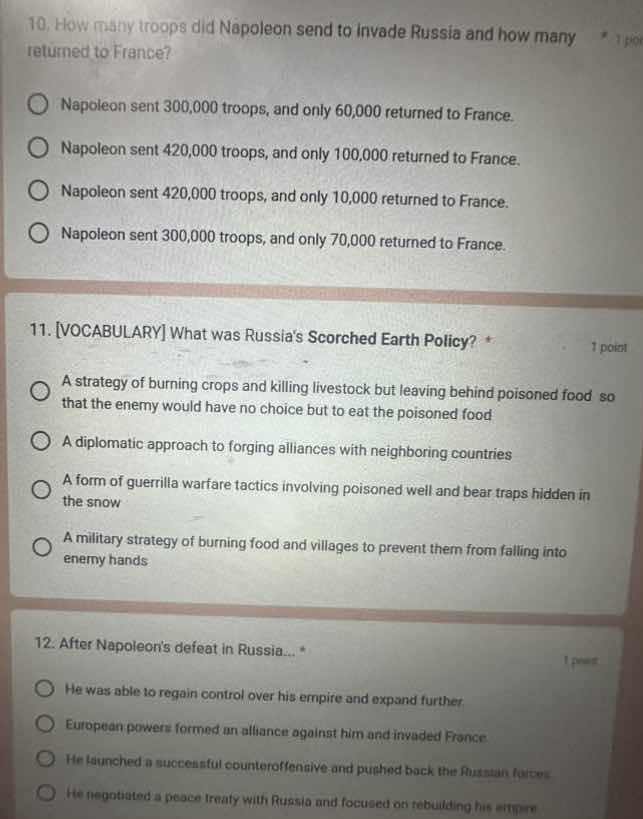
- how many troops did napoleon send to invade russia and how many returned to france?
options:
napoleon sent 300,000 troops, and only 60,000 returned to france.
napoleon sent 420,000 troops, and only 100,000 returned to france.
napoleon sent 420,000 troops, and only 10,000 returned to france.
napoleon sent 300,000 troops, and only 70,000 returned to france.
- vocabulary what was russia’s scorched earth policy?
options:
a strategy of burning crops and killing livestock but leaving behind poisoned food so that the enemy would have no choice but to eat the poisoned food
a diplomatic approach to forging alliances with neighboring countries
a form of guerrilla warfare tactics involving poisoned well and bear traps hidden in the snow
a military strategy of burning food and villages to prevent them from falling into enemy hands
- after napoleon’s defeat in russia...
options:
he was able to regain control over his empire and expand further.
european powers formed an alliance against him and invaded france.
he launched a successful counteroffensive and pushed back the russian forces.
he negotiated a peace treaty with russia and focused on rebuilding his empire
Question 10
To determine the correct answer, we recall historical facts about Napoleon's invasion of Russia. Napoleon's Grand Army (the forces sent to invade Russia) was around 420,000 troops. The number of troops that returned to France was extremely low, around 10,000 due to the harsh conditions, battles, and the Russian winter. So we compare the options:
- First option: 300,000 sent and 60,000 returned is incorrect.
- Second option: 420,000 sent and 100,000 returned is incorrect.
- Third option: 420,000 sent and 10,000 returned matches historical records.
- Fourth option: 300,000 sent and 70,000 returned is incorrect.
The Scorched Earth Policy is a military strategy where resources (like food, villages, crops) are destroyed to prevent the enemy from using them. Let's analyze the options:
- First option: Mention of "poisoned food" is not part of the traditional Scorched Earth Policy; it's about destroying, not poisoning to force eating. Incorrect.
- Second option: It's a military strategy, not diplomatic. Incorrect.
- Third option: "Poisoned well and bear traps" are not part of Scorched Earth; it's about destroying resources, not guerrilla with traps. Incorrect.
- Fourth option: "Burning food and villages to prevent them from falling into enemy hands" matches the definition of Scorched Earth Policy. Correct.
After Napoleon's defeat in Russia, his military power was weakened. European powers (like Russia, Prussia, Austria, etc.) formed an alliance against him and invaded France. Let's check the options:
- First option: He could not regain control and expand; his defeat in Russia weakened him. Incorrect.
- Second option: European powers formed an alliance (the Sixth Coalition) and invaded France. Correct.
- Third option: He did not launch a successful counteroffensive against Russia after the defeat; his army was devastated. Incorrect.
- Fourth option: He did not negotiate a peace treaty and focus on rebuilding; instead, he faced invasion. Incorrect.

Snap & solve any problem in the app
Get step-by-step solutions on Sovi AI
Photo-based solutions with guided steps
Explore more problems and detailed explanations
C. Napoleon sent 420,000 troops, and only 10,000 returned to France. (assuming the options are labeled A, B, C, D with C being the third option as per the order: first option A, second B, third C, fourth D)