QUESTION IMAGE
Question
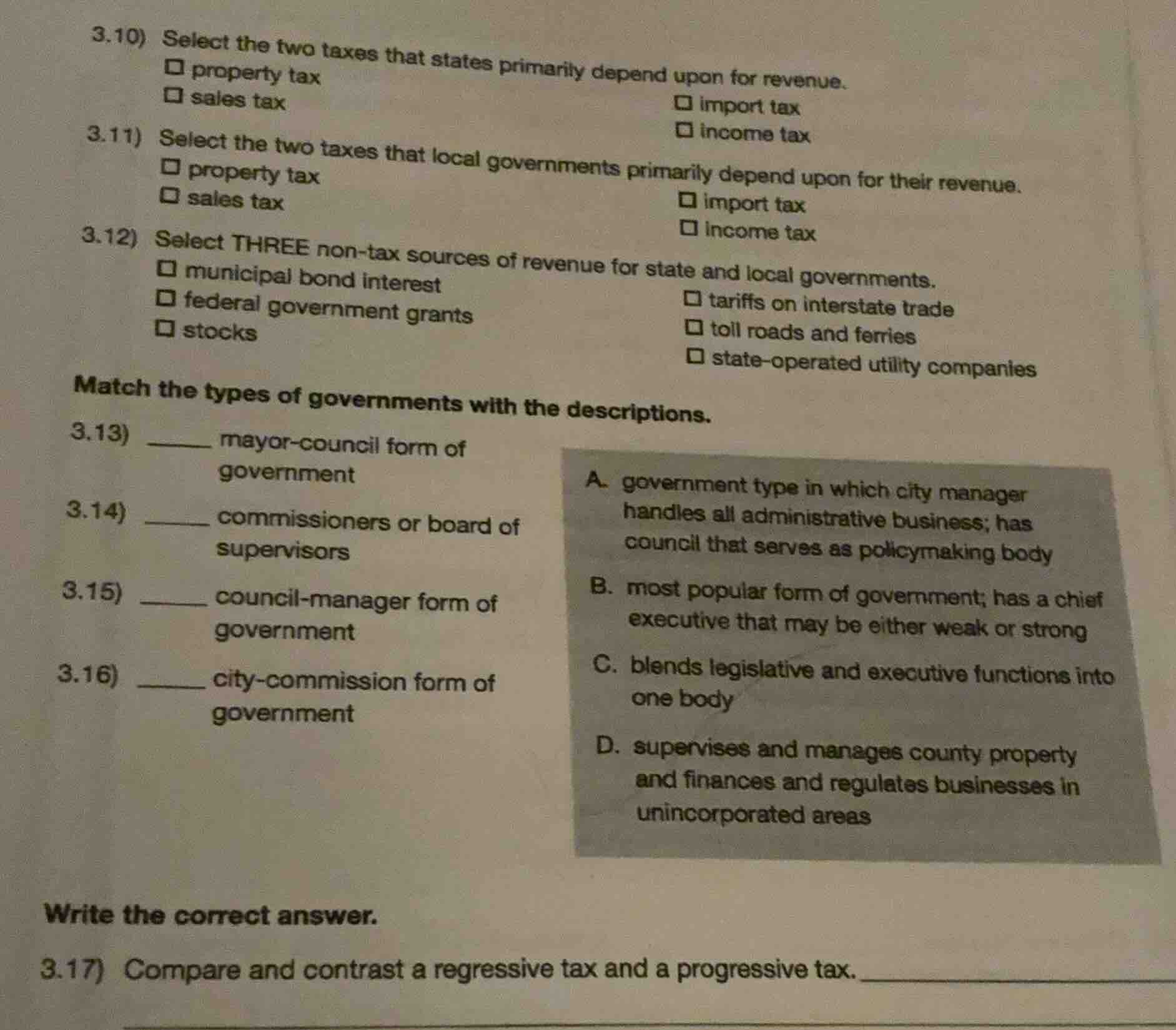
3.10) select the two taxes that states primarily depend upon for revenue.
□ property tax
□ sales tax
□ import tax
□ income tax
3.11) select the two taxes that local governments primarily depend upon for their revenue.
□ property tax
□ sales tax
□ import tax
□ income tax
3.12) select three non - tax sources of revenue for state and local governments.
□ municipal bond interest
□ federal government grants
□ stocks
□ tariffs on interstate trade
□ toll roads and ferries
□ state - operated utility companies
match the types of governments with the descriptions.
3.13) ______ mayor - council form of government
3.14) ______ commissioners or board of supervisors
3.15) ______ council - manager form of government
3.16) ______ city - commission form of government
a. government type in which city manager handles all administrative business; has council that serves as policymaking body
b. most popular form of government; has a chief executive that may be either weak or strong
c. blends legislative and executive functions into one body
d. supervises and manages county property and finances and regulates businesses in unincorporated areas
write the correct answer.
3.17) compare and contrast a regressive tax and a progressive tax. ______
3.10
State governments rely heavily on broad-based consumption and individual earnings taxes for revenue.
3.11
Local governments prioritize taxes tied to local property and consumer spending.
3.12
Non-tax revenue comes from federal support, user fees, and public enterprise earnings; tariffs are federal taxes, and stocks/bond interest are not core public revenue sources.
3.13-3.16
- Mayor-council is the most common municipal form with a chief executive.
- County boards of supervisors manage county-level property and unincorporated areas.
- Council-manager systems use a professional administrator for daily operations.
- City-commission systems combine legislative and executive roles in one body.
3.17
Regressive and progressive taxes differ in how tax burden shifts with income, impacting low vs. high earners differently.

Snap & solve any problem in the app
Get step-by-step solutions on Sovi AI
Photo-based solutions with guided steps
Explore more problems and detailed explanations
3.10:
- □ property tax
- ☑ sales tax
- □ import tax
- ☑ income tax
3.11:
- ☑ property tax
- ☑ sales tax
- □ import tax
- □ income tax
3.12:
- □ municipal bond interest
- ☑ federal government grants
- □ tariffs on interstate trade
- ☑ toll roads and ferries
- □ stocks
- ☑ state-operated utility companies
3.13: B. most popular form of government; has a chief executive that may be either weak or strong
3.14: D. supervises and manages county property and finances and regulates businesses in unincorporated areas
3.15: A. government type in which city manager handles all administrative business; has council that serves as policymaking body
3.16: C. blends legislative and executive functions into one body
3.17: A regressive tax imposes a higher effective tax rate on lower-income individuals (e.g., sales tax, as it takes a larger share of a low earner's income) while the effective rate falls as income rises. A progressive tax imposes a higher effective tax rate on higher-income individuals (e.g., federal income tax, with tax brackets that increase as income rises), so the tax burden takes a larger share of high earners' income. Both are methods of government revenue collection, but they distribute the tax burden inversely based on income levels.