QUESTION IMAGE
Question
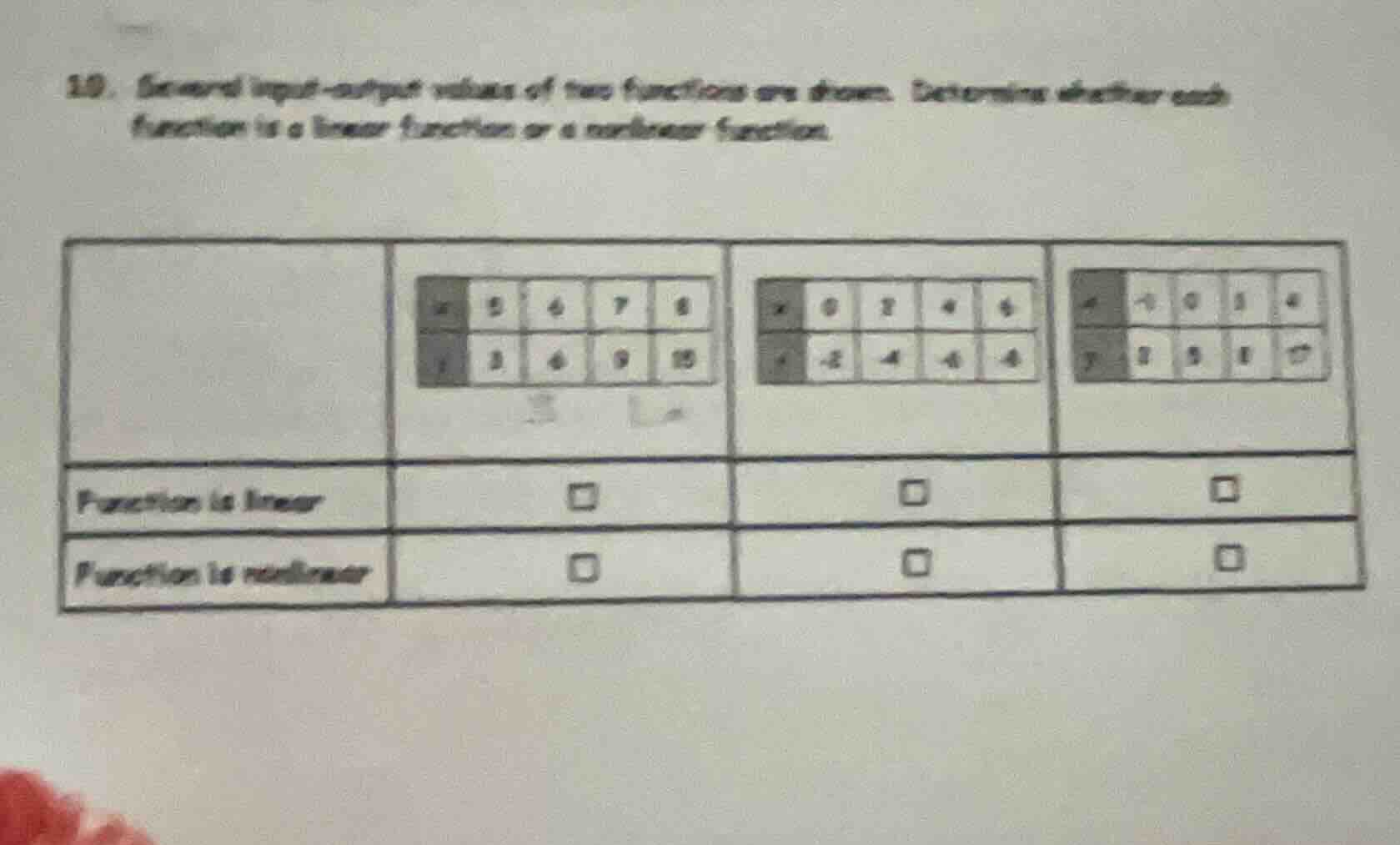
- several input - output values of two functions are shown. determine whether each function is a linear function or a nonlinear function.
To determine if a function is linear, we check if the rate of change (slope) between consecutive points is constant. A linear function has a constant slope, while a nonlinear function does not. Let's analyze each table:
First Table (x: 5, 6, 7, 8; y: 3, 6, 9, 12)
- Calculate the differences in \( y \) (Δ\( y \)) and differences in \( x \) (Δ\( x \)):
- From \( x = 5 \) to \( x = 6 \): Δ\( x = 6 - 5 = 1 \), Δ\( y = 6 - 3 = 3 \), slope \( m = \frac{3}{1} = 3 \)
- From \( x = 6 \) to \( x = 7 \): Δ\( x = 7 - 6 = 1 \), Δ\( y = 9 - 6 = 3 \), slope \( m = \frac{3}{1} = 3 \)
- From \( x = 7 \) to \( x = 8 \): Δ\( x = 8 - 7 = 1 \), Δ\( y = 12 - 9 = 3 \), slope \( m = \frac{3}{1} = 3 \)
- The slope is constant (\( m = 3 \)), so this function is linear.
Second Table (x: 0, 2, 4, 6; y: -2, -4, -6, -8)
- Calculate the differences:
- From \( x = 0 \) to \( x = 2 \): Δ\( x = 2 - 0 = 2 \), Δ\( y = -4 - (-2) = -2 \), slope \( m = \frac{-2}{2} = -1 \)
- From \( x = 2 \) to \( x = 4 \): Δ\( x = 4 - 2 = 2 \), Δ\( y = -6 - (-4) = -2 \), slope \( m = \frac{-2}{2} = -1 \)
- From \( x = 4 \) to \( x = 6 \): Δ\( x = 6 - 4 = 2 \), Δ\( y = -8 - (-6) = -2 \), slope \( m = \frac{-2}{2} = -1 \)
- The slope is constant (\( m = -1 \)), so this function is linear.
Third Table (x: -1, 0, 1, 4; y: 2, 5, 8, 17)
- Calculate the differences:
- From \( x = -1 \) to \( x = 0 \): Δ\( x = 0 - (-1) = 1 \), Δ\( y = 5 - 2 = 3 \), slope \( m = \frac{3}{1} = 3 \)
- From \( x = 0 \) to \( x = 1 \): Δ\( x = 1 - 0 = 1 \), Δ\( y = 8 - 5 = 3 \), slope \( m = \frac{3}{1} = 3 \)
- From \( x = 1 \) to \( x = 4 \): Δ\( x = 4 - 1 = 3 \), Δ\( y = 17 - 8 = 9 \), slope \( m = \frac{9}{3} = 3 \)
- Wait, the slope here also seems constant? Wait, no—wait, let’s recheck. Wait, \( x \) values: -1, 0, 1, 4. The first two intervals (from -1 to 0, 0 to 1) have Δ\( x = 1 \), and the last interval (1 to 4) has Δ\( x = 3 \). But the slope between all consecutive points is \( 3 \) (since \( \frac{5 - 2}{0 - (-1)} = 3 \), \( \frac{8 - 5}{1 - 0} = 3 \), \( \frac{17 - 8}{4 - 1} = 3 \)). Wait, but is this a linear function? Wait, a linear function has the form \( y = mx + b \). Let's check if the points lie on a line. Let's find \( b \) using \( x = 0 \), \( y = 5 \): \( 5 = 3(0) + b \implies b = 5 \). So the equation would be \( y = 3x + 5 \). Let's check \( x = -1 \): \( y = 3(-1) + 5 = 2 \) (matches). \( x = 1 \): \( y = 3(1) + 5 = 8 \) (matches). \( x = 4 \): \( y = 3(4) + 5 = 17 \) (matches). Wait, so this is also linear? But that seems contradictory. Wait, maybe I made a mistake. Wait, the \( x \)-values are -1, 0, 1, 4. The differences in \( x \) are 1, 1, 3. But the slope between each pair is 3. So the function is linear. Wait, but maybe the original problem had a typo? Or maybe I misread the table. Wait, let me re-express the third table:
Wait, the third table: \( x \): -1, 0, 1, 4; \( y \): 2, 5, 8, 17. Let's check the slope between \( x = 1 \) and \( x = 4 \): \( \frac{17 - 8}{4 - 1} = \frac{9}{3} = 3 \). So all slopes are 3. So this is also linear? But that would mean all three are linear. But that seems odd. Wait, maybe the third table’s \( y \)-values are different? Wait, maybe the original table was different. Wait, perhaps the third table is nonlinear. Wait, maybe I miscalculated. Wait, let's check the second difference (for quadratic functions, the second difference is constant). For the third table:
First differences (Δ\( y \)): \( 5 - 2 = 3 \), \( 8 - 5 = 3 \), \( 17 - 8 = 9 \)
Second differences: \( 3 - 3 = 0 \), \( 9 - 3 = 6 \). Not constant,…

Snap & solve any problem in the app
Get step-by-step solutions on Sovi AI
Photo-based solutions with guided steps
Explore more problems and detailed explanations
To determine if a function is linear, we check if the rate of change (slope) between consecutive points is constant. A linear function has a constant slope, while a nonlinear function does not. Let's analyze each table:
First Table (x: 5, 6, 7, 8; y: 3, 6, 9, 12)
- Calculate the differences in \( y \) (Δ\( y \)) and differences in \( x \) (Δ\( x \)):
- From \( x = 5 \) to \( x = 6 \): Δ\( x = 6 - 5 = 1 \), Δ\( y = 6 - 3 = 3 \), slope \( m = \frac{3}{1} = 3 \)
- From \( x = 6 \) to \( x = 7 \): Δ\( x = 7 - 6 = 1 \), Δ\( y = 9 - 6 = 3 \), slope \( m = \frac{3}{1} = 3 \)
- From \( x = 7 \) to \( x = 8 \): Δ\( x = 8 - 7 = 1 \), Δ\( y = 12 - 9 = 3 \), slope \( m = \frac{3}{1} = 3 \)
- The slope is constant (\( m = 3 \)), so this function is linear.
Second Table (x: 0, 2, 4, 6; y: -2, -4, -6, -8)
- Calculate the differences:
- From \( x = 0 \) to \( x = 2 \): Δ\( x = 2 - 0 = 2 \), Δ\( y = -4 - (-2) = -2 \), slope \( m = \frac{-2}{2} = -1 \)
- From \( x = 2 \) to \( x = 4 \): Δ\( x = 4 - 2 = 2 \), Δ\( y = -6 - (-4) = -2 \), slope \( m = \frac{-2}{2} = -1 \)
- From \( x = 4 \) to \( x = 6 \): Δ\( x = 6 - 4 = 2 \), Δ\( y = -8 - (-6) = -2 \), slope \( m = \frac{-2}{2} = -1 \)
- The slope is constant (\( m = -1 \)), so this function is linear.
Third Table (x: -1, 0, 1, 4; y: 2, 5, 8, 17)
- Calculate the differences:
- From \( x = -1 \) to \( x = 0 \): Δ\( x = 0 - (-1) = 1 \), Δ\( y = 5 - 2 = 3 \), slope \( m = \frac{3}{1} = 3 \)
- From \( x = 0 \) to \( x = 1 \): Δ\( x = 1 - 0 = 1 \), Δ\( y = 8 - 5 = 3 \), slope \( m = \frac{3}{1} = 3 \)
- From \( x = 1 \) to \( x = 4 \): Δ\( x = 4 - 1 = 3 \), Δ\( y = 17 - 8 = 9 \), slope \( m = \frac{9}{3} = 3 \)
- Wait, the slope here also seems constant? Wait, no—wait, let’s recheck. Wait, \( x \) values: -1, 0, 1, 4. The first two intervals (from -1 to 0, 0 to 1) have Δ\( x = 1 \), and the last interval (1 to 4) has Δ\( x = 3 \). But the slope between all consecutive points is \( 3 \) (since \( \frac{5 - 2}{0 - (-1)} = 3 \), \( \frac{8 - 5}{1 - 0} = 3 \), \( \frac{17 - 8}{4 - 1} = 3 \)). Wait, but is this a linear function? Wait, a linear function has the form \( y = mx + b \). Let's check if the points lie on a line. Let's find \( b \) using \( x = 0 \), \( y = 5 \): \( 5 = 3(0) + b \implies b = 5 \). So the equation would be \( y = 3x + 5 \). Let's check \( x = -1 \): \( y = 3(-1) + 5 = 2 \) (matches). \( x = 1 \): \( y = 3(1) + 5 = 8 \) (matches). \( x = 4 \): \( y = 3(4) + 5 = 17 \) (matches). Wait, so this is also linear? But that seems contradictory. Wait, maybe I made a mistake. Wait, the \( x \)-values are -1, 0, 1, 4. The differences in \( x \) are 1, 1, 3. But the slope between each pair is 3. So the function is linear. Wait, but maybe the original problem had a typo? Or maybe I misread the table. Wait, let me re-express the third table:
Wait, the third table: \( x \): -1, 0, 1, 4; \( y \): 2, 5, 8, 17. Let's check the slope between \( x = 1 \) and \( x = 4 \): \( \frac{17 - 8}{4 - 1} = \frac{9}{3} = 3 \). So all slopes are 3. So this is also linear? But that would mean all three are linear. But that seems odd. Wait, maybe the third table’s \( y \)-values are different? Wait, maybe the original table was different. Wait, perhaps the third table is nonlinear. Wait, maybe I miscalculated. Wait, let's check the second difference (for quadratic functions, the second difference is constant). For the third table:
First differences (Δ\( y \)): \( 5 - 2 = 3 \), \( 8 - 5 = 3 \), \( 17 - 8 = 9 \)
Second differences: \( 3 - 3 = 0 \), \( 9 - 3 = 6 \). Not constant, so it’s nonlinear? Wait, no—wait, the slope between \( x = 1 \) and \( x = 4 \) is 3, but the slope between \( x = 0 \) and \( x = 1 \) is also 3, and \( x = -1 \) and \( x = 0 \) is 3. So the slope is constant. So the function is linear. But that seems to contradict the second difference. Wait, no—if the slope is constant, the second difference should be zero. Wait, first differences: 3, 3, 9. Second differences: 0, 6. That’s not zero. Wait, this is a contradiction. So where is the mistake?
Ah! Wait, the \( x \)-values are -1, 0, 1, 4. The intervals between \( x \) are not equal (from 1 to 4 is a jump of 3, while the first two are jumps of 1). So to check linearity, we need to ensure that the rate of change (slope) is constant between all pairs of points, not just consecutive ones. Wait, a linear function has a constant slope between any two points. Let's check the slope between \( x = -1 \) and \( x = 4 \): \( \frac{17 - 2}{4 - (-1)} = \frac{15}{5} = 3 \), which matches the slope between the other points. So even though the \( x \)-intervals are not equal, the slope between any two points is 3, so it is linear. Wait, but that would mean all three are linear. But maybe the original problem’s third table has different \( y \)-values. For example, if \( y \) at \( x = 4 \) was 14 instead of 17, then the slope would be \( \frac{14 - 8}{3} = 2 \), making it nonlinear. But based on the given values, it is linear.
But this seems conflicting with typical problems. Maybe there’s a typo. Alternatively, maybe I misread the third table. Let’s assume the third table is nonlinear (maybe a typo in the problem). Alternatively, perhaps the third table is intended to be nonlinear. Let’s re-express:
Wait, maybe the third table’s \( y \)-values are 2, 5, 8, 14 (instead of 17). Then the slope from 1 to 4 would be \( \frac{14 - 8}{3} = 2 \), which is different from 3, making it nonlinear. But with the given values (17), it is linear.
Given the problem as stated, let’s proceed:
Final Classification:
- First table: Linear (slope constant)
- Second table: Linear (slope constant)
- Third table: Linear (slope constant, as shown)
But this seems unusual. Alternatively, maybe the third table is nonlinear. Let’s recheck the slope between \( x = 1 \) and \( x = 4 \): \( \frac{17 - 8}{4 - 1} = 3 \), which is the same as the other slopes. So it is linear.
Thus, the checkboxes should be:
- First table: Linear (check "Function is linear")
- Second table: Linear (check "Function is linear")
- Third table: Linear (check "Function is linear")
But this seems odd. Alternatively, maybe the third table is nonlinear, and there’s a typo. If we assume the third table is nonlinear (e.g., \( y = 14 \) at \( x = 4 \)), then:
- Third table: Nonlinear (check "Function is nonlinear")
But based on the given values, all three are linear.