QUESTION IMAGE
Question
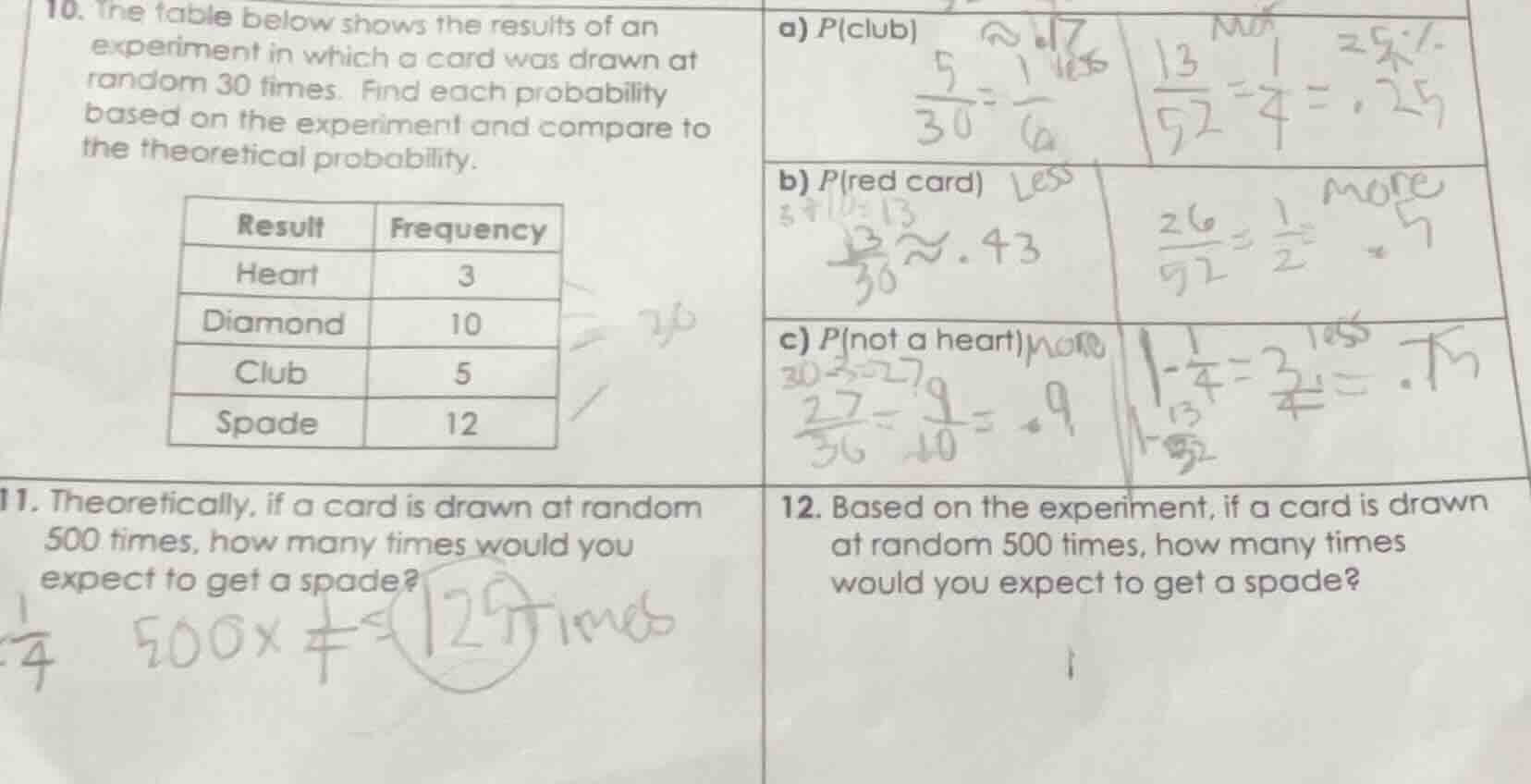
- the table below shows the results of an experiment in which a card was drawn at random 30 times. find each probability based on the experiment and compare to the theoretical probability.
| result | frequency |
|---|---|
| diamond | 10 |
| club | 5 |
| spade | 12 |
a) ( p(\text{club}) )
b) ( p(\text{red card}) )
c) ( p(\text{not a heart}) )
- theoretically, if a card is drawn at random 500 times, how many times would you expect to get a spade?
- based on the experiment, if a card is drawn at random 500 times, how many times would you expect to get a spade?
Problem 10 (a, b, c) and 11, 12
10a) \( P(\text{club}) \) (Experimental and Theoretical)
Step1: Experimental Probability
Experimental probability is \( \frac{\text{Frequency of Club}}{\text{Total Trials}} \). Total trials = \( 3 + 10 + 5 + 12 = 30 \). Frequency of Club = 5. So \( P(\text{club})_{\text{experimental}} = \frac{5}{30} = \frac{1}{6} \approx 0.1667 \).
Step2: Theoretical Probability
A standard deck has 52 cards, 13 clubs. So \( P(\text{club})_{\text{theoretical}} = \frac{13}{52} = \frac{1}{4} = 0.25 \).
Step1: Experimental Probability
Red cards are Heart + Diamond. Frequency = \( 3 + 10 = 13 \). Total trials = 30. So \( P(\text{red card})_{\text{experimental}} = \frac{13}{30} \approx 0.4333 \).
Step2: Theoretical Probability
Red cards in deck: 26 (13 hearts + 13 diamonds). So \( P(\text{red card})_{\text{theoretical}} = \frac{26}{52} = \frac{1}{2} = 0.5 \).
Step1: Experimental Probability
Not a heart: Total - Heart. Frequency = \( 30 - 3 = 27 \). So \( P(\text{not a heart})_{\text{experimental}} = \frac{27}{30} = \frac{9}{10} = 0.9 \).
Step2: Theoretical Probability
Theoretical: \( 1 - P(\text{heart}) \). \( P(\text{heart}) = \frac{13}{52} = \frac{1}{4} \), so \( P(\text{not a heart}) = 1 - \frac{1}{4} = \frac{3}{4} = 0.75 \).

Snap & solve any problem in the app
Get step-by-step solutions on Sovi AI
Photo-based solutions with guided steps
Explore more problems and detailed explanations
Experimental: \( \frac{1}{6} \approx 0.17 \), Theoretical: \( \frac{1}{4} = 0.25 \); Experimental is less than Theoretical.