QUESTION IMAGE
Question
10 things you can do to avoid fraud
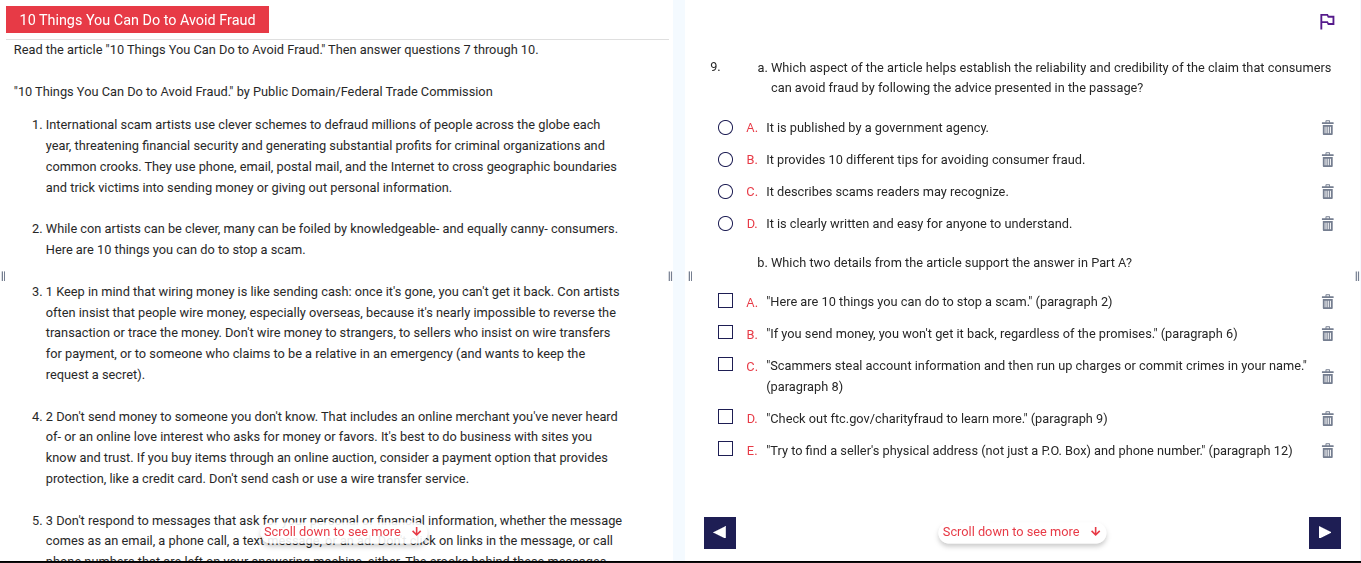
read the article \10 things you can do to avoid fraud.\ then answer questions 7 through 10.
\10 things you can do to avoid fraud\ by public domain/federal trade commission
- international scam artists use clever schemes to defraud millions of people across the globe each year, threatening financial security and generating substantial profits for criminal organizations and common crooks. they use phone, email, postal mail, and the internet to cross geographic boundaries and trick victims into sending money or giving out personal information.
- while con artists can be clever, many can be foiled by knowledgeable- and equally canny- consumers. here are 10 things you can do to stop a scam.
3.1 keep in mind that wiring money is like sending cash: once its gone, you cant get it back. con artists often insist that people wire money, especially overseas, because its nearly impossible to reverse the transaction or trace the money. dont wire money to strangers, to sellers who insist on wire transfers for payment, or to someone who claims to be a relative in an emergency (and wants to keep the request a secret).
4.2 dont send money to someone you dont know. that includes an online merchant youve never heard of or an online love interest who asks for money or favors. its best to do business with sites you know and trust. if you buy items through an online auction, consider a payment option that provides protection, like a credit card. dont send cash or use a wire transfer service.
5.3 dont respond to messages that ask for your personal or financial information, whether the message comes as an email, a phone call, a text...
scroll down to see more
- a. which aspect of the article helps establish the reliability and credibility of the claim that consumers can avoid fraud by following the advice presented in the passage?
○ a. it is published by a government agency.
○ b. it provides 10 different tips for avoiding consumer fraud.
○ c. it describes scams readers may recognize.
○ d. it is clearly written and easy for anyone to understand.
b. which two details from the article support the answer in part a?
□ a. \here are 10 things you can do to stop a scam.\ (paragraph 2)
□ b. \if you send money, you wont get it back, regardless of the promises.\ (paragraph 6)
□ c. \scammers steal account information and then run up charges or commit crimes in your name.\ (paragraph 8)
□ d. \check out ftc.gov/charityfraud to learn more.\ (paragraph 9)
□ e. \try to find a sellers physical address (not just a p.o. box) and phone number.\ (paragraph 12)
scroll down to see more
Part 9a:
A government agency like the FTC is a trusted, authoritative source for consumer protection information, so its publication of the article directly supports the reliability of the fraud-avoidance advice. Other options do not address credibility of the claim itself.
Part 9b:
Option D links to an official FTC website, which reinforces that the content is affiliated with a government agency. Option B states a clear, direct warning about irreversible payments, which is a specific, authoritative tip from the government-backed guide that aligns with the reliable source.

Snap & solve any problem in the app
Get step-by-step solutions on Sovi AI
Photo-based solutions with guided steps
Explore more problems and detailed explanations
- a. A. It is published by a government agency.
b. B. "If you send money, you won't get it back, regardless of the promises." (paragraph 6)
D. "Check out ftc.gov/charityfraud to learn more." (paragraph 9)