QUESTION IMAGE
Question
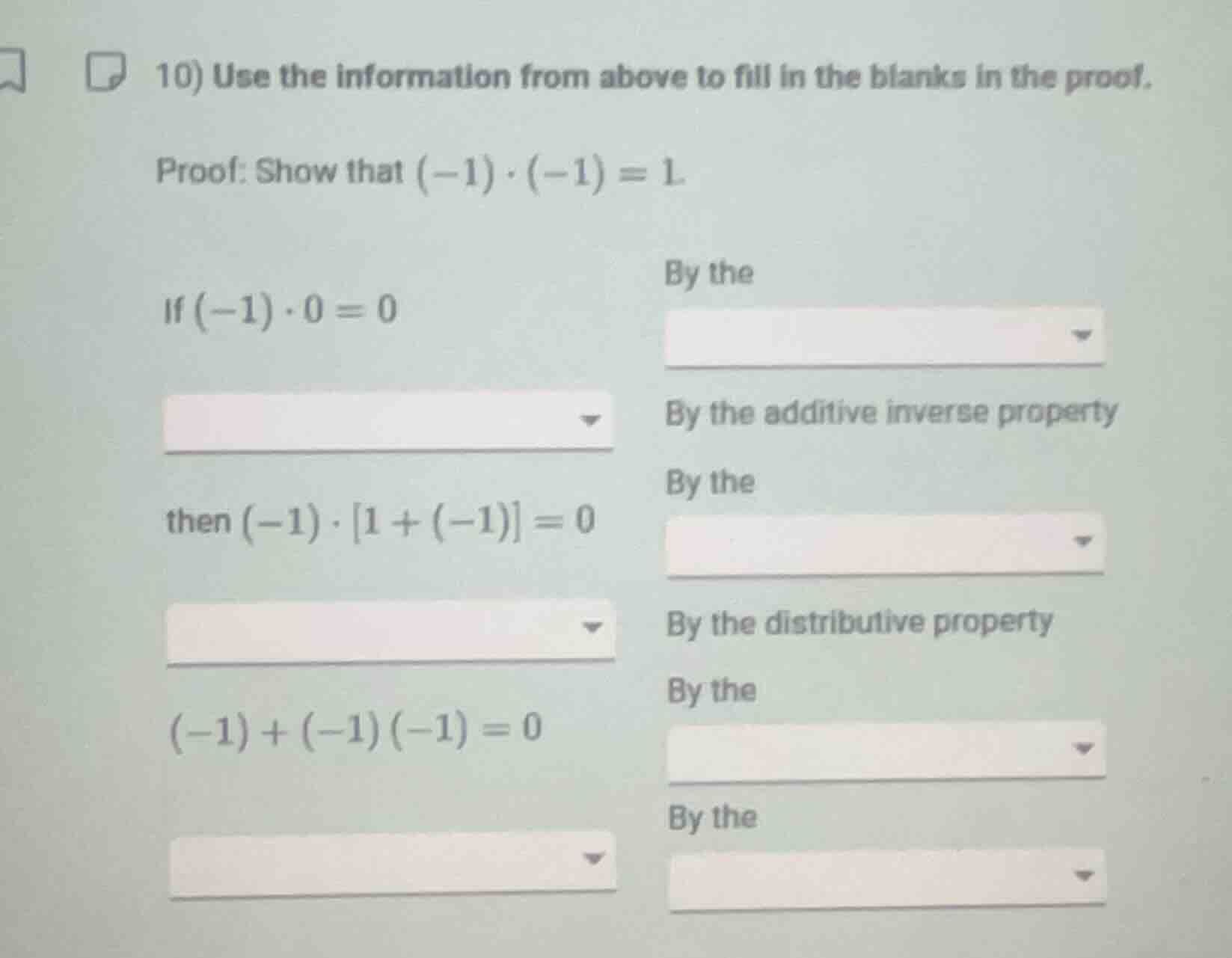
- use the information from above to fill in the blanks in the proof. proof: show that $(-1) \cdot (-1) = 1$. if $(-1) \cdot 0 = 0$ by the then $(-1) \cdot 1 + (-1) = 0$ by the additive inverse property by the distributive property $(-1) + (-1)(-1) = 0$ by the by the
Step1: Identify zero multiplication property
$\text{Zero multiplication property: } a \cdot 0 = 0$
Step2: Substitute 0 with additive inverse
$0 = 1 + (-1)$
Step3: Substitute into the equation
$(-1) \cdot [1 + (-1)] = 0$
Step4: Apply distributive property
$(-1) \cdot 1 + (-1) \cdot (-1) = 0$
Step5: Simplify $(-1) \cdot 1$
$(-1) \cdot 1 = -1$ (multiplicative identity property)
Step6: Solve for $(-1)\cdot(-1)$
Add 1 to both sides: $(-1)\cdot(-1) = 1$ (additive inverse property)

Snap & solve any problem in the app
Get step-by-step solutions on Sovi AI
Photo-based solutions with guided steps
Explore more problems and detailed explanations
- First blank (right, for $(-1)\cdot0=0$): $\text{Zero Multiplication Property}$
- Second blank (left, for additive inverse): $0 = 1 + (-1)$
- Third blank (right, for $(-1)\cdot[1+(-1)]=0$): $\text{Substitution Property}$
- Fourth blank (left, for distributive step): $(-1)\cdot1 + (-1)\cdot(-1) = 0$
- Fifth blank (right, for $(-1)+(-1)(-1)=0$): $\text{Multiplicative Identity Property}$
- Sixth blank (left, final step): $(-1)\cdot(-1) = 1$
- Seventh blank (right, final step): $\text{Additive Inverse Property}$