QUESTION IMAGE
Question
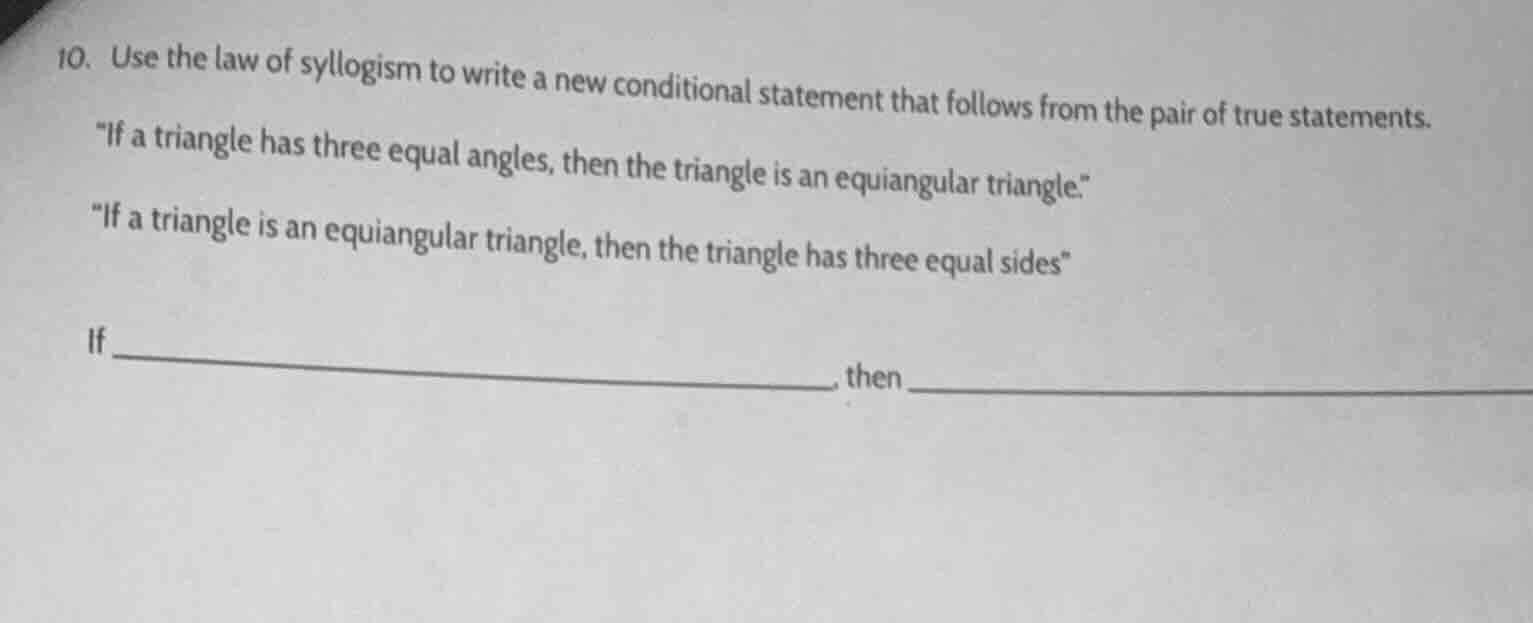
- use the law of syllogism to write a new conditional statement that follows from the pair of true statements. \if a triangle has three equal angles, then the triangle is an equiangular triangle.\ \if a triangle is an equiangular triangle, then the triangle has three equal sides\ if ______________________________________, then ______________________________________
Step1: Recall law of syllogism
The law of syllogism states that if we have two conditionals: "If $P$, then $Q$" and "If $Q$, then $R$", we can conclude "If $P$, then $R$".
Step2: Identify P, Q, R
Let $P$ = "a triangle has three equal angles", $Q$ = "the triangle is an equiangular triangle", $R$ = "the triangle has three equal sides".
Step3: Apply syllogism
Combine the two statements using the structure of the law of syllogism.

Snap & solve any problem in the app
Get step-by-step solutions on Sovi AI
Photo-based solutions with guided steps
Explore more problems and detailed explanations
If a triangle has three equal angles, then the triangle has three equal sides