QUESTION IMAGE
Question
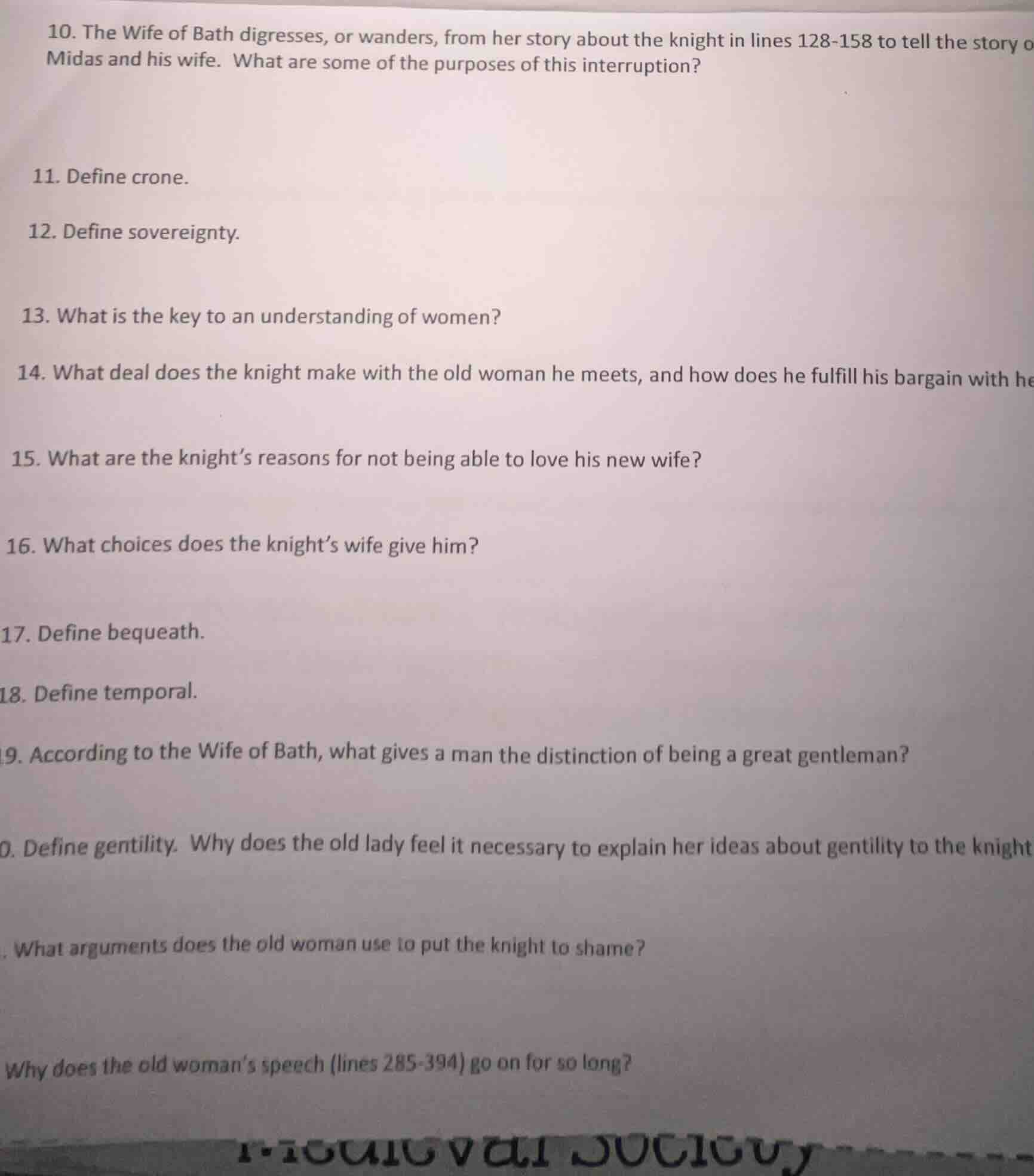
- the wife of bath digresses, or wanders, from her story about the knight in lines 128 - 158 to tell the story of midas and his wife. what are some of the purposes of this interruption?
- define crone.
- define sovereignty.
- what is the key to an understanding of women?
- what deal does the knight make with the old woman he meets, and how does he fulfill his bargain with her?
- what are the knight’s reasons for not being able to love his new wife?
- what choices does the knight’s wife give him?
- define bequeath.
- define temporal.
- according to the wife of bath, what gives a man the distinction of being a great gentleman?
- define gentility. why does the old lady feel it necessary to explain her ideas about gentility to the knight?
- what arguments does the old woman use to put the knight to shame?
- why does the old woman’s speech (lines 285 - 394) go on for so long?

Snap & solve any problem in the app
Get step-by-step solutions on Sovi AI
Photo-based solutions with guided steps
Explore more problems and detailed explanations
- To illustrate that women cannot keep secrets and to showcase the Wife of Bath's own talkative, digressive personality.
- An ugly, withered old woman.
- Supreme power or authority; in this context, the right of a woman to have control over her husband and her own life.
- Understanding that what women most desire is sovereignty over their husbands and lovers.
- The knight promises to do whatever she next requires of him in exchange for the answer to his quest; he fulfills it by marrying her.
- He finds her too old, too ugly, and of too low a social birth (plain/poor).
- To have her be old, ugly, but a true and humble wife, or to have her be young, beautiful, and take her chances with her fidelity.
- To leave property or assets to a person or beneficiary by a will.
- Relating to worldly as opposed to spiritual affairs; secular; or relating to time.
- Performing virtuous deeds and living a life of "gentilesse" rather than relying on noble birth or inherited wealth.
- Gentility is true nobility of character; she explains it because the knight insulted her low birth and lack of status.
- She argues that true poverty is wanting what you don't have, and that her age and ugliness are virtues that ensure her loyalty.
- To thoroughly deconstruct the knight's prejudices regarding social class, poverty, and physical appearance through a sermon on virtue.