QUESTION IMAGE
Question
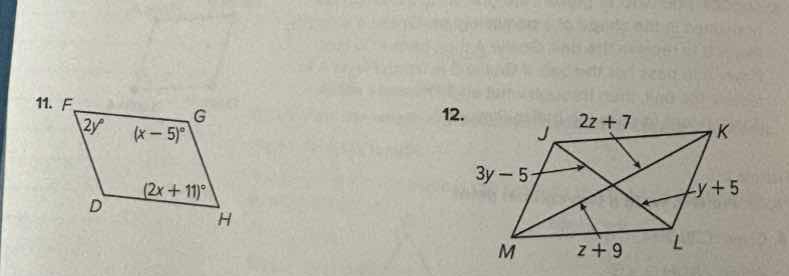
- in parallelogram fdg h, the angles are $angle f=2y^circ$, $angle g=(x-5)^circ$, $angle h=(2x+11)^circ$
- in parallelogram jklm, the lengths of the segments are $mj=3y-5$, $kl=2z+7$, $ml=z+9$, $jk=y+5$
Response
Problem 11
Step1: Use parallelogram consecutive angles sum to 180°
$2y + (2x + 11) = 180$
Step2: Use parallelogram opposite angles equal
$2y = x - 5$
Step3: Substitute $2y$ into Step1 equation
$(x - 5) + 2x + 11 = 180$
Simplify: $3x + 6 = 180$
Step4: Solve for $x$
$3x = 180 - 6 = 174$
$x = \frac{174}{3} = 58$
Step5: Solve for $y$ using Step2
$2y = 58 - 5 = 53$
$y = \frac{53}{2} = 26.5$
Step1: Use parallelogram diagonals bisect each other (MJ=LK)
$3y - 5 = y + 5$
Step2: Solve for $y$
$3y - y = 5 + 5$
$2y = 10$
$y = 5$
Step3: Use parallelogram diagonals bisect each other (JK=ML)
$2z + 7 = z + 9$
Step4: Solve for $z$
$2z - z = 9 - 7$
$z = 2$

Snap & solve any problem in the app
Get step-by-step solutions on Sovi AI
Photo-based solutions with guided steps
Explore more problems and detailed explanations
$x=58$, $y=26.5$
---