QUESTION IMAGE
Question
11.
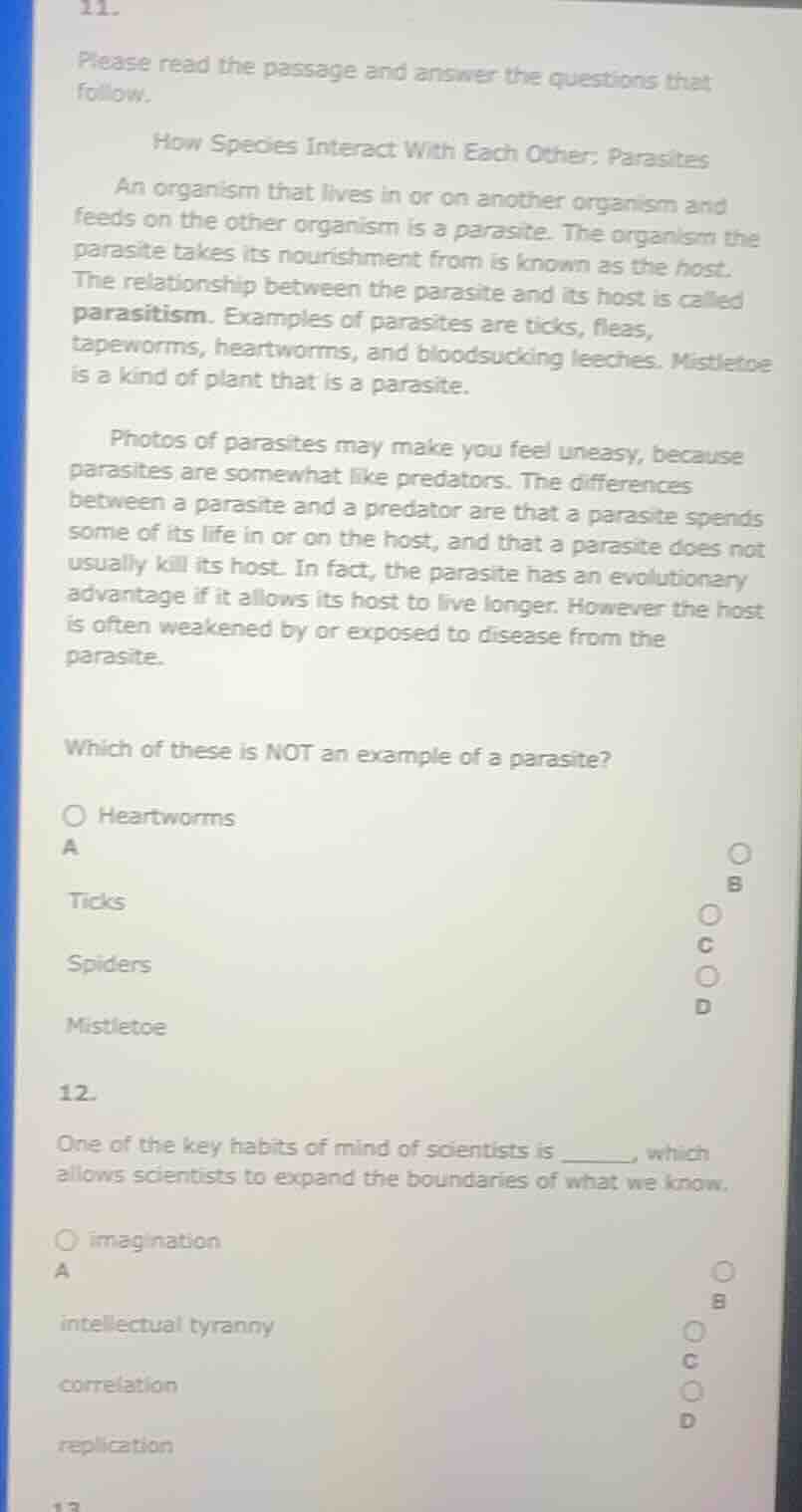
please read the passage and answer the questions that follow.
how species interact with each other: parasites
an organism that lives in or on another organism and feeds on the other organism is a parasite. the organism the parasite takes its nourishment from is known as the host. the relationship between the parasite and its host is called parasitism. examples of parasites are ticks, fleas, tapeworms, heartworms, and bloodsucking leeches. mistletoe is a kind of plant that is a parasite.
photos of parasites may make you feel uneasy, because parasites are somewhat like predators. the differences between a parasite and a predator are that a parasite spends some of its life in or on the host, and that a parasite does not usually kill its host. in fact, the parasite has an evolutionary advantage if it allows its host to live longer. however the host is often weakened by or exposed to disease from the parasite.
which of these is not an example of a parasite?
○ heartworms
a
○ ticks
b
○ spiders
c
○ mistletoe
d
12.
one of the key habits of mind of scientists is ______, which allows scientists to expand the boundaries of what we know.
○ imagination
a
○ intellectual tyranny
b
○ correlation
c
○ replication
d
13
For question 11: The passage lists heartworms, ticks, and mistletoe as examples of parasites. Spiders are not mentioned as parasites, as they are typically predators that hunt and kill their prey rather than living on/inside a host to feed without immediately killing it.
For question 12: Imagination allows scientists to propose new ideas, hypotheses, and approaches that expand the limits of current knowledge. Intellectual tyranny restricts thinking, correlation is a statistical relationship, and replication is repeating experiments to verify results—none of these expand knowledge boundaries like imagination.

Snap & solve any problem in the app
Get step-by-step solutions on Sovi AI
Photo-based solutions with guided steps
Explore more problems and detailed explanations
- C. Spiders
- A. imagination