QUESTION IMAGE
Question
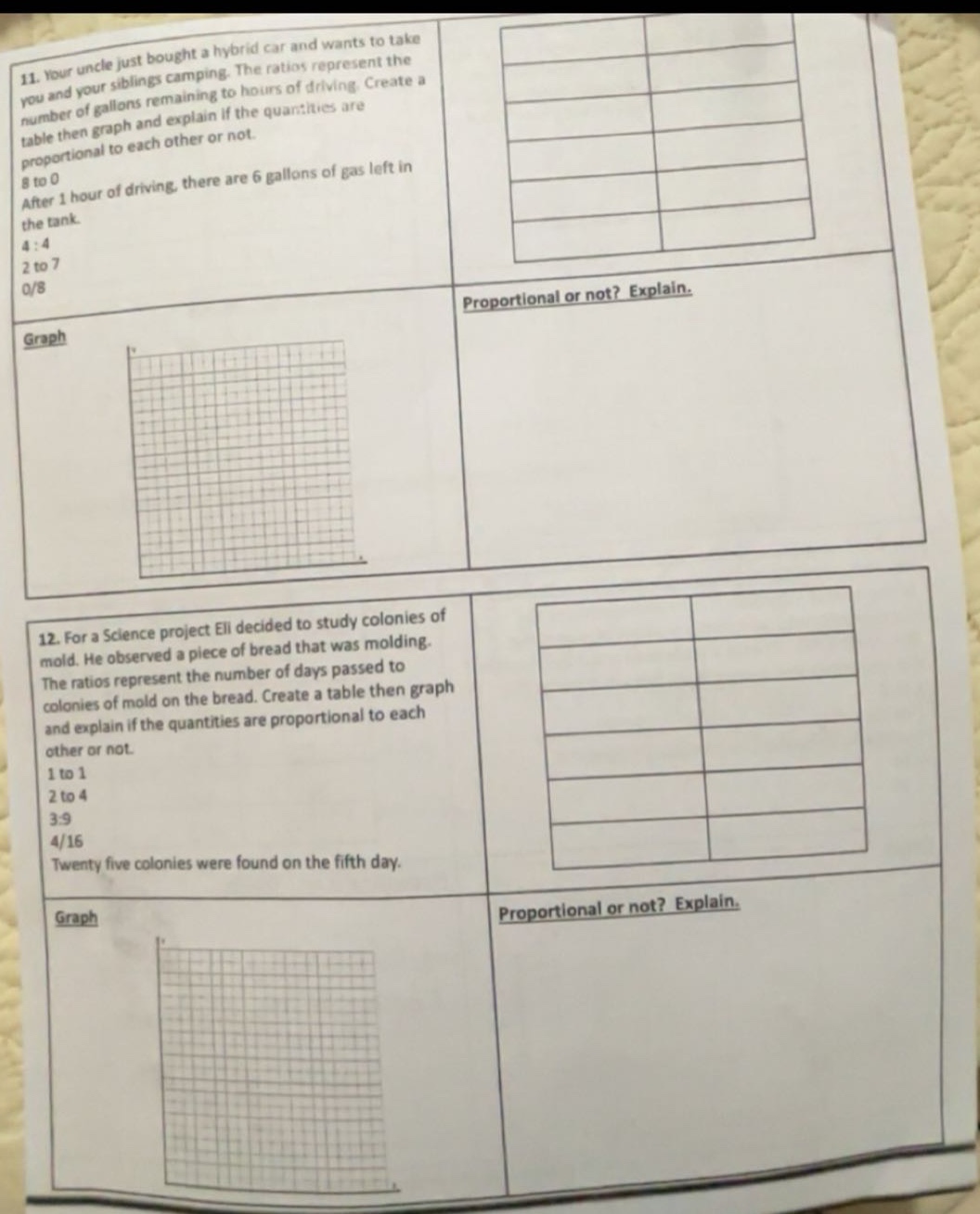
- your uncle just bought a hybrid car and wants to take you and your siblings camping. the ratios represent the number of gallons remaining to hours of driving. create a table then graph and explain if the quantities are proportional to each other or not. 8 to 0 after 1 hour of driving, there are 6 gallons of gas left in the tank. 4 : 4 2 to 7 0/8 graph proportional or not? explain. 12. for a science project eli decided to study colonies of mold. he observed a piece of bread that was molding. the ratios represent the number of days passed to colonies of mold on the bread. create a table then graph and explain if the quantities are proportional to each other or not. 1 to 1 2 to 4 3:9 4/16 twenty five colonies were found on the fifth day. graph proportional or not? explain.
Problem 11 (Hybrid Car Gas and Driving Hours)
Step 1: Organize the data into a table
We have the following ratios and information:
- Initial: 8 gallons at 0 hours (8 : 0)
- After 1 hour: 6 gallons (6 : 1)
- The given ratios: 4 : 4, 2 : 7, 0 : 8 (we need to check consistency)
First, let's list the hours (x) and gallons remaining (y) properly. The correct data points from the problem:
- When \( x = 0 \), \( y = 8 \) (since 8 to 0 means 8 gallons at 0 hours)
- When \( x = 1 \), \( y = 6 \) (given: after 1 hour, 6 gallons left)
Now, let's check the other ratios. The ratio 4 : 4 would imply 4 gallons at 4 hours? Let's see the rate of change. From \( x = 0 \) to \( x = 1 \), the change in y is \( 6 - 8=- 2 \), so the rate is -2 gallons per hour. So the equation should be \( y = 8-2x \).
Let's check the other ratios:
- For 4 : 4: If \( x = 4 \), then \( y = 8 - 2(4)=0 \), not 4. So 4 : 4 is inconsistent.
- For 2 : 7: If \( x = 7 \), \( y = 8-2(7)=8 - 14=-6 \), which doesn't make sense (can't have negative gallons), and not 2.
- For 0 : 8: If \( x = 8 \), \( y = 8-2(8)=-8 \), not 0.
So the correct table with the valid data points (from the problem's description, ignoring the inconsistent ratios) is:
| Hours (x) | Gallons Remaining (y) | |
|---|---|---|
| 1 | 6 | |
| 2 | 4 | (since \( y = 8-2(2)=4 \)) |
| 3 | 2 | ( \( y = 8-2(3)=2 \)) |
| 4 | 0 | ( \( y = 8-2(4)=0 \)) |
Step 2: Check for proportionality
Proportional relationships have the form \( y = kx \), where \( k \) is a constant (the constant of proportionality), and they pass through the origin (0,0).
In our case, when \( x = 0 \), \( y = 8
eq 0 \). Also, let's check the ratios \( \frac{y}{x} \):
- For \( x = 0 \), \( \frac{y}{x} \) is undefined (division by zero)
- For \( x = 1 \), \( \frac{y}{x}=\frac{6}{1} = 6 \)
- For \( x = 2 \), \( \frac{y}{x}=\frac{4}{2}=2 \)
- For \( x = 3 \), \( \frac{y}{x}=\frac{2}{3}\approx0.666 \)
- For \( x = 4 \), \( \frac{y}{x}=\frac{0}{4} = 0 \)
Since the ratio \( \frac{y}{x} \) is not constant (6, 2, 0.666, 0) and the graph does not pass through the origin (it has a y - intercept of 8), the quantities are not proportional.
Step 3: Graph the data
The graph of \( y = 8 - 2x \) is a straight line with a y - intercept of 8 and a slope of -2. It will pass through the points (0,8), (1,6), (2,4), (3,2), (4,0).
Problem 12 (Mold Colonies and Days Passed)
Step 1: Organize the data into a table
We have the following ratios and information:
- 1 to 1: 1 day, 1 colony? Wait, the problem says "Twenty five colonies were found on the fifth day." Let's analyze the ratios: 1 to 1, 2 to 4, 3 : 9, 4/16, and 5 days with 25 colonies.
First, let's check the ratio of colonies (y) to days (x).
For the ratio 1 to 1: If \( x = 1 \), \( y = 1 \)
For 2 to 4: If \( x = 2 \), \( y = 4 \)
For 3 : 9: If \( x = 3 \), \( y = 9 \)
For 4/16: If \( x = 4 \), \( y = 16 \)
For \( x = 5 \), \( y = 25 \) (given: twenty five colonies on the fifth day)
Let's check the ratio \( \frac{y}{x} \) for each:
- When \( x = 1 \), \( \frac{y}{x}=\frac{1}{1}=1 \)
- When \( x = 2 \), \( \frac{y}{x}=\frac{4}{2}=2 \)
- When \( x = 3 \), \( \frac{y}{x}=\frac{9}{3}=3 \)
- When \( x = 4 \), \( \frac{y}{x}=\frac{16}{4}=4 \)
- When \( x = 5 \), \( \frac{y}{x}=\frac{25}{5}=5 \)
Wait, this is a pattern. Let's see the relationship between x and y. For \( x = 1 \), \( y = 1=1^2 \); \( x = 2 \), \( y = 4 = 2^2 \); \…

Snap & solve any problem in the app
Get step-by-step solutions on Sovi AI
Photo-based solutions with guided steps
Explore more problems and detailed explanations
Problem 11 (Hybrid Car Gas and Driving Hours)
Step 1: Organize the data into a table
We have the following ratios and information:
- Initial: 8 gallons at 0 hours (8 : 0)
- After 1 hour: 6 gallons (6 : 1)
- The given ratios: 4 : 4, 2 : 7, 0 : 8 (we need to check consistency)
First, let's list the hours (x) and gallons remaining (y) properly. The correct data points from the problem:
- When \( x = 0 \), \( y = 8 \) (since 8 to 0 means 8 gallons at 0 hours)
- When \( x = 1 \), \( y = 6 \) (given: after 1 hour, 6 gallons left)
Now, let's check the other ratios. The ratio 4 : 4 would imply 4 gallons at 4 hours? Let's see the rate of change. From \( x = 0 \) to \( x = 1 \), the change in y is \( 6 - 8=- 2 \), so the rate is -2 gallons per hour. So the equation should be \( y = 8-2x \).
Let's check the other ratios:
- For 4 : 4: If \( x = 4 \), then \( y = 8 - 2(4)=0 \), not 4. So 4 : 4 is inconsistent.
- For 2 : 7: If \( x = 7 \), \( y = 8-2(7)=8 - 14=-6 \), which doesn't make sense (can't have negative gallons), and not 2.
- For 0 : 8: If \( x = 8 \), \( y = 8-2(8)=-8 \), not 0.
So the correct table with the valid data points (from the problem's description, ignoring the inconsistent ratios) is:
| Hours (x) | Gallons Remaining (y) | |
|---|---|---|
| 1 | 6 | |
| 2 | 4 | (since \( y = 8-2(2)=4 \)) |
| 3 | 2 | ( \( y = 8-2(3)=2 \)) |
| 4 | 0 | ( \( y = 8-2(4)=0 \)) |
Step 2: Check for proportionality
Proportional relationships have the form \( y = kx \), where \( k \) is a constant (the constant of proportionality), and they pass through the origin (0,0).
In our case, when \( x = 0 \), \( y = 8
eq 0 \). Also, let's check the ratios \( \frac{y}{x} \):
- For \( x = 0 \), \( \frac{y}{x} \) is undefined (division by zero)
- For \( x = 1 \), \( \frac{y}{x}=\frac{6}{1} = 6 \)
- For \( x = 2 \), \( \frac{y}{x}=\frac{4}{2}=2 \)
- For \( x = 3 \), \( \frac{y}{x}=\frac{2}{3}\approx0.666 \)
- For \( x = 4 \), \( \frac{y}{x}=\frac{0}{4} = 0 \)
Since the ratio \( \frac{y}{x} \) is not constant (6, 2, 0.666, 0) and the graph does not pass through the origin (it has a y - intercept of 8), the quantities are not proportional.
Step 3: Graph the data
The graph of \( y = 8 - 2x \) is a straight line with a y - intercept of 8 and a slope of -2. It will pass through the points (0,8), (1,6), (2,4), (3,2), (4,0).
Problem 12 (Mold Colonies and Days Passed)
Step 1: Organize the data into a table
We have the following ratios and information:
- 1 to 1: 1 day, 1 colony? Wait, the problem says "Twenty five colonies were found on the fifth day." Let's analyze the ratios: 1 to 1, 2 to 4, 3 : 9, 4/16, and 5 days with 25 colonies.
First, let's check the ratio of colonies (y) to days (x).
For the ratio 1 to 1: If \( x = 1 \), \( y = 1 \)
For 2 to 4: If \( x = 2 \), \( y = 4 \)
For 3 : 9: If \( x = 3 \), \( y = 9 \)
For 4/16: If \( x = 4 \), \( y = 16 \)
For \( x = 5 \), \( y = 25 \) (given: twenty five colonies on the fifth day)
Let's check the ratio \( \frac{y}{x} \) for each:
- When \( x = 1 \), \( \frac{y}{x}=\frac{1}{1}=1 \)
- When \( x = 2 \), \( \frac{y}{x}=\frac{4}{2}=2 \)
- When \( x = 3 \), \( \frac{y}{x}=\frac{9}{3}=3 \)
- When \( x = 4 \), \( \frac{y}{x}=\frac{16}{4}=4 \)
- When \( x = 5 \), \( \frac{y}{x}=\frac{25}{5}=5 \)
Wait, this is a pattern. Let's see the relationship between x and y. For \( x = 1 \), \( y = 1=1^2 \); \( x = 2 \), \( y = 4 = 2^2 \); \( x = 3 \), \( y = 9=3^2 \); \( x = 4 \), \( y = 16 = 4^2 \); \( x = 5 \), \( y = 25=5^2 \). So the equation is \( y=x^{2} \), not a linear relationship \( y = kx \) (proportional relationships are linear with \( k=\frac{y}{x} \) constant and passing through the origin).
Let's check the ratio \( \frac{y}{x} \):
- At \( x = 1 \), \( \frac{y}{x}=1 \)
- At \( x = 2 \), \( \frac{y}{x}=2 \)
- At \( x = 3 \), \( \frac{y}{x}=3 \)
- At \( x = 4 \), \( \frac{y}{x}=4 \)
- At \( x = 5 \), \( \frac{y}{x}=5 \)
Since the ratio \( \frac{y}{x} \) is not constant (it's equal to x, which is changing), the relationship is not proportional. But wait, let's re - evaluate. Wait, the problem says "the ratios represent the number of days passed to colonies of mold". So days (x) and colonies (y). Let's check the initial ratio 1 to 1: 1 day, 1 colony. 2 to 4: 2 days, 4 colonies (4 = 2×2), 3 : 9 (9 = 3×3), 4/16 (16 = 4×4), 5 days: 25 = 5×5. So the relationship is \( y=x^{2} \), which is a quadratic relationship, not a proportional (linear) relationship.
Step 2: Check for proportionality
A proportional relationship has the form \( y = kx \), where \( k \) is a constant. Let's check the constant of proportionality \( k=\frac{y}{x} \):
- For \( x = 1 \), \( k=\frac{1}{1}=1 \)
- For \( x = 2 \), \( k=\frac{4}{2}=2 \)
- For \( x = 3 \), \( k=\frac{9}{3}=3 \)
- For \( x = 4 \), \( k=\frac{16}{4}=4 \)
- For \( x = 5 \), \( k=\frac{25}{5}=5 \)
Since \( k \) is not constant (it increases as x increases), the quantities (days and mold colonies) are not proportional.
Final Answers
Problem 11
- Table:
| Hours (x) | Gallons Remaining (y) |
|---|---|
| 1 | 6 |
| 2 | 4 |
| 3 | 2 |
| 4 | 0 |
- Graph: A straight line with points (0,8), (1,6), (2,4), (3,2), (4,0)
- Proportional or not?: Not proportional. Explanation: The relationship is \( y = 8-2x \), which is a linear relationship with a y - intercept of 8 (not passing through the origin) and the ratio \( \frac{y}{x} \) is not constant (e.g., at \( x = 0 \), \( \frac{y}{x} \) is undefined; at \( x = 1 \), \( \frac{y}{x}=6 \); at \( x = 2 \), \( \frac{y}{x}=2 \)). Also, the given inconsistent ratios (4 : 4, 2 : 7, 0 : 8) do not fit the linear pattern of \( y = 8-2x \).
Problem 12
- Table:
| Days (x) | Colonies of Mold (y) |
|---|---|
| 2 | 4 |
| 3 | 9 |
| 4 | 16 |
| 5 | 25 |
- Graph: A curve (parabola) passing through the points (1,1), (2,4), (3,9), (4,16), (5,25)
- Proportional or not?: Not proportional. Explanation: The relationship is \( y=x^{2} \), which is a quadratic relationship. For a proportional relationship, \( \frac{y}{x} \) should be constant, but here \( \frac{y}{x}=x \) (e.g., at \( x = 1 \), \( \frac{y}{x}=1 \); at \( x = 2 \), \( \frac{y}{x}=2 \); at \( x = 3 \), \( \frac{y}{x}=3 \)), which is not constant. Also, the graph is a parabola, not a straight line through the origin.