QUESTION IMAGE
Question
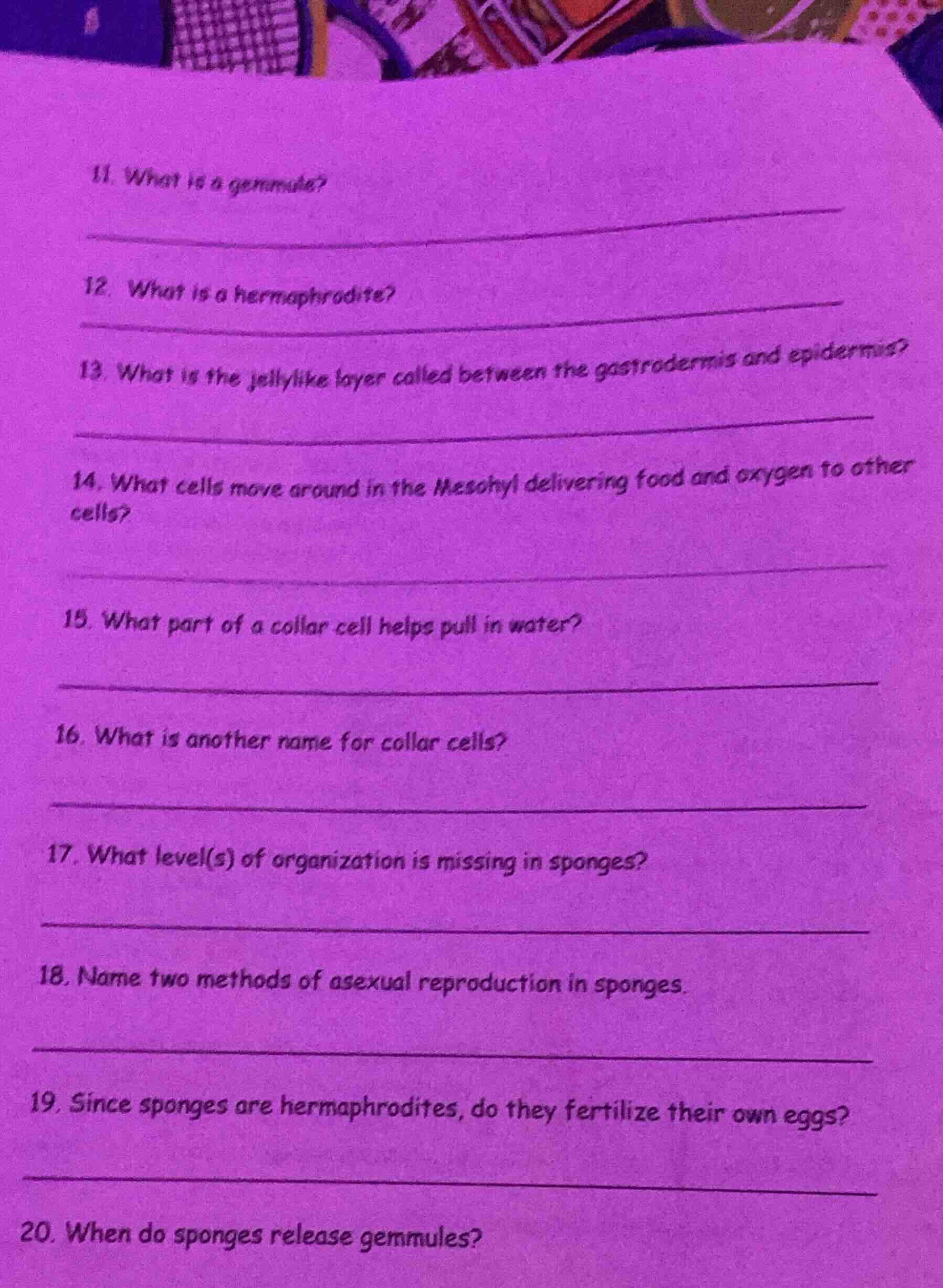
- what is a gemmule?
- what is a hermaphrodite?
- what is the jellylike layer called between the gastrodermis and epidermis?
- what cells move around in the mesohyl delivering food and oxygen to other cells?
- what part of a collar cell helps pull in water?
- what is another name for collar cells?
- what level(s) of organization is missing in sponges?
- name two methods of asexual reproduction in sponges.
- since sponges are hermaphrodites, do they fertilize their own eggs?
- when do sponges release gemmules?
Question 11: What is a gemmule?
A gemmule is a resistant structure formed by sponges (usually freshwater sponges) during unfavorable conditions. It consists of a cluster of amebocytes (archaeocytes) surrounded by a tough, spicule - reinforced coat. Gemmules can survive harsh environmental conditions like drought, extreme temperatures, or lack of food. When conditions become favorable again, the cells within the gemmule can develop into a new sponge.
A hermaphrodite is an organism that has both male and female reproductive organs (or the ability to produce both male and female gametes). In the context of sponges (and many other organisms), hermaphroditism can be simultaneous (having both reproductive capabilities at the same time) or sequential (changing from one sex to another over time). For example, many sponges are hermaphrodites, meaning an individual sponge can produce both eggs and sperm, although they often do not self - fertilize (to increase genetic diversity).
In sponges (and also in cnidarians like jellyfish, corals, etc.), the jelly - like layer between the gastrodermis (inner cell layer) and the epidermis (outer cell layer) is called the mesohyl (in sponges) or mesoglea (in cnidarians). In sponges, the mesohyl is a gelatinous matrix that contains amebocytes (archaeocytes), spicules, and collagen fibers. It provides structural support and a medium for the movement of cells within the sponge.

Snap & solve any problem in the app
Get step-by-step solutions on Sovi AI
Photo-based solutions with guided steps
Explore more problems and detailed explanations
A gemmule is a resistant, spore - like structure produced by some sponges (especially freshwater sponges) that contains a cluster of cells (amebocytes) surrounded by a tough coat, allowing the sponge to survive unfavorable environmental conditions and develop into a new sponge when conditions improve.