QUESTION IMAGE
Question
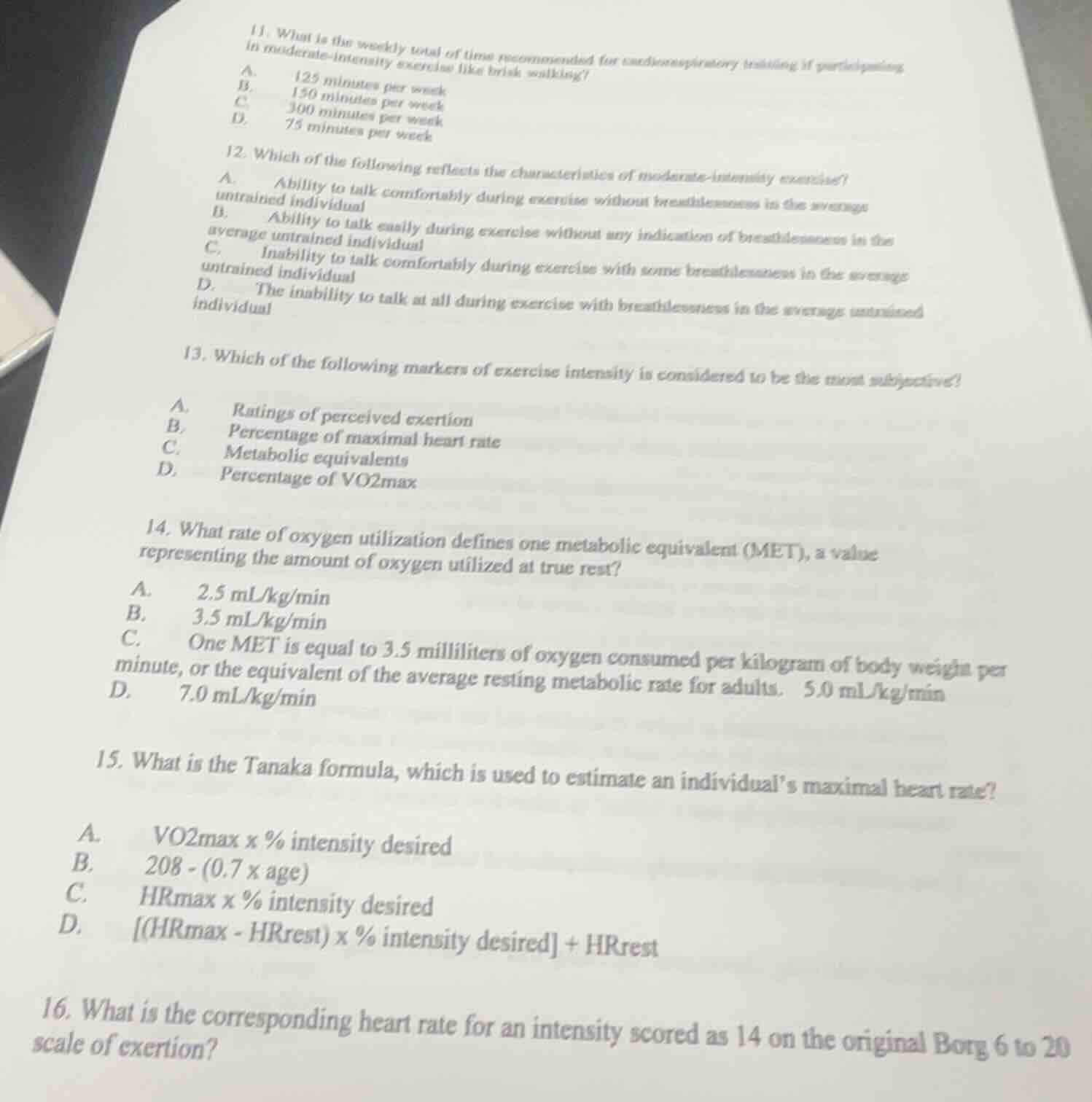
- what is the weekly total of time recommended for cardiorespiratory training if participating in moderate-intensity exercise like brisk walking?a. 125 minutes per weekb. 150 minutes per weekc. 300 minutes per weekd. 75 minutes per week12. which of the following reflects the characteristics of moderate-intensity exercise?a. ability to talk comfortably during exercise without breathlessness in the average untrained individualb. ability to talk easily during exercise without any indication of breathlessness in the average untrained individualc. inability to talk comfortably during exercise with some breathlessness in the average untrained individuald. the inability to talk at all during exercise with breathlessness in the average untrained individual13. which of the following markers of exercise intensity is considered to be the most subjective?a. ratings of perceived exertionb. percentage of maximal heart ratec. metabolic equivalentsd. percentage of vo2max14. what rate of oxygen utilization defines one metabolic equivalent (met), a value representing the amount of oxygen utilized at true rest?a. 2.5 ml/kg/minb. 3.5 ml/kg/minc. one met is equal to 3.5 milliliters of oxygen consumed per kilogram of body weight per minute, or the equivalent of the average resting metabolic rate for adults. 5.0 ml/kg/mind. 7.0 ml/kg/min15. what is the tanaka formula, which is used to estimate an individuals maximal heart rate?a. vo2max x % intensity desiredb. $208 - (0.7 \times age)$c. hrmax x % intensity desiredd. $(hrmax - hrrest) \times \\% \text{intensity desired} + hrrest$16. what is the corresponding heart rate for an intensity scored as 14 on the original borg 6 to 20 scale of exertion?
Brief Explanations
- Standard guidelines recommend 150 minutes weekly moderate cardio.
- Moderate exercise allows talking with mild breathlessness.
- Perceived exertion relies on personal feeling, not objective metrics.
- 1 MET is defined as resting oxygen uptake of 3.5 mL/kg/min.
- Tanaka formula estimates max heart rate using age.
- Original Borg 6-20 scale: score 14 equals ~140 bpm (10x score).

Snap & solve any problem in the app
Get step-by-step solutions on Sovi AI
Photo-based solutions with guided steps
Explore more problems and detailed explanations
- B. 150 minutes per week
- C. Inability to talk comfortably during exercise with some breathlessness in the average untrained individual
- A. Ratings of perceived exertion
- B. 3.5 mL/kg/min
- B. $208 - (0.7 \times \text{age})$
- 140 beats per minute (bpm)