QUESTION IMAGE
Question
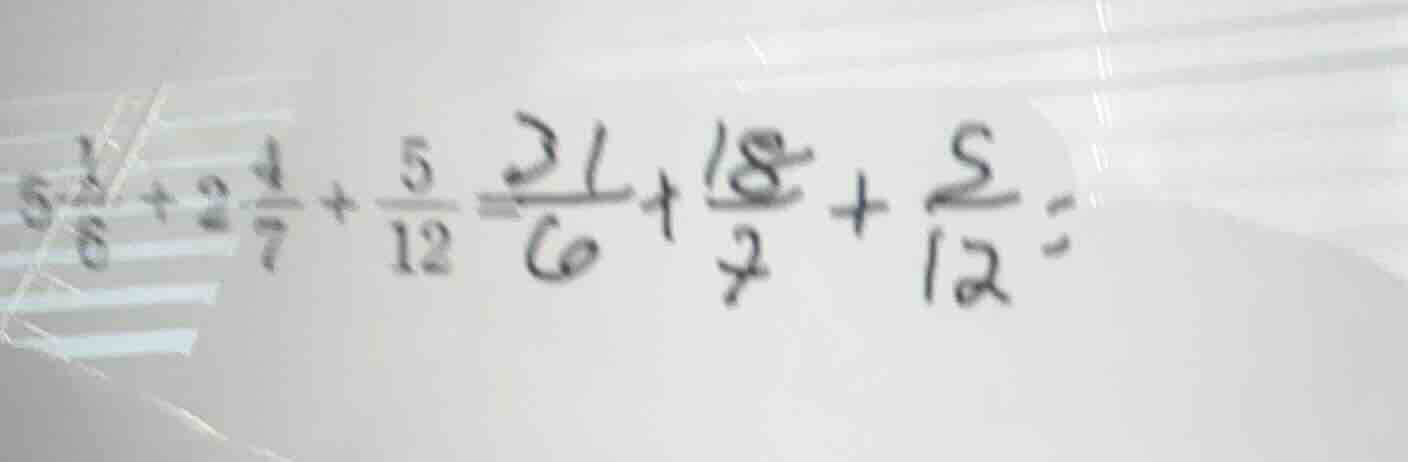
5\frac{1}{6} + 2\frac{4}{7} + \frac{5}{12} = \frac{31}{6} + \frac{18}{7} + \frac{5}{12} =
Step1: Correct the mixed numbers to improper fractions (note: there was a typo in the original, assume \(5\frac{1}{6}\), \(2\frac{4}{7}\))
\(5\frac{1}{6}=\frac{5\times6 + 1}{6}=\frac{31}{6}\), \(2\frac{4}{7}=\frac{2\times7+4}{7}=\frac{18}{7}\), the third term is \(\frac{5}{12}\) as is.
Step2: Find the least common denominator (LCD) of 6, 7, 12. Prime factors: \(6 = 2\times3\), \(7 = 7\), \(12 = 2^2\times3\). So LCD is \(2^2\times3\times7=84\).
Step3: Convert each fraction to have denominator 84.
\(\frac{31}{6}=\frac{31\times14}{6\times14}=\frac{434}{84}\), \(\frac{18}{7}=\frac{18\times12}{7\times12}=\frac{216}{84}\), \(\frac{5}{12}=\frac{5\times7}{12\times7}=\frac{35}{84}\).
Step4: Add the numerators.
\(\frac{434 + 216+35}{84}=\frac{434+251}{84}=\frac{685}{84}\).
Step5: Convert back to mixed number (optional, but common). \(685\div84 = 8\) with remainder \(13\), so \(\frac{685}{84}=8\frac{13}{84}\). Wait, wait, let's recalculate the addition: \(434+216 = 650\), \(650 + 35=685\). \(84\times8 = 672\), \(685 - 672 = 13\). So yes, \(8\frac{13}{84}\). But wait, maybe I misread the original problem. Wait the original had a typo in the second fraction's denominator? Wait the user wrote \(2\frac{4}{7}\) (correct) and then a wrong fraction? Wait no, the user's original writing: \(5\frac{1}{6}+2\frac{4}{7}+\frac{5}{12}=\frac{31}{6}+\frac{18}{7}+\frac{5}{12}\) (that part is correct). So proceeding:
Wait, maybe I made a mistake in LCD? Let's check again. 6,7,12. Multiples of 6: 6,12,18,24,30,36,42,48,54,60,66,72,78,84... Multiples of 7:7,14,21,28,35,42,49,56,63,70,77,84... Multiples of 12:12,24,36,48,60,72,84... So LCD is 84, correct.
Wait, but maybe the original problem had a different second term? Wait the user's handwritten part has a typo (like \(\frac{18}{7}\) was written as \(\frac{18}{2}\)? No, that's a handwritten error. So assuming the correct mixed numbers are \(5\frac{1}{6}\) and \(2\frac{4}{7}\), the calculation is as above.
Wait, let's re - do the addition of numerators:
\(\frac{31}{6}+\frac{18}{7}+\frac{5}{12}\)
First, group \(\frac{31}{6}+\frac{5}{12}\) first, since they have a common factor. \(\frac{31}{6}=\frac{62}{12}\), so \(\frac{62}{12}+\frac{5}{12}=\frac{67}{12}\). Then add \(\frac{18}{7}\):
\(\frac{67}{12}+\frac{18}{7}=\frac{67\times7+18\times12}{84}=\frac{469 + 216}{84}=\frac{685}{84}=8\frac{13}{84}\).

Snap & solve any problem in the app
Get step-by-step solutions on Sovi AI
Photo-based solutions with guided steps
Explore more problems and detailed explanations
\(8\frac{13}{84}\) (or \(\frac{685}{84}\))