QUESTION IMAGE
Question
- clean air acts were passed by governments of industrialized nations beginning in the mid-1950s. use this information to explain why the color of the moth population shifted again.
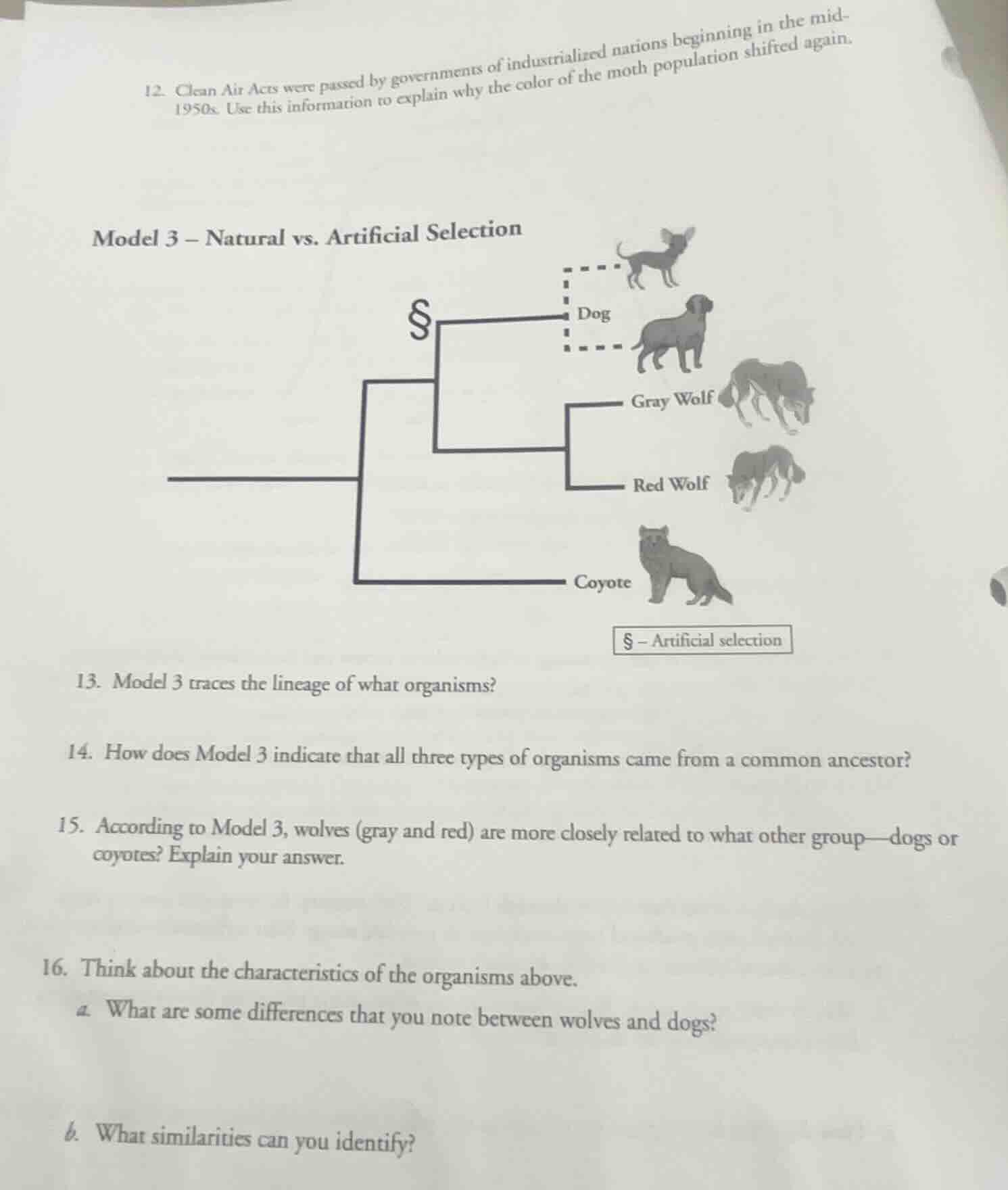
model 3 – natural vs. artificial selection
§ – artificial selection
- model 3 traces the lineage of what organisms?
- how does model 3 indicate that all three types of organisms came from a common ancestor?
- according to model 3, wolves (gray and red) are more closely related to what other group—dogs or coyotes? explain your answer.
- think about the characteristics of the organisms above.
a. what are some differences that you note between wolves and dogs?
b. what similarities can you identify?
- For question 12: Clean Air Acts reduced air pollution, making tree trunks lighter. Dark moths were now more visible to predators, so lighter-colored moths survived and reproduced more, shifting the population's color.
- For question 13: The phylogenetic tree explicitly shows dogs, gray wolves, red wolves, and coyotes.
- For question 14: In phylogenetic trees, a single shared starting branch point represents a common ancestor for all subsequent lineages.
- For question 15: Wolves and dogs share a more recent branching point than wolves and coyotes, meaning their common ancestor lived more recently.
- For question 16a: Domestic dogs have been artificially selected for traits that differ from wild wolves, while wolves retain wild, survival-focused traits.
- For question 16b: All these species are canids, sharing core anatomical and genetic traits from their common ancestor.

Snap & solve any problem in the app
Get step-by-step solutions on Sovi AI
Photo-based solutions with guided steps
Explore more problems and detailed explanations
- Clean Air Acts reduced industrial soot, lightening tree bark. Dark-colored moths became easier for predators to spot, so lighter moths had higher survival and reproduction rates, causing the moth population to shift back to lighter colors.
- Dogs, gray wolves, red wolves, and coyotes
- All the organisms branch off from a single, common initial root on the phylogenetic tree, which represents a shared common ancestor.
- Dogs. Wolves (gray and red) share a more recent common ancestor with dogs than they do with coyotes, as shown by their closer branching point on the tree.
16.
a. Examples include: Dogs have a wide range of body sizes/shapes due to artificial selection; wolves have a more uniform, robust build for hunting. Dogs are typically more docile and adapted to human interaction, while wolves are inherently wary of humans. Wolves have larger jaws and teeth for hunting large prey, compared to many dog breeds.
b. Examples include: All are canids with similar skeletal structures, including four legs, a tail, and a carnivorous dentition. They share genetic similarities, have a social pack structure (in wild populations and some dog groups), and are carnivorous/omnivorous with similar digestive systems.