QUESTION IMAGE
Question
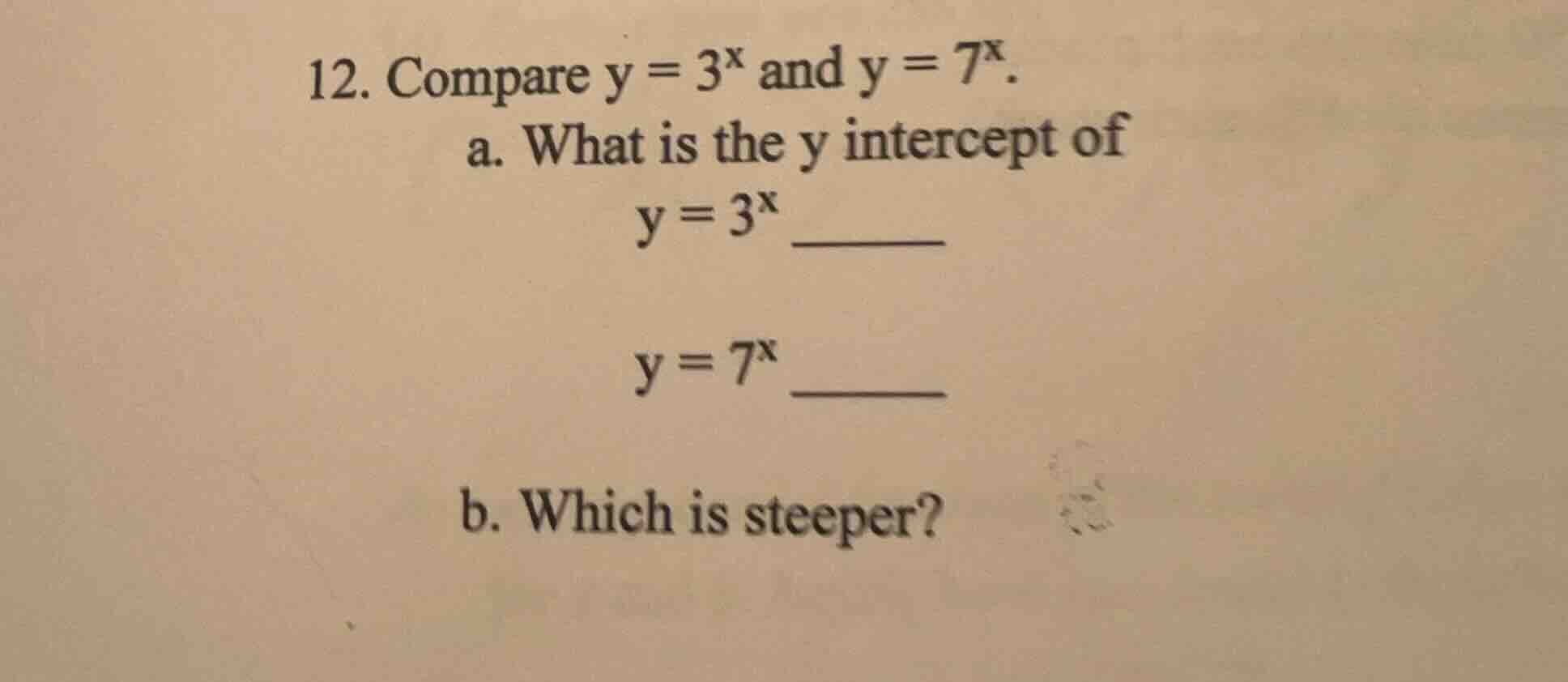
- compare $y = 3^x$ and $y = 7^x$.
a. what is the y intercept of
$y = 3^x$
$y = 7^x$
b. which is steeper?
Part a
For \( y = 3^x \)
Step1: Recall y-intercept definition
The y-intercept of a function is the value of \( y \) when \( x = 0 \).
Step2: Substitute \( x = 0 \) into \( y = 3^x \)
Substitute \( x = 0 \) into the function: \( y=3^{0}\).
We know that any non - zero number to the power of 0 is 1, so \( 3^{0}=1 \). So the y - intercept of \( y = 3^x \) is 1.
For \( y = 7^x \)
Step1: Recall y-intercept definition
The y-intercept of a function is the value of \( y \) when \( x = 0 \).
Step2: Substitute \( x = 0 \) into \( y = 7^x \)
Substitute \( x = 0 \) into the function: \( y = 7^{0}\).
Since any non - zero number to the power of 0 is 1, \( 7^{0}=1 \). So the y - intercept of \( y = 7^x \) is 1.
Part b
Step1: Recall the behavior of exponential functions
For an exponential function of the form \( y = a^{x}\), where \( a>1 \), as the value of \( a \) increases, the graph of the function becomes steeper (grows faster) for \( x>0 \) and approaches 0 faster for \( x < 0 \).
Step2: Compare the bases
We have two exponential functions \( y = 3^{x}\) with base \( a_1=3 \) and \( y = 7^{x}\) with base \( a_2 = 7 \).
Since \( 7>3 \), the function \( y = 7^{x}\) has a steeper graph than \( y=3^{x}\).
Part a Answers
The y - intercept of \( y = 3^x \) is \( \boldsymbol{1} \), and the y - intercept of \( y = 7^x \) is \( \boldsymbol{1} \).
Part b Answer
\( y = 7^{x} \) is steeper.

Snap & solve any problem in the app
Get step-by-step solutions on Sovi AI
Photo-based solutions with guided steps
Explore more problems and detailed explanations
Part a
For \( y = 3^x \)
Step1: Recall y-intercept definition
The y-intercept of a function is the value of \( y \) when \( x = 0 \).
Step2: Substitute \( x = 0 \) into \( y = 3^x \)
Substitute \( x = 0 \) into the function: \( y=3^{0}\).
We know that any non - zero number to the power of 0 is 1, so \( 3^{0}=1 \). So the y - intercept of \( y = 3^x \) is 1.
For \( y = 7^x \)
Step1: Recall y-intercept definition
The y-intercept of a function is the value of \( y \) when \( x = 0 \).
Step2: Substitute \( x = 0 \) into \( y = 7^x \)
Substitute \( x = 0 \) into the function: \( y = 7^{0}\).
Since any non - zero number to the power of 0 is 1, \( 7^{0}=1 \). So the y - intercept of \( y = 7^x \) is 1.
Part b
Step1: Recall the behavior of exponential functions
For an exponential function of the form \( y = a^{x}\), where \( a>1 \), as the value of \( a \) increases, the graph of the function becomes steeper (grows faster) for \( x>0 \) and approaches 0 faster for \( x < 0 \).
Step2: Compare the bases
We have two exponential functions \( y = 3^{x}\) with base \( a_1=3 \) and \( y = 7^{x}\) with base \( a_2 = 7 \).
Since \( 7>3 \), the function \( y = 7^{x}\) has a steeper graph than \( y=3^{x}\).
Part a Answers
The y - intercept of \( y = 3^x \) is \( \boldsymbol{1} \), and the y - intercept of \( y = 7^x \) is \( \boldsymbol{1} \).
Part b Answer
\( y = 7^{x} \) is steeper.