QUESTION IMAGE
Question
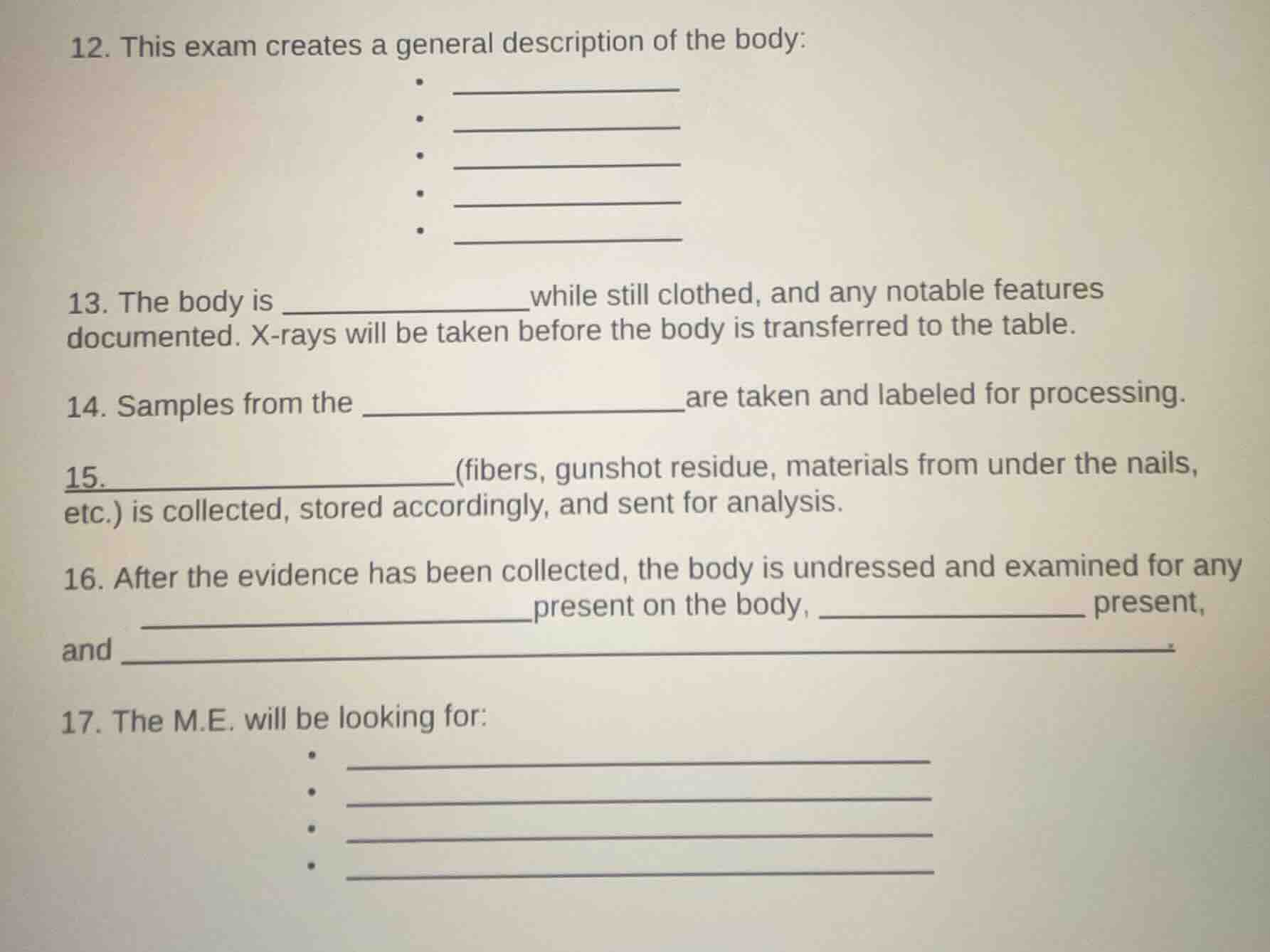
- this exam creates a general description of the body:
- _____________
- _____________
- _____________
- _____________
- _____________
- the body is _____________while still clothed, and any notable features documented. x - rays will be taken before the body is transferred to the table.
- samples from the _________________are taken and labeled for processing.
- _________________(fibers, gunshot residue, materials from under the nails, etc.) is collected, stored accordingly, and sent for analysis.
- after the evidence has been collected, the body is undressed and examined for any __________________present on the body, ___________ present, and ___________________________________.
- the m.e. will be looking for:
- _____________________________________
- _____________________________________
- _____________________________________
- _____________________________________
To answer these questions, we analyze each based on forensic pathology (a sub - field of Medicine and Health, Natural Science) concepts:
Question 12
In a forensic autopsy (a medical - based examination of the body, especially in legal or investigative contexts), the general description of the body includes aspects like External examination (observing the body's outward appearance, such as skin color, presence of wounds, etc.), Body weight (measuring the weight of the body), Body height (measuring the height of the body), Presence of identifying marks (like tattoos, birthmarks, scars), Clothing description (what the body is wearing, brand, style, etc.).
Question 13
The body is photographed while still clothed. This is a standard procedure in forensic examinations to document the body's state in its original (clothed) condition before any further handling. X - rays are taken at this stage to check for internal injuries or foreign objects without disturbing the body's external state.
Question 14
Samples from the body (such as blood, urine, tissue samples) are taken and labeled for processing. In forensic and medical examinations, these samples are crucial for toxicology reports, disease diagnosis (in some cases), or to check for the presence of drugs, poisons, etc.
Question 15
Trace evidence (fibers, gunshot residue, materials from under the nails, etc.) is collected, stored accordingly, and sent for analysis. Trace evidence is any small - scale material that can be transferred during a crime or event and is vital for linking a suspect to a crime scene or victim.
Question 16
After the evidence has been collected, the body is undressed and examined for any wounds (cuts, stab wounds, bullet wounds, etc.) present on the body, bruises (contusions, which can indicate blunt force trauma) present, and signs of disease (like tumors, abnormal growths, or signs of infectious diseases).
Question 17
The Medical Examiner (M.E.) will be looking for:
- Cause of death (what led to the person's death, such as trauma, disease, poisoning)
- Manner of death (whether it was natural, accidental, suicidal, or homicidal)
- Time of death (estimating when the person died, using factors like body temperature, rigor mortis, livor mortis)
- Evidence of foul play (signs that the death was not natural, like signs of struggle, unnatural wounds)
Final Answers (Filling in the Blanks)
12.
- External examination
- Body weight
- Body height
- Presence of identifying marks
- Clothing description
- photographed
- body (e.g., blood, tissue, etc.)
- Trace evidence
- wounds; bruises; signs of disease
17.
- Cause of death
- Manner of death
- Time of death
- Evidence of foul play

Snap & solve any problem in the app
Get step-by-step solutions on Sovi AI
Photo-based solutions with guided steps
Explore more problems and detailed explanations
To answer these questions, we analyze each based on forensic pathology (a sub - field of Medicine and Health, Natural Science) concepts:
Question 12
In a forensic autopsy (a medical - based examination of the body, especially in legal or investigative contexts), the general description of the body includes aspects like External examination (observing the body's outward appearance, such as skin color, presence of wounds, etc.), Body weight (measuring the weight of the body), Body height (measuring the height of the body), Presence of identifying marks (like tattoos, birthmarks, scars), Clothing description (what the body is wearing, brand, style, etc.).
Question 13
The body is photographed while still clothed. This is a standard procedure in forensic examinations to document the body's state in its original (clothed) condition before any further handling. X - rays are taken at this stage to check for internal injuries or foreign objects without disturbing the body's external state.
Question 14
Samples from the body (such as blood, urine, tissue samples) are taken and labeled for processing. In forensic and medical examinations, these samples are crucial for toxicology reports, disease diagnosis (in some cases), or to check for the presence of drugs, poisons, etc.
Question 15
Trace evidence (fibers, gunshot residue, materials from under the nails, etc.) is collected, stored accordingly, and sent for analysis. Trace evidence is any small - scale material that can be transferred during a crime or event and is vital for linking a suspect to a crime scene or victim.
Question 16
After the evidence has been collected, the body is undressed and examined for any wounds (cuts, stab wounds, bullet wounds, etc.) present on the body, bruises (contusions, which can indicate blunt force trauma) present, and signs of disease (like tumors, abnormal growths, or signs of infectious diseases).
Question 17
The Medical Examiner (M.E.) will be looking for:
- Cause of death (what led to the person's death, such as trauma, disease, poisoning)
- Manner of death (whether it was natural, accidental, suicidal, or homicidal)
- Time of death (estimating when the person died, using factors like body temperature, rigor mortis, livor mortis)
- Evidence of foul play (signs that the death was not natural, like signs of struggle, unnatural wounds)
Final Answers (Filling in the Blanks)
12.
- External examination
- Body weight
- Body height
- Presence of identifying marks
- Clothing description
- photographed
- body (e.g., blood, tissue, etc.)
- Trace evidence
- wounds; bruises; signs of disease
17.
- Cause of death
- Manner of death
- Time of death
- Evidence of foul play