QUESTION IMAGE
Question
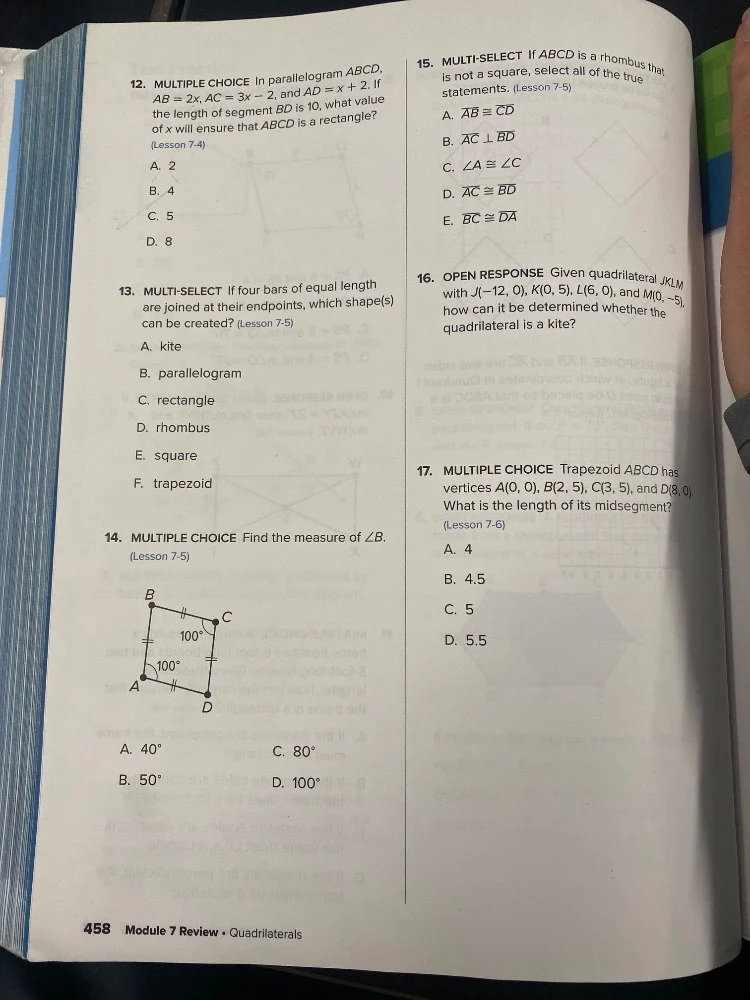
- multiple choice in parallelogram abcd, $ab = 2x$, $ac = 3x - 2$, and $ad = x + 2$. if the length of segment $bd$ is 10, what value of $x$ will ensure that abcd is a rectangle? (lesson 7-4)a. 2b. 4c. 5d. 813. multi-select if four bars of equal length are joined at their endpoints, which shape(s) can be created? (lesson 7-5)a. kiteb. parallelogramc. rectangled. rhombuse. squaref. trapezoid14. multiple choice find the measure of $angle b$. (lesson 7-5)a. $40^circ$b. $50^circ$c. $80^circ$d. $100^circ$15. multi-select if abcd is a rhombus that is not a square, select all of the true statements. (lesson 7-5)a. $overline{ab} cong overline{cd}$b. $overline{ac} perp overline{bd}$c. $angle a cong angle c$d. $overline{ac} cong overline{bd}$e. $overline{bc} cong overline{da}$16. open response given quadrilateral jklm with $j(-12, 0)$, $k(10, 0)$, $l(6, 0)$, and $m(0, -5)$, how can it be determined whether the quadrilateral is a kite?17. multiple choice trapezoid abcd has vertices $a(0, 0)$, $b(2, 5)$, $c(3, 5)$, and $d(8, 0)$. what is the length of its midsegment? (lesson 7-6)a. 4b. 4.5c. 5d. 5.5
Question 12
Step1: Recall rectangle diagonal property
In a rectangle, diagonals are equal, so $AC = BD$. For a parallelogram, $BD = 2 \times$ half-diagonal, but here we use the side-length relationship for a rectangle: by the Pythagorean theorem, $AB^2 + AD^2 = AC^2$.
Step2: Substitute expressions
Substitute $AB=2x$, $AD=x+2$, $AC=3x-2$:
$$(2x)^2 + (x+2)^2 = (3x-2)^2$$
Step3: Expand all terms
$$4x^2 + x^2 +4x +4 = 9x^2 -12x +4$$
Step4: Simplify equation
$$5x^2 +4x +4 -9x^2 +12x -4 = 0$$
$$-4x^2 +16x = 0$$
$$-4x(x-4)=0$$
Step5: Solve for valid x
$x=0$ is invalid (side length can't be 0), so $x=4$.
- A kite requires two distinct pairs of adjacent equal sides, so equal-length bars cannot form it.
- A parallelogram is formed when equal-length bars are joined as opposite sides.
- A rectangle needs right angles, which is not guaranteed by only equal bar lengths.
- A rhombus is a parallelogram with all sides equal, which fits equal-length bars.
- A square is a rhombus with right angles, which is a special case possible if joined at right angles.
- A trapezoid requires at least one pair of parallel sides, which can be formed with equal bars.
Step1: Identify quadrilateral type
The figure is a rhombus (all sides marked equal). In a rhombus, consecutive angles are supplementary.
Step2: Calculate $\angle B$
$\angle B + 100^\circ = 180^\circ$
$$\angle B = 180^\circ - 100^\circ = 80^\circ$$

Snap & solve any problem in the app
Get step-by-step solutions on Sovi AI
Photo-based solutions with guided steps
Explore more problems and detailed explanations
B. 4
---