QUESTION IMAGE
Question
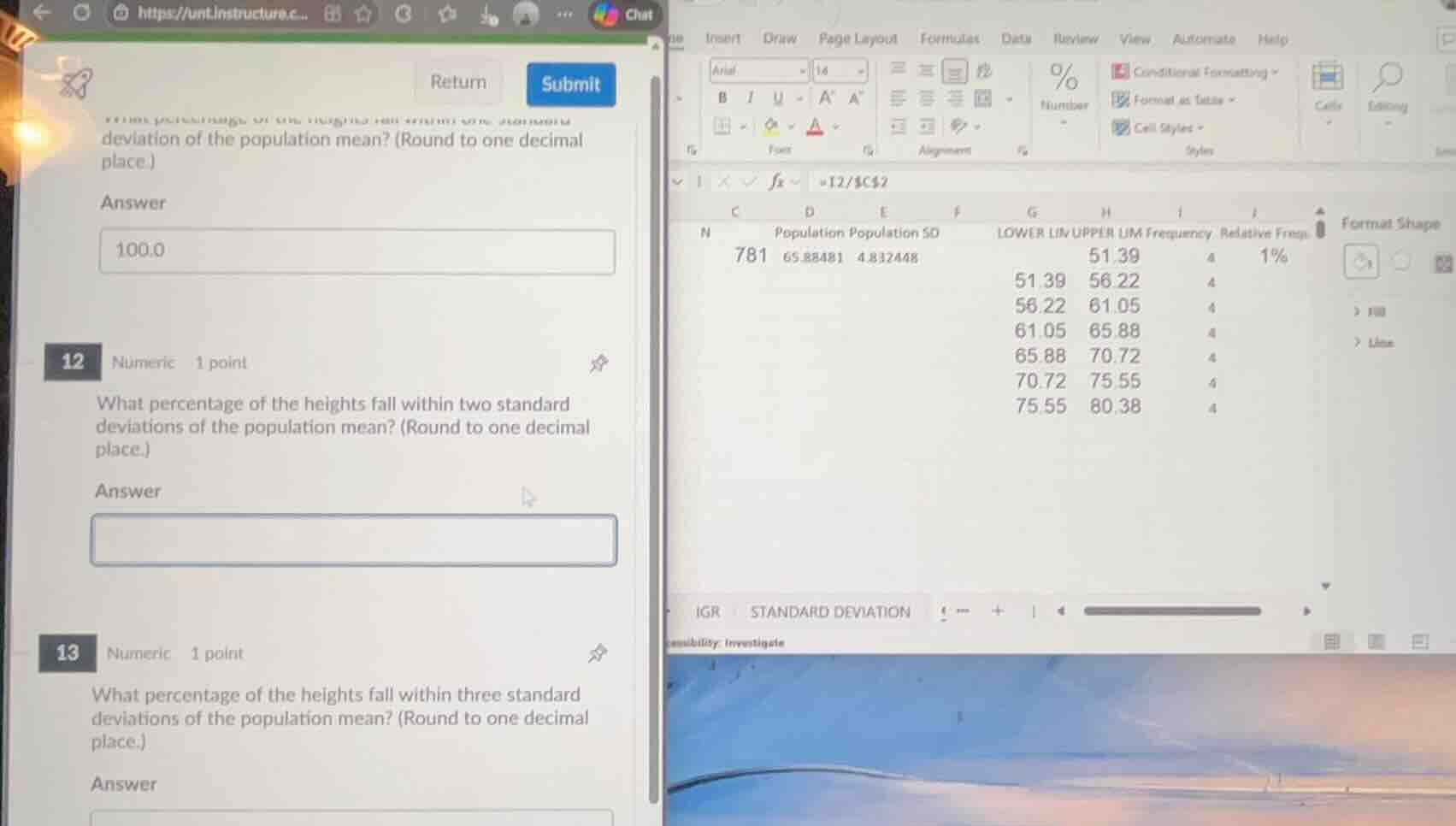
12 numeric 1 point what percentage of the heights fall within two standard deviations of the population mean? (round to one decimal place.) answer 13 numeric 1 point what percentage of the heights fall within three standard deviations of the population mean? (round to one decimal place.) answer
Step1: Calculate total frequency
$4 + 4 + 4 + 4 + 4 + 4 = 24$
Step2: Define 2σ range
Population mean $\mu = 65.88481$, SD $\sigma = 4.832448$
Lower bound: $\mu - 2\sigma = 65.88481 - 2\times4.832448 = 56.22$
Upper bound: $\mu + 2\sigma = 65.88481 + 2\times4.832448 = 75.55$
Step3: Count data in 2σ range
All classes from 56.22-61.05 to 70.72-75.55: 5 classes, each with frequency 4.
Total in range: $5\times4 = 20$
Step4: Calculate 2σ percentage
$\text{Percentage} = \frac{20}{24} \times 100\% \approx 83.3\%$
Step5: Define 3σ range
Lower bound: $\mu - 3\sigma = 65.88481 - 3\times4.832448 = 51.39$
Upper bound: $\mu + 3\sigma = 65.88481 + 3\times4.832448 = 80.38$
Step6: Count data in 3σ range
All 6 classes fall within this range, total frequency 24.
Step7: Calculate 3σ percentage
$\text{Percentage} = \frac{24}{24} \times 100\% = 100.0\%$

Snap & solve any problem in the app
Get step-by-step solutions on Sovi AI
Photo-based solutions with guided steps
Explore more problems and detailed explanations
Question 12: 83.3
Question 13: 100.0