QUESTION IMAGE
Question
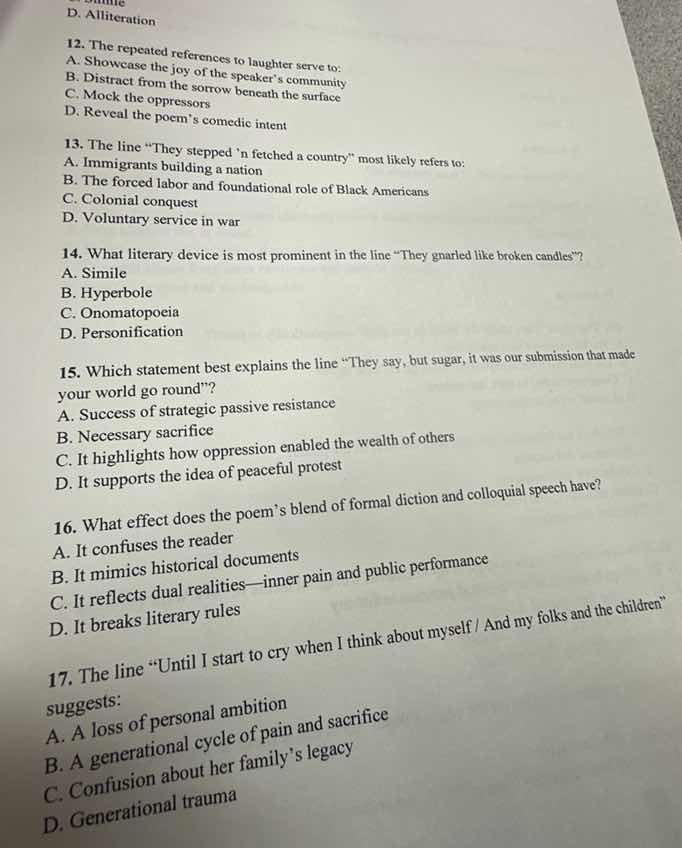
- the repeated references to laughter serve to:
a. showcase the joy of the speaker’s community
b. distract from the sorrow beneath the surface
c. mock the oppressors
d. reveal the poem’s comedic intent
- the line “they stepped ’n fetched a country” most likely refers to:
a. immigrants building a nation
b. the forced labor and foundational role of black americans
c. colonial conquest
d. voluntary service in war
- what literary device is most prominent in the line “they gnarled like broken candles”?
a. simile
b. hyperbole
c. onomatopoeia
d. personification
- which statement best explains the line “they say, but sugar, it was our submission that made your world go round”?
a. success of strategic passive resistance
b. necessary sacrifice
c. it highlights how oppression enabled the wealth of others
d. it supports the idea of peaceful protest
- what effect does the poem’s blend of formal diction and colloquial speech have?
a. it confuses the reader
b. it mimics historical documents
c. it reflects dual realities—inner pain and public performance
d. it breaks literary rules
- the line “until i start to cry when i think about myself / and my folks and the children” suggests:
a. a loss of personal ambition
b. a generational cycle of pain and sacrifice
c. confusion about her family’s legacy
d. generational trauma
- In poems centered on Black American experiences, laughter often masks underlying grief and trauma, so repeated laughter references distract from the hidden sorrow.
- The line "They stepped 'n fetched a country" alludes to the forced labor of enslaved Black people that was foundational to building the United States.
- The line uses "like" to compare "gnarled" features to "broken candles", which is the definition of a simile.
- The line critiques how the submission (exploitation) of marginalized groups enabled the wealth and prosperity of the dominant group's world.
- Blending formal and colloquial speech mirrors the dual experiences of the speaker: performing for an audience (public, formal) while holding inner, personal pain (colloquial, intimate).
- The line reflects the intergenerational pain of the speaker, their family, and children, showing a cycle of suffering passed down through generations.

Snap & solve any problem in the app
Get step-by-step solutions on Sovi AI
Photo-based solutions with guided steps
Explore more problems and detailed explanations
- B. Distract from the sorrow beneath the surface
- B. The forced labor and foundational role of Black Americans
- A. Simile
- C. It highlights how oppression enabled the wealth of others
- C. It reflects dual realities—inner pain and public performance
- B. A generational cycle of pain and sacrifice