QUESTION IMAGE
Question
q 12
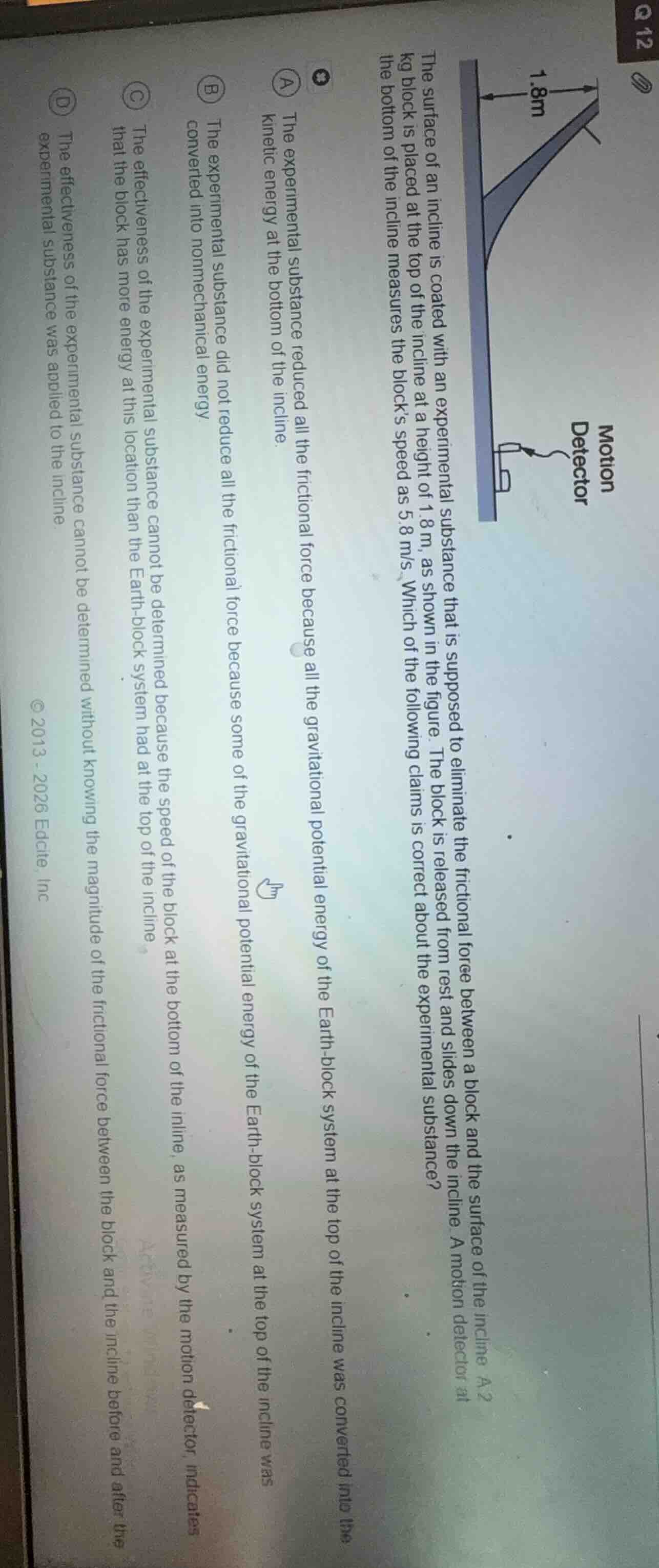
the surface of an incline is coated with an experimental substance that is supposed to eliminate the frictional force between a block and the surface of the incline. a 2 kg block is placed at the top of the incline at a height of 1.8 m, as shown in the figure. the block is released from rest and slides down the incline. a motion detector at the bottom of the incline measures the blocks speed as 5.8 m/s. which of the following claims is correct about the experimental substance?
a) the experimental substance reduced all the frictional force because all the gravitational potential energy of the earth-block system at the top of the incline was converted into the kinetic energy at the bottom of the incline.
b) the experimental substance did not reduce all the frictional force because some of the gravitational potential energy of the earth-block system at the top of the incline was converted into nonmechanical energy
c) the effectiveness of the experimental substance cannot be determined because the speed of the block at the bottom of the incline, as measured by the motion detector, indicates that the block has more energy at this location than the earth-block system had at the top of the incline
d) the effectiveness of the experimental substance cannot be determined without knowing the magnitude of the frictional force between the block and the incline before and after the experimental substance was applied to the incline.
© 2013 - 2026 edcite, inc
Step1: Calculate ideal kinetic energy
First, find the theoretical kinetic energy at the bottom if there is no friction (all gravitational potential energy converts to kinetic energy). Use $U = mgh$ for potential energy and $K = \frac{1}{2}mv^2$ for kinetic energy, set $mgh = \frac{1}{2}mv_{ideal}^2$ (mass cancels out).
$$v_{ideal} = \sqrt{2gh} = \sqrt{2 \times 9.8 \times 1.8}$$
$$v_{ideal} = \sqrt{35.28} \approx 5.94 \, \text{m/s}$$
Step2: Compare ideal and measured speed
The measured speed is $5.8 \, \text{m/s}$, which is less than the ideal speed. This means not all potential energy was converted to kinetic energy; some was lost to friction (nonmechanical energy, like heat).
Step3: Analyze each option
- Option A: Incorrect, since friction was not eliminated (speed is less than ideal).
- Option B: Correct, because the measured speed is lower than ideal, so some potential energy was converted to nonmechanical energy (friction), meaning not all friction was reduced.
- Option C: Incorrect, energy is conserved in the system; the block's energy at the bottom is less than the system's potential energy at the top.
- Option D: Incorrect, we can compare ideal and measured speed to assess effectiveness.

Snap & solve any problem in the app
Get step-by-step solutions on Sovi AI
Photo-based solutions with guided steps
Explore more problems and detailed explanations
B. The experimental substance did not reduce all the frictional force because some of the gravitational potential energy of the Earth-block system at the top of the incline was converted into nonmechanical energy