QUESTION IMAGE
Question
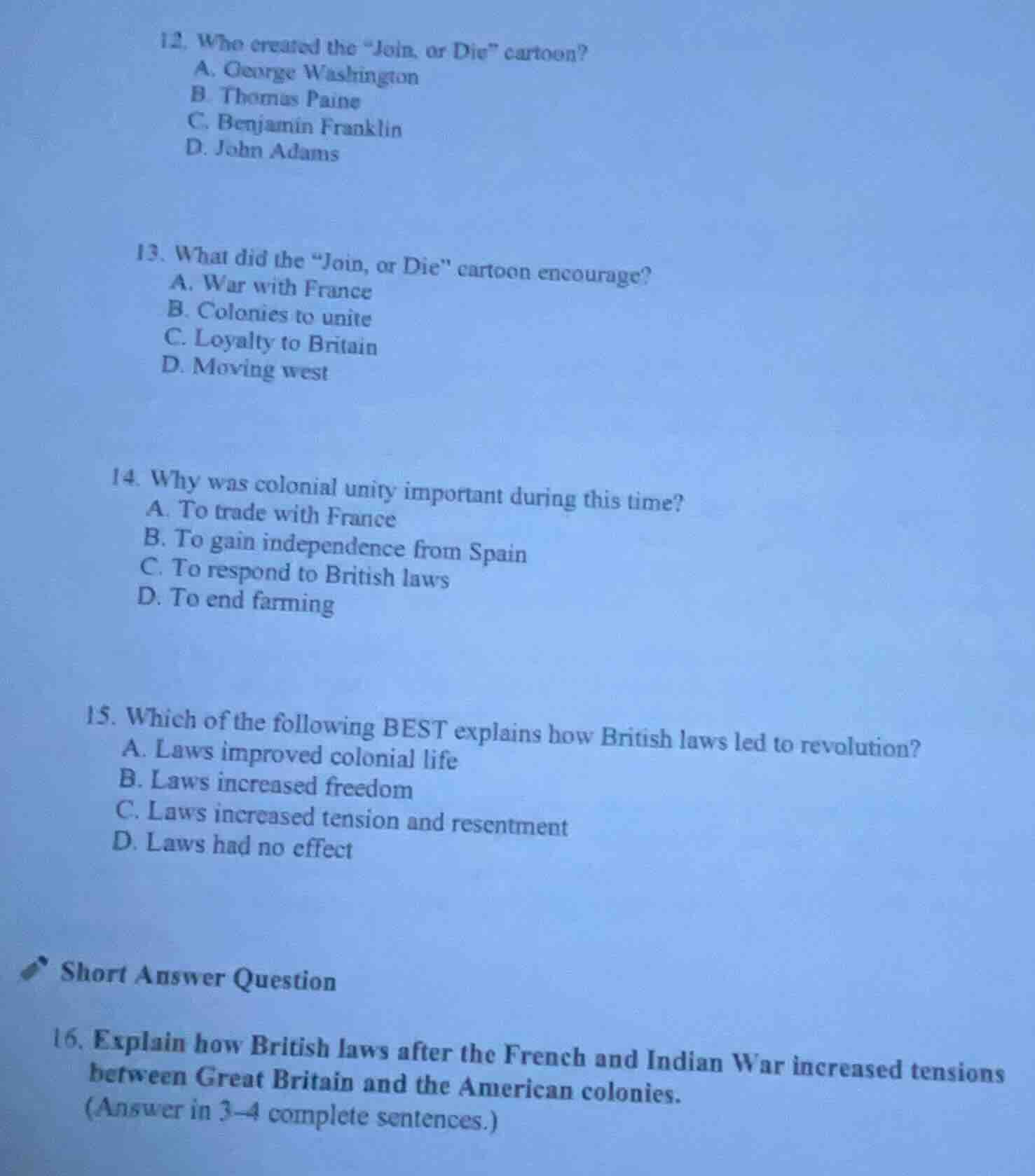
- who created the \join, or die\ cartoon?a. george washingtonb. thomas painec. benjamin franklind. john adams13. what did the \join, or die\ cartoon encourage?a. war with franceb. colonies to unitec. loyalty to britaind. moving west14. why was colonial unity important during this time?a. to trade with franceb. to gain independence from spainc. to respond to british lawsd. to end farming15. which of the following best explains how british laws led to revolution?a. laws improved colonial lifeb. laws increased freedomc. laws increased tension and resentmentd. laws had no effectshort answer question16. explain how british laws after the french and indian war increased tensions between great britain and the american colonies.(answer in 3-4 complete sentences.)
Brief Explanations
- The "Join, or Die" cartoon was first published by Benjamin Franklin in 1754.
- The cartoon, depicting a segmented snake, was designed to push the American colonies to work together against shared threats.
- In the lead-up to the American Revolution, unified colonies could better push back against restrictive British policies and laws.
- British laws like the Stamp Act and Townshend Acts imposed taxes and restrictions without colonial representation, growing anger that fueled revolution.
- After the French and Indian War, Britain faced massive war debt and turned to the colonies to pay it, passing laws like the Sugar Act and Stamp Act that taxed colonists without their consent. These laws were seen as violations of colonial self-governance, as colonists had no elected representatives in Parliament to advocate for their interests. Additionally, laws like the Quartering Act forced colonists to house and feed British soldiers, which felt like an invasion of privacy and further resentment. Over time, these cumulative measures made colonists view Britain as an oppressive power, pushing them toward unified resistance and eventually revolution.

Snap & solve any problem in the app
Get step-by-step solutions on Sovi AI
Photo-based solutions with guided steps
Explore more problems and detailed explanations
- C. Benjamin Franklin
- B. Colonies to unite
- C. To respond to British laws
- C. Laws increased tension and resentment
- After the French and Indian War, Britain enacted a series of laws aimed at paying off its war debt by taxing and restricting the American colonies, such as the Stamp Act and Sugar Act, which imposed taxes on colonists without giving them representation in Parliament. This lack of "no taxation without representation" violated the colonists' sense of self-governance, sparking widespread anger and protests. Laws like the Quartering Act, which forced colonists to shelter British troops, further escalated tensions by making colonists feel their rights and privacy were being violated. These repeated, unpopular measures unified the colonies in their opposition to British rule, laying the groundwork for the American Revolution.