QUESTION IMAGE
Question
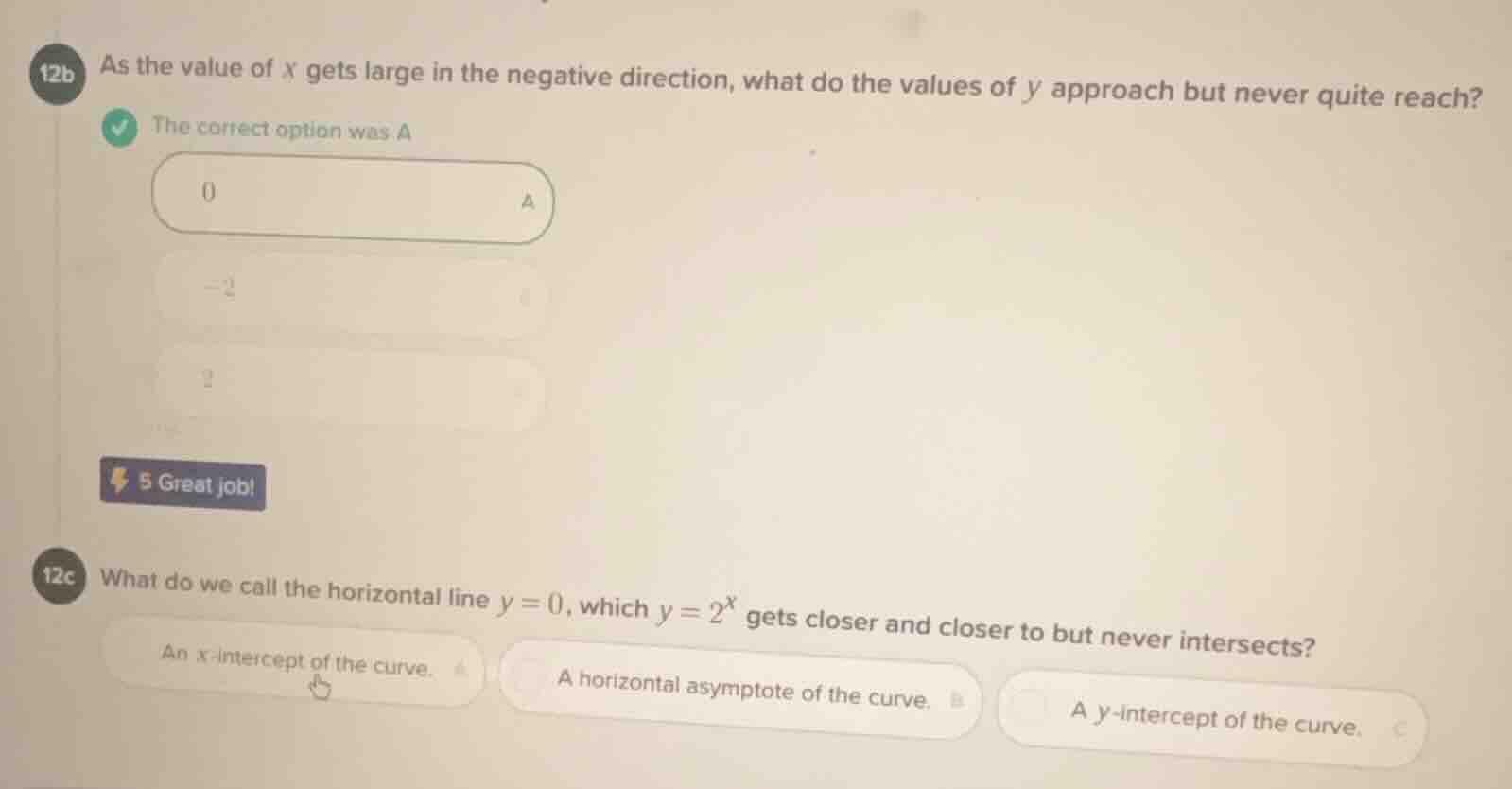
12b as the value of x gets large in the negative direction, what do the values of y approach but never quite reach? the correct option was a 0 a -2 2 12c what do we call the horizontal line y = 0, which y = 2^x gets closer and closer to but never intersects? an x - intercept of the curve. a a horizontal asymptote of the curve. b a y - intercept of the curve. c
Response
12c
Brief Explanations
To determine the correct term, we analyze each option:
- An \( x \)-intercept is where \( y = 0 \) and the curve crosses the \( x \)-axis. But \( y = 2^x \) never actually reaches \( y = 0 \), so it's not an \( x \)-intercept.
- A horizontal asymptote is a horizontal line that a function approaches as \( x \) approaches \( \pm\infty \). For \( y = 2^x \), as \( x \to -\infty \), \( y \to 0 \), so \( y = 0 \) is a horizontal asymptote.
- A \( y \)-intercept is where \( x = 0 \), and for \( y = 2^x \), the \( y \)-intercept is \( (0, 1) \), not \( y = 0 \).

Snap & solve any problem in the app
Get step-by-step solutions on Sovi AI
Photo-based solutions with guided steps
Explore more problems and detailed explanations
B. A horizontal asymptote of the curve.