QUESTION IMAGE
Question
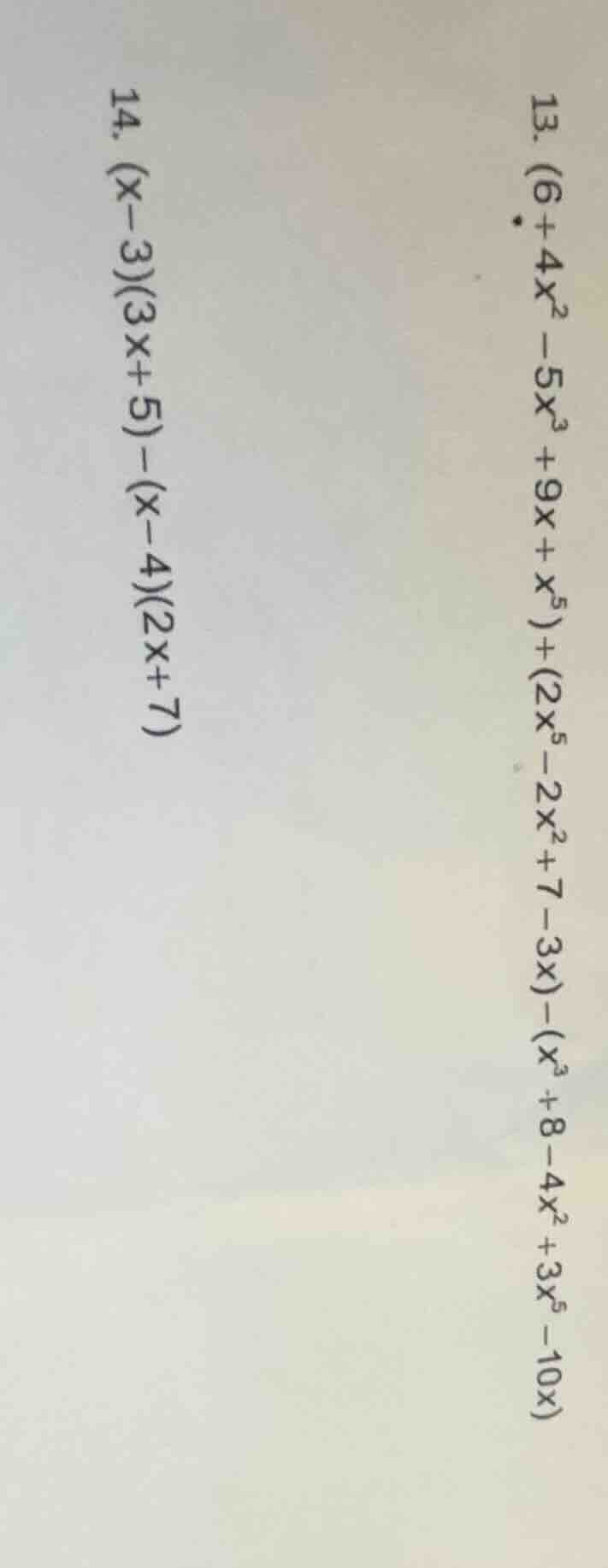
- $(6 + 4x^2 - 5x^3 + 9x + x^5)+(2x^5 - 2x^2 + 7 - 3x)-(x^3 + 8 - 4x^2 + 3x^5 - 10x)$
- $(x - 3)(3x + 5)-(x - 4)(2x + 7)$
Problem 13:
Step 1: Remove parentheses
First, we remove the parentheses. When we have a positive sign in front of a parenthesis, the terms inside remain the same. When we have a negative sign in front of a parenthesis, we change the sign of each term inside.
So, the expression \((6 + 4x^2 - 5x^3 + 9x + x^5)+(2x^5 - 2x^2 + 7 - 3x)-(x^3 + 8 - 4x^2 + 3x^5 - 10x)\) becomes:
\(6 + 4x^2 - 5x^3 + 9x + x^5 + 2x^5 - 2x^2 + 7 - 3x - x^3 - 8 + 4x^2 - 3x^5 + 10x\)
Step 2: Combine like terms for \(x^5\) terms
The \(x^5\) terms are \(x^5\), \(2x^5\), and \(-3x^5\).
Combining them: \(x^5 + 2x^5 - 3x^5=(1 + 2 - 3)x^5 = 0x^5 = 0\)
Step 3: Combine like terms for \(x^3\) terms
The \(x^3\) terms are \(-5x^3\), \(-x^3\).
Combining them: \(-5x^3 - x^3=(-5 - 1)x^3=-6x^3\)
Step 4: Combine like terms for \(x^2\) terms
The \(x^2\) terms are \(4x^2\), \(-2x^2\), \(4x^2\).
Combining them: \(4x^2 - 2x^2 + 4x^2=(4 - 2 + 4)x^2 = 6x^2\)
Step 5: Combine like terms for \(x\) terms
The \(x\) terms are \(9x\), \(-3x\), \(10x\).
Combining them: \(9x - 3x + 10x=(9 - 3 + 10)x = 16x\)
Step 6: Combine constant terms
The constant terms are \(6\), \(7\), \(-8\).
Combining them: \(6 + 7 - 8=(6 + 7)-8 = 13 - 8 = 5\)
Step 7: Combine all combined terms
Now we combine all the combined terms:
\(0 - 6x^3 + 6x^2 + 16x + 5=-6x^3 + 6x^2 + 16x + 5\)
Step 1: Expand the first product \((x - 3)(3x + 5)\)
Using the distributive property (FOIL method):
\((x - 3)(3x + 5)=x(3x)+x(5)-3(3x)-3(5)=3x^2 + 5x - 9x - 15=3x^2 - 4x - 15\)
Step 2: Expand the second product \((x - 4)(2x + 7)\)
Using the distributive property (FOIL method):
\((x - 4)(2x + 7)=x(2x)+x(7)-4(2x)-4(7)=2x^2 + 7x - 8x - 28=2x^2 - x - 28\)
Step 3: Subtract the second expanded expression from the first
We have \((3x^2 - 4x - 15)-(2x^2 - x - 28)\)
Remove the parentheses (remember to change signs for the second expression):
\(3x^2 - 4x - 15 - 2x^2 + x + 28\)
Step 4: Combine like terms for \(x^2\) terms
\(3x^2 - 2x^2=(3 - 2)x^2 = x^2\)
Step 5: Combine like terms for \(x\) terms
\(-4x + x=(-4 + 1)x=-3x\)
Step 6: Combine constant terms
\(-15 + 28=( - 15 + 28)=13\)
Step 7: Combine all combined terms
\(x^2 - 3x + 13\)

Snap & solve any problem in the app
Get step-by-step solutions on Sovi AI
Photo-based solutions with guided steps
Explore more problems and detailed explanations
\(-6x^3 + 6x^2 + 16x + 5\)