QUESTION IMAGE
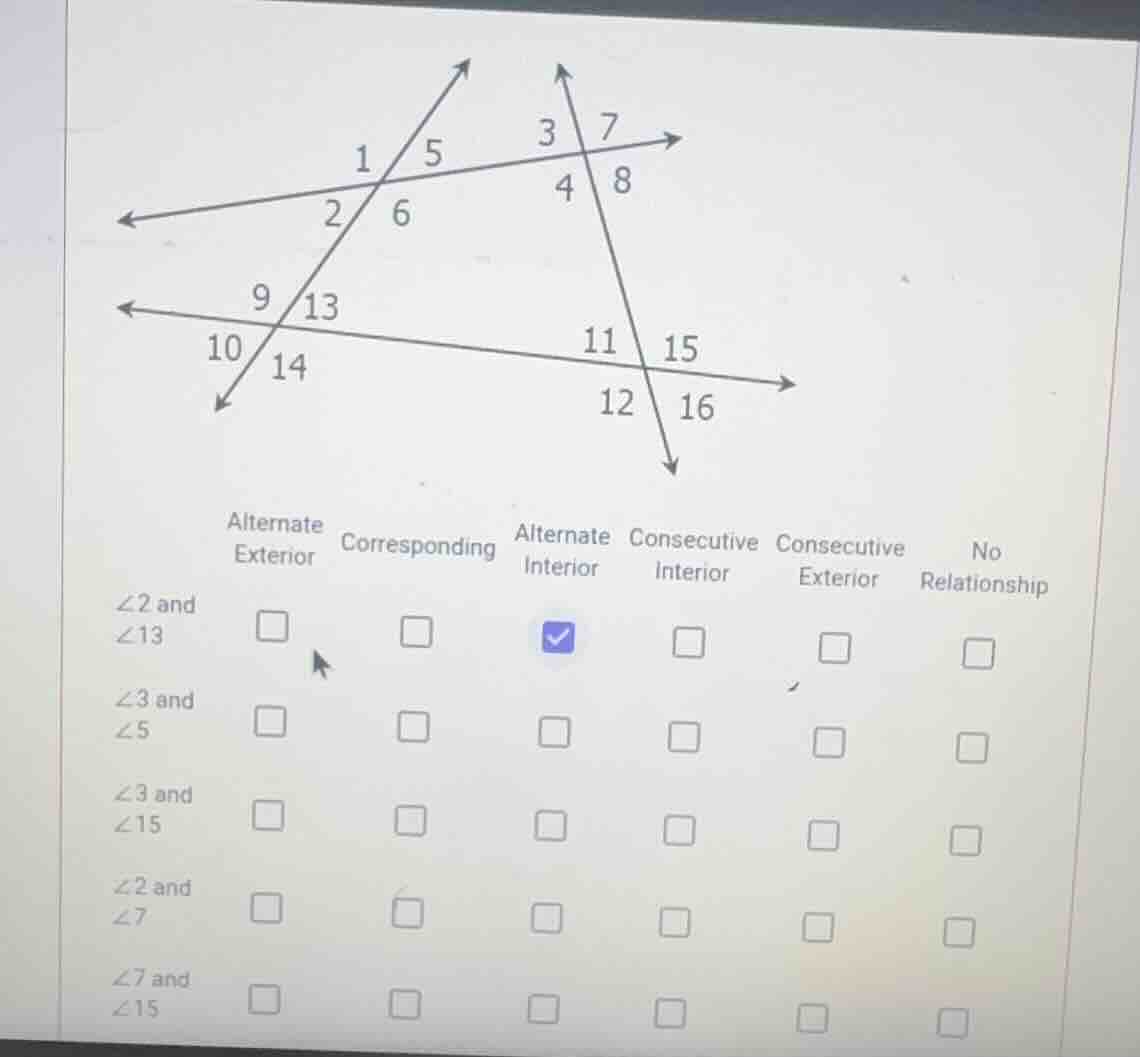
Question
∠2 and ∠13
∠3 and ∠5
∠3 and ∠15
∠2 and ∠7
∠7 and ∠15
alternate exterior corresponding alternate interior consecutive interior consecutive exterior no relationship
∠3 and ∠5
Step1: Recall angle relationship definitions
Corresponding angles: same position relative to transversal and parallel lines. Alternate interior: inside, opposite sides. Consecutive interior: inside, same side. Alternate exterior: outside, opposite sides. Consecutive exterior: outside, same side.
Step2: Analyze ∠3 and ∠5
∠3 and ∠5 are adjacent, forming a linear pair? No, wait, they are on a straight line? Wait, no, the lines: the transversal and the other line. Wait, ∠3 and ∠5 are adjacent, forming a linear pair? No, actually, ∠3 and ∠5 are supplementary? Wait, no, the question is about their relationship. Wait, ∠3 and ∠5: looking at the lines, the two horizontal lines (the top and middle) and the two transversals (the two slanted lines). Wait, ∠3 is on the top horizontal, ∠5 is on the same transversal? Wait, no, the first transversal (left slant) and second transversal (right slant). Wait, ∠3 and ∠5: they are adjacent, forming a linear pair? No, actually, ∠3 and ∠5 are vertical angles? No, vertical angles are opposite. Wait, ∠3 and ∠5: let's see the lines. The top horizontal line is cut by the left slant transversal, creating ∠1, ∠2, ∠5, ∠6. Then the right slant transversal cuts the top horizontal, creating ∠3, ∠4, ∠7, ∠8. Wait, ∠3 and ∠5: they are on the same straight line (the top horizontal) and the transversal (right slant and left slant). Wait, no, ∠3 and ∠5 are adjacent, forming a linear pair? No, ∠3 and ∠5 are supplementary? Wait, no, the key is: ∠3 and ∠5 are adjacent, forming a linear pair? Wait, no, actually, ∠3 and ∠5 are vertical angles? No, vertical angles are opposite. Wait, maybe I made a mistake. Wait, the lines: the top horizontal line is intersected by the two transversals (left slant and right slant). So ∠3 and ∠5: are they vertical? No, ∠3 and ∠4 are vertical, ∠5 and ∠6 are vertical. Wait, ∠3 and ∠5: they are adjacent, forming a linear pair? So their relationship: they are supplementary (sum to 180°), but the options are the given ones. Wait, no, maybe I misread. Wait, the options are Alternate Exterior, Corresponding, Alternate Interior, Consecutive Interior, Consecutive Exterior, No Relationship. Wait, ∠3 and ∠5: are they on a straight line? Yes, the top horizontal line is a straight line, so ∠3 + ∠5 = 180°, but the options don't have supplementary. Wait, maybe the lines are parallel? Wait, the diagram: are the two horizontal lines parallel? The problem doesn't state, but assuming they are (since it's a transversal angle problem). Wait, no, ∠3 and ∠5: let's see, the two transversals (left slant and right slant) intersect the top horizontal line. So ∠3 and ∠5 are adjacent, forming a linear pair, so they are supplementary, but the options given don't include that. Wait, maybe I made a mistake. Wait, the options are Alternate Exterior, Corresponding, Alternate Interior, Consecutive Interior, Consecutive Exterior, No Relationship. So ∠3 and ∠5: do they fit any? Let's check each:
- Alternate Exterior: no, they are inside? No, top horizontal, so inside the two horizontal lines? Wait, the two horizontal lines are the top and middle. So ∠3 is on top horizontal, ∠5 is on top horizontal, same line. So they are adjacent, forming a linear pair, so their relationship is that they are supplementary, but since the options don't have that, maybe "No Relationship" is not correct. Wait, no, maybe the lines are the two slanted lines and the two horizontal lines. Wait, the first transversal (left slant) cuts the two horizontal lines, creating ∠1,∠2,∠5,∠6 (top horizontal) and ∠9,∠10,∠13,∠14 (middle horizontal). The second tran…
Step1: Identify lines and transversal
Two horizontal lines (top and middle) are parallel (assumed, as it's an angle relationship problem). The right slant transversal cuts them, creating ∠3 (top horizontal, upper) and ∠15 (middle horizontal, upper).
Step2: Check angle relationship
Corresponding angles: same position relative to transversal and parallel lines. ∠3 is on top horizontal, right transversal, upper; ∠15 is on middle horizontal, right transversal, upper. So they are corresponding angles.
Step1: Identify lines and transversal
Two horizontal lines (top and middle) are parallel. The left slant transversal (∠2) and right slant transversal (∠7). ∠2 is on top horizontal, left transversal, lower; ∠7 is on top horizontal, right transversal, upper.
Step2: Check relationships
Alternate Exterior: no, both on top horizontal (inside? No, top horizontal is one line). Alternate Interior: no. Consecutive Interior: no. Corresponding: no. Consecutive Exterior: no. So no relationship? Wait, no, ∠2 is on left transversal, ∠7 is on right transversal, top horizontal. Wait, maybe the two horizontal lines are parallel, and the two transversals (left and right slant) are not parallel. So ∠2 and ∠7: no specific angle relationship (alternate, corresponding, etc.), so "No Relationship".

Snap & solve any problem in the app
Get step-by-step solutions on Sovi AI
Photo-based solutions with guided steps
Explore more problems and detailed explanations
Corresponding (check the "Corresponding" box)