QUESTION IMAGE
Question
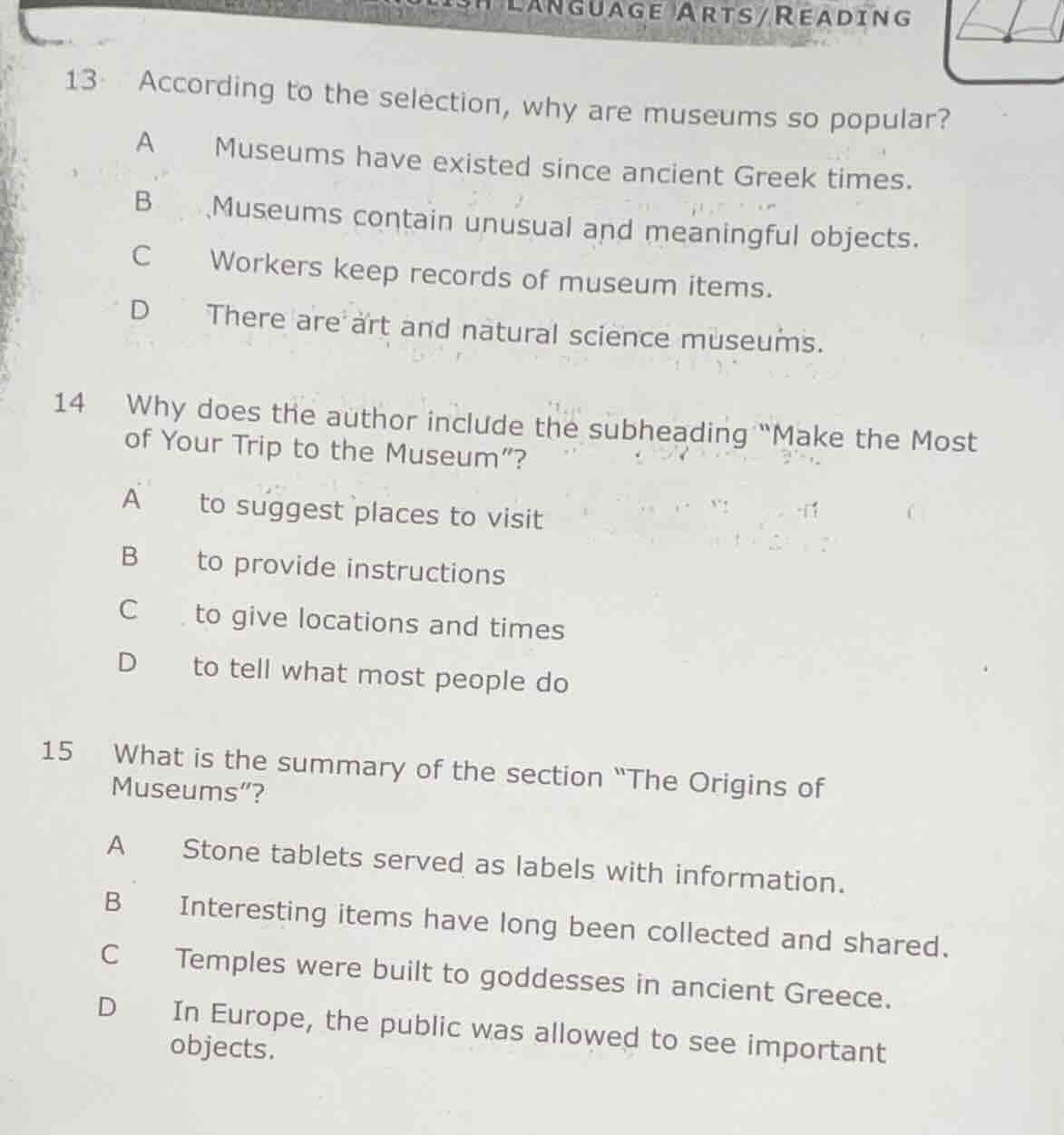
13 according to the selection, why are museums so popular?
a museums have existed since ancient greek times.
b museums contain unusual and meaningful objects.
c workers keep records of museum items.
d there are art and natural science museums.
14 why does the author include the subheading \make the most of your trip to the museum\?
a to suggest places to visit
b to provide instructions
c to give locations and times
d to tell what most people do
15 what is the summary of the section \the origins of museums\?
a stone tablets served as labels with information.
b interesting items have long been collected and shared.
c temples were built to goddesses in ancient greece.
d in europe, the public was allowed to see important objects.
Question 13
To determine why museums are popular, we analyze each option:
- Option A: The existence since ancient Greek times doesn't directly explain popularity.
- Option B: Museums having unusual and meaningful objects would attract people, making them popular.
- Option C: Workers keeping records is not related to why people like museums.
- Option D: The types of museums don't explain their popularity.
For the subheading "Make the Most of Your Trip to the Museum", we analyze:
- Option A: It's not about suggesting places.
- Option B: A subheading about making the most of a trip would likely provide instructions on how to do so.
- Option C: It doesn't give locations and times.
- Option D: It's not about telling what most people do.
For the summary of "The Origins of Museums":
- Option A: Stone tablets as labels is a detail, not a summary.
- Option B: The section on origins would cover that interesting items have been collected and shared over time, which is a broad summary.
- Option C: Temples in ancient Greece is a detail, not a summary.
- Option D: Public access in Europe is a detail, not a summary.

Snap & solve any problem in the app
Get step-by-step solutions on Sovi AI
Photo-based solutions with guided steps
Explore more problems and detailed explanations
B. Museums contain unusual and meaningful objects.