QUESTION IMAGE
Question
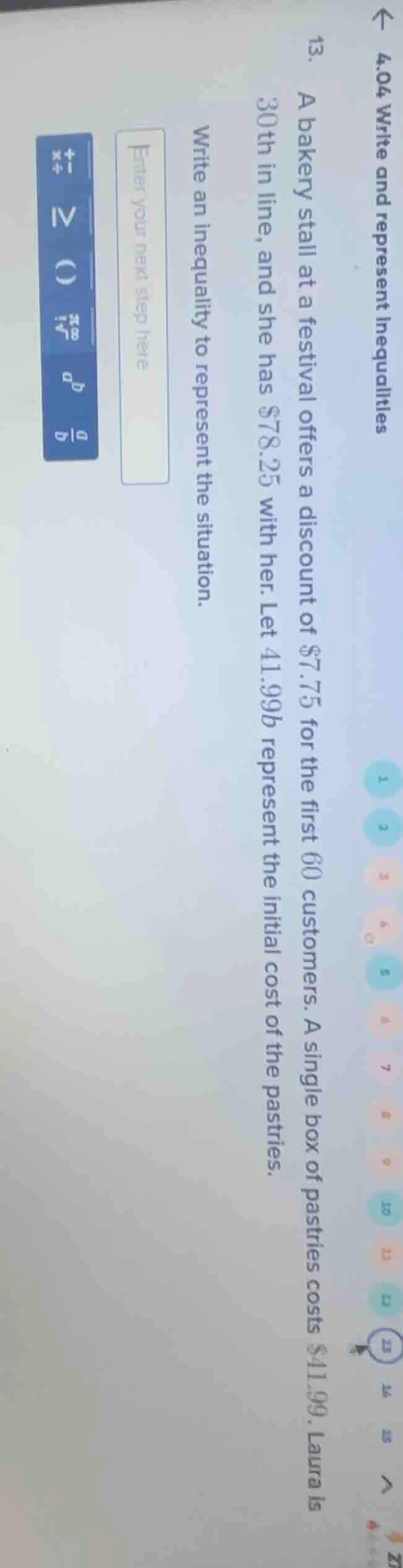
- a bakery stall at a festival offers a discount of $7.75 for the first 60 customers. a single box of pastries costs $41.99. laura is 30th in line, and she has $78.25 with her. let 41.99b represent the initial cost of the pastries. write an inequality to represent the situation.
Step1: Determine the discounted price
The initial cost of a box of pastries is $41.99, and there's a discount of $7.75 for the first 60 customers. So the discounted price per box is $41.99 - $7.75. Let's calculate that: $41.99 - $7.75 = $34.24. But actually, we can represent the total cost Laura will pay as (41.99 - 7.75)b, or more simply, since we know she has $78.25, the total cost of b boxes (with the discount, since she's within the first 60) must be less than or equal to the money she has. Wait, actually, the total cost for b boxes with the discount is (41.99 - 7.75)b, and this must be ≤ 78.25 because she can't spend more than she has. Wait, no, let's re-examine. The problem says "Write an inequality to represent the situation." Laura is the 30th in line, so she qualifies for the discount. The cost per box after discount is 41.99 - 7.75, and she has $78.25. So the total cost of b boxes (41.99 - 7.75)b must be less than or equal to 78.25, because she can spend up to the money she has. Wait, but maybe it's the other way? Wait, no, she has $78.25, so the amount she spends (discounted price times number of boxes) must be ≤ 78.25. So first, calculate the discounted price: 41.99 - 7.75 = 34.24. So the inequality is 34.24b ≤ 78.25? Wait, no, maybe I misread. Wait, the problem says "Let 41.99b represent the initial cost of the pastries." Wait, maybe the discount is applied to the total? Wait, no, the bakery offers a discount of $7.75 for the first 60 customers. So maybe the total cost for Laura is (41.99b - 7.75) ≤ 78.25? Wait, no, that doesn't make sense. Wait, let's re-express the problem. A single box costs $41.99. Discount of $7.75 for first 60 customers. So for each box, the discount is $7.75? Or is the discount a total discount? Wait, the problem says "a discount of $7.75 for the first 60 customers". Maybe it's a discount per box? So each box for the first 60 customers is $41.99 - $7.75. So the cost per box is $34.24. Then, if Laura buys b boxes, the total cost is 34.24b, and this must be ≤ 78.25, because she has $78.25. Alternatively, maybe the discount is a one-time discount? But that's less likely. The problem says "a discount of $7.75 for the first 60 customers" – probably per box. So the initial cost is 41.99b, and the discount is 7.75 (since it's for the first 60, maybe the discount is $7.75 total? Wait, the problem says "a discount of $7.75 for the first 60 customers" – maybe it's a discount of $7.75 off the total purchase for the first 60 customers. So total cost is 41.99b - 7.75, and this must be ≤ 78.25. Ah, that makes more sense. So if she buys b boxes, the initial cost is 41.99b, then subtract the $7.75 discount (since she's in the first 60), and that total must be ≤ 78.25. So the inequality is 41.99b - 7.75 ≤ 78.25. Let's check: 41.99b is the initial cost, minus $7.75 discount, and this has to be less than or equal to the $78.25 she has. Yes, that makes sense. So let's write that inequality.
Step2: Formulate the inequality
Laura's total cost after discount is (initial cost of b boxes) minus the discount, and this must be ≤ the money she has. So:
41.99b - 7.75 ≤ 78.25

Snap & solve any problem in the app
Get step-by-step solutions on Sovi AI
Photo-based solutions with guided steps
Explore more problems and detailed explanations
The inequality representing the situation is $41.99b - 7.75 \leq 78.25$.