QUESTION IMAGE
Question
13.
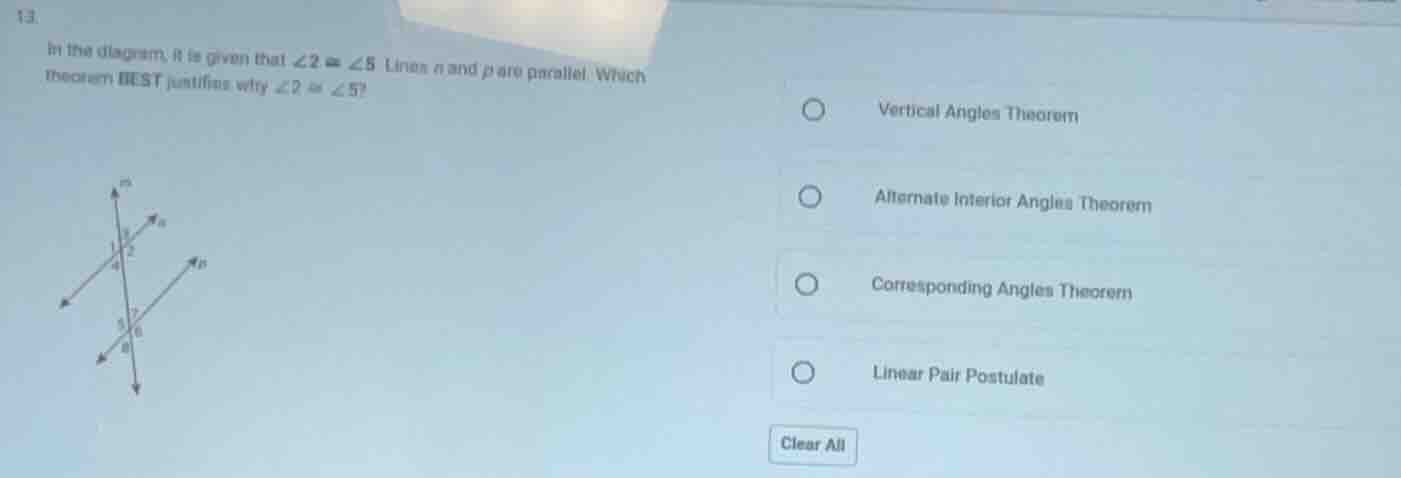
in the diagram, it is given that $\angle 2 \cong \angle 5$. lines $n$ and $p$ are parallel. which theorem best justifies why $\angle 2 \cong \angle 5$?
\bigcirc \quad vertical angles theorem
\bigcirc \quad alternate interior angles theorem
\bigcirc \quad corresponding angles theorem
\bigcirc \quad linear pair postulate
clear all
Brief Explanations
To determine which theorem justifies \( \angle 2 \cong \angle 5 \) when lines \( n \) and \( p \) are parallel, we analyze each option:
- Vertical Angles Theorem: Applies to angles opposite each other when two lines intersect, not related to parallel lines cut by a transversal for \( \angle 2 \) and \( \angle 5 \).
- Alternate Interior Angles Theorem: States that if two parallel lines are cut by a transversal, then alternate interior angles are congruent. \( \angle 2 \) and \( \angle 5 \) are alternate interior angles (they lie between the two parallel lines \( n \) and \( p \) and on opposite sides of the transversal), so this theorem applies.
- Corresponding Angles Theorem: Applies to angles in the same position relative to the parallel lines and transversal, which is not the case for \( \angle 2 \) and \( \angle 5 \).
- Linear Pair Postulate: Applies to adjacent angles forming a linear pair (supplementary), not relevant here.

Snap & solve any problem in the app
Get step-by-step solutions on Sovi AI
Photo-based solutions with guided steps
Explore more problems and detailed explanations
Alternate Interior Angles Theorem