QUESTION IMAGE
Question
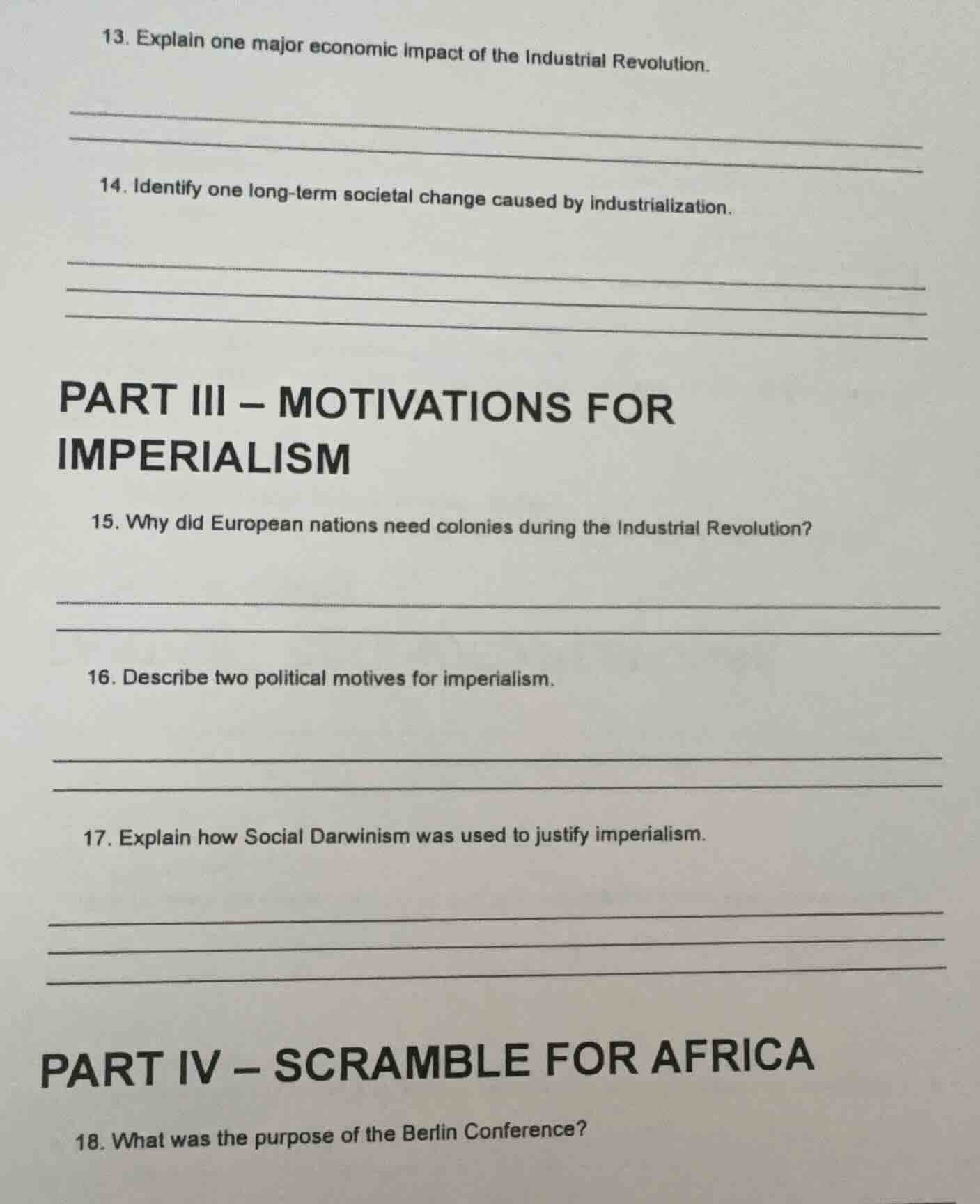
- explain one major economic impact of the industrial revolution.
- identify one long-term societal change caused by industrialization.
part iii – motivations for imperialism
- why did european nations need colonies during the industrial revolution?
- describe two political motives for imperialism.
- explain how social darwinism was used to justify imperialism.
part iv – scramble for africa
- what was the purpose of the berlin conference?
Brief Explanations
- The Industrial Revolution shifted economies from agrarian to industrial, creating a new system of mass production and wage labor that boosted overall output and shifted wealth to industrialists.
- Industrialization drew large numbers of people from rural areas to cities for factory jobs, permanently changing settlement patterns.
- European industrial powers needed colonies to access cheap raw materials for factories and to create exclusive markets to sell their mass-produced goods.
- Political motives for imperialism included gaining strategic military bases to protect trade routes and expanding national power and prestige relative to rival European nations.
- Social Darwinism adapted Darwin's "survival of the fittest" concept to human societies, framing European nations as "superior" and justifying the takeover of "weaker" non-European societies as a natural, progressive process.
- The Berlin Conference was held to establish rules for European nations to divide and colonize Africa, avoiding violent conflicts between competing imperial powers.

Snap & solve any problem in the app
Get step-by-step solutions on Sovi AI
Photo-based solutions with guided steps
Explore more problems and detailed explanations
- A major economic impact was the shift from an agrarian-based economy to a mechanized, industrial economy, which led to mass production, the growth of capitalist markets, and a significant increase in overall economic output, while also concentrating wealth in the hands of industrial factory owners.
- One long-term societal change is the mass urbanization of populations, as people moved from rural agricultural areas to growing industrial cities to work in factories, permanently altering living patterns and social structures.
- European nations needed colonies to secure a steady supply of cheap raw materials (like cotton, rubber, and minerals) to feed their industrial factories, and to create captive markets where they could sell their mass-produced manufactured goods at high profits.
- Two political motives for imperialism are:
- To gain strategic military outposts and naval bases around the world to protect international trade routes and project national power globally.
- To compete with rival European nations for territorial control, as larger empires were seen as a sign of national strength, prestige, and political dominance.
- Social Darwinism was used to justify imperialism by applying the idea of "survival of the fittest" to human societies. Imperialists argued that European nations were "biologically and culturally superior" to non-European societies, framing the conquest and rule of colonized peoples as a natural, progressive process that would "civilize" supposedly "weaker" societies.
- The purpose of the Berlin Conference (1884-1885) was to create formal, agreed-upon rules for European powers to divide and colonize African territory, preventing violent conflicts between competing imperial nations over African lands and resources.