QUESTION IMAGE
Question
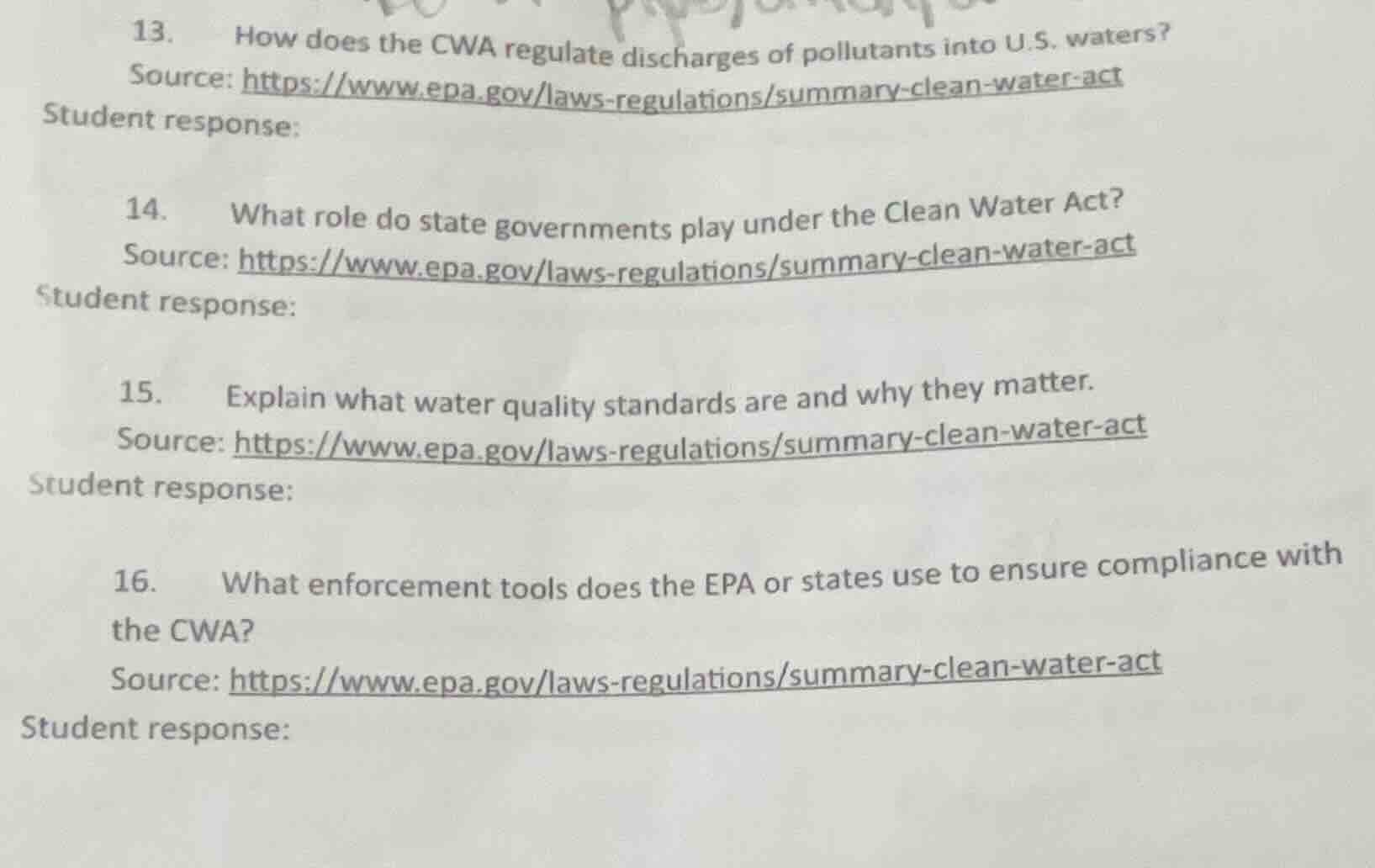
- how does the cwa regulate discharges of pollutants into u.s. waters?
source: https://www.epa.gov/laws-regulations/summary-clean-water-act
student response:
- what role do state governments play under the clean water act?
source: https://www.epa.gov/laws-regulations/summary-clean-water-act
student response:
- explain what water quality standards are and why they matter.
source: https://www.epa.gov/laws-regulations/summary-clean-water-act
student response:
- what enforcement tools does the epa or states use to ensure compliance with
the cwa?
source: https://www.epa.gov/laws-regulations/summary-clean-water-act
student response:
Question 13
The Clean Water Act (CWA) regulates pollutant discharges into U.S. waters mainly through a permit system. The National Pollutant Discharge Elimination System (NPDES) requires entities (like industries, municipalities) discharging pollutants into navigable waters or their tributaries to obtain permits. These permits set limits on the type and amount of pollutants that can be discharged, based on factors like technology - based and water - quality - based standards. Also, the CWA prohibits unpermitted discharges of pollutants into these waters, and it has provisions for monitoring, reporting, and enforcement to ensure compliance.
Under the Clean Water Act, state governments have several key roles. They can assume the administration of the NPDES program (after EPA approval) to issue, monitor, and enforce discharge permits within their jurisdiction. States also develop and implement water quality standards (including criteria for pollutants and designated uses of water bodies) tailored to their local waters. They conduct water quality monitoring and assessment to identify impaired waters and develop Total Maximum Daily Loads (TMDLs) for those waters. Additionally, states may provide technical and financial assistance to local governments and entities for water pollution control and restoration projects.
Water quality standards are legal requirements that define the desired condition of a water body (e.g., for drinking, swimming, supporting aquatic life) and the maximum allowable levels of pollutants in that water body. They consist of two main parts: (1) Designated uses (e.g., drinking water supply, aquatic habitat, recreation) which specify how the water body should be used. (2) Water quality criteria, which are scientific values (e.g., maximum pollutant concentrations) that protect the designated uses. They matter because they provide a basis for regulating pollutant discharges (e.g., setting permit limits), guiding water pollution control efforts, protecting public health (e.g., safe drinking water, recreational safety), and safeguarding aquatic ecosystems (ensuring habitats for fish and wildlife are maintained).

Snap & solve any problem in the app
Get step-by-step solutions on Sovi AI
Photo-based solutions with guided steps
Explore more problems and detailed explanations
The CWA regulates pollutant discharges into U.S. waters primarily via the National Pollutant Discharge Elimination System (NPDES) permit program. Entities (e.g., industries, municipalities) discharging pollutants into navigable waters or their tributaries must obtain an NPDES permit, which sets limits on pollutant types/amounts (based on tech - and water - quality - based standards). Unpermitted discharges are prohibited, and the CWA includes monitoring, reporting, and enforcement provisions.