QUESTION IMAGE
Question
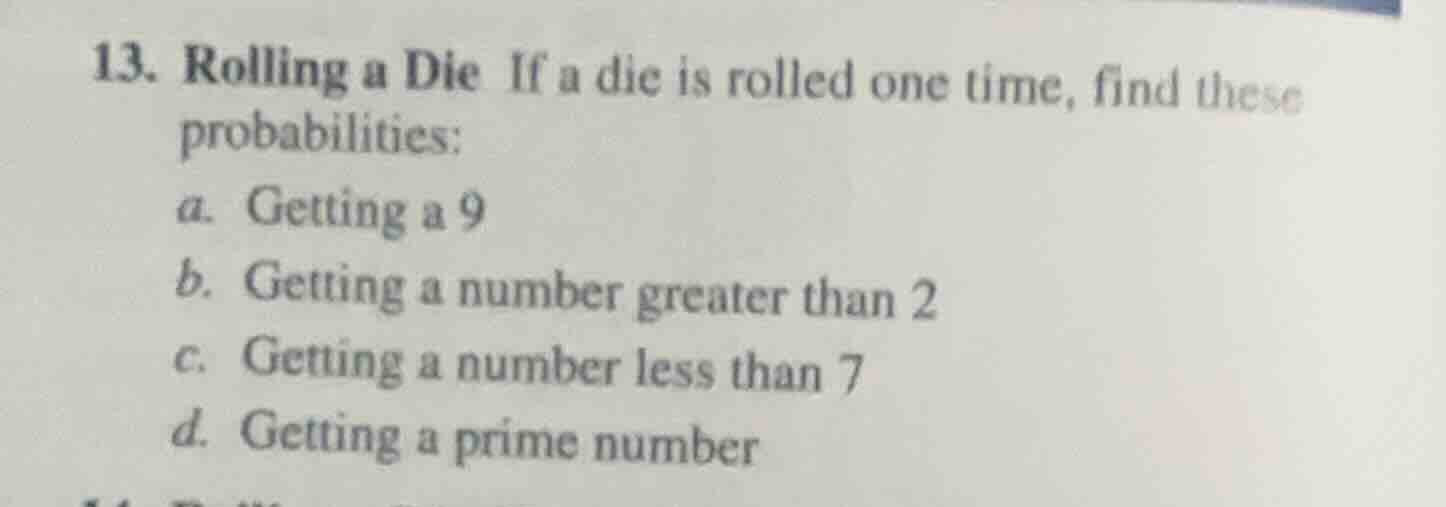
- rolling a die if a die is rolled one time, find these probabilities:
a. getting a 9
b. getting a number greater than 2
c. getting a number less than 7
d. getting a prime number
Step1: Define total outcomes
A standard die has 6 faces, so total possible outcomes $n(S) = 6$.
Step2: Solve part a: Probability of 9
No faces show 9, so favorable outcomes $n(A)=0$.
Probability: $P(A) = \frac{n(A)}{n(S)} = \frac{0}{6} = 0$
Step3: Solve part b: Number >2
Favorable outcomes: {3,4,5,6}, so $n(B)=4$.
Probability: $P(B) = \frac{n(B)}{n(S)} = \frac{4}{6} = \frac{2}{3}$
Step4: Solve part c: Number <7
All faces (1-6) are <7, so $n(C)=6$.
Probability: $P(C) = \frac{n(C)}{n(S)} = \frac{6}{6} = 1$
Step5: Solve part d: Prime number
Prime numbers on die: {2,3,5}, so $n(D)=3$.
Probability: $P(D) = \frac{n(D)}{n(S)} = \frac{3}{6} = \frac{1}{2}$

Snap & solve any problem in the app
Get step-by-step solutions on Sovi AI
Photo-based solutions with guided steps
Explore more problems and detailed explanations
a. $0$
b. $\frac{2}{3}$
c. $1$
d. $\frac{1}{2}$