QUESTION IMAGE
Question
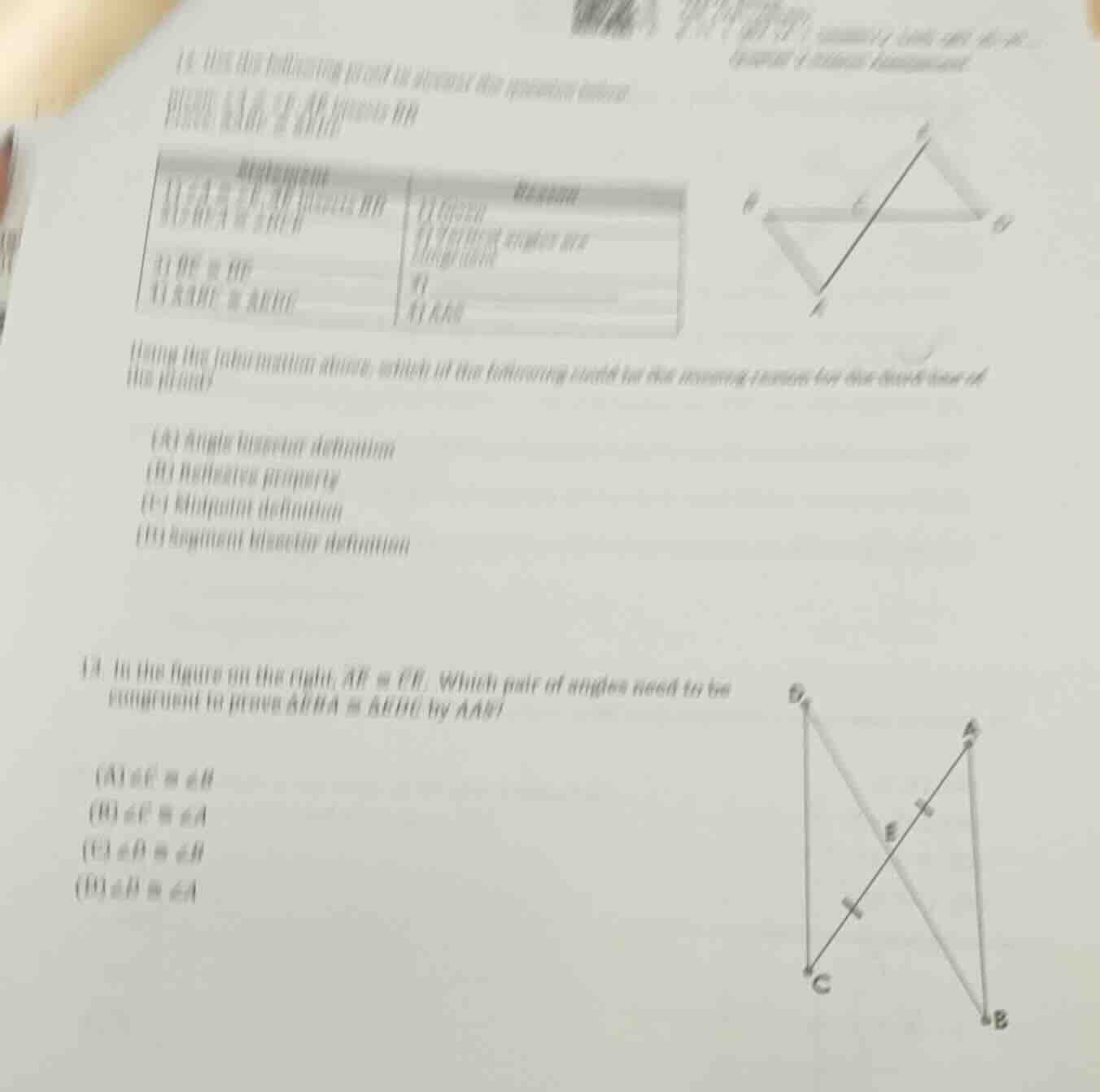
- use the induction proof to reverse the problem below. prove: ab ≅ de, ac ≅ df, bc ≅ ef. statements reasons 1) ab ≅ de, ac ≅ df, bc ≅ ef 1) given 2) ∠a ≅ ∠d 2) if two triangles are congruent, corresponding angles are congruent 3) △abc ≅ △def 3) ? from the information above, which of the following could be the missing reason for the third line of the proof? (a) angle bisector definition (b) reflexive property (c) midpoint definition (d) segment bisector definition 14. in the figure on the right, ae ≅ fe. which pair of angles need to be congruent to prove △cea ≅ △bef by aas? (a) ∠e ≅ ∠b (b) ∠c ≅ ∠a (c) ∠d ≅ ∠b (d) ∠b ≅ ∠a
Response
Question 13 (Assuming the first question about the proof's third line reason):
Brief Explanations
To determine the missing reason for the third line of the proof (where we have \( \angle ABE \cong \angle DBE \)), we analyze the options:
- Option A (Angle Bisector Definition): An angle bisector divides an angle into two congruent angles. If \( BE \) is an angle bisector of \( \angle ABD \), then \( \angle ABE \cong \angle DBE \), which matches the third line.
- Option B (Reflexive Property): Applies to a quantity being congruent to itself (e.g., \( \angle B \cong \angle B \)), not for two distinct angles formed by a bisector.
- Option C (Midpoint Definition): Applies to segments (dividing a segment into two equal parts), not angles.
- Option D (Segment Bisector Definition): Applies to segments (dividing a segment into two congruent segments), not angles.
Thus, the Angle Bisector Definition is the correct reason.
Brief Explanations
For AAS (Angle - Angle - Side) congruence, we need two pairs of congruent angles and a non - included pair of congruent sides. We know \( AE = CE \) (from the markings). The vertical angles \( \angle AEB \) and \( \angle CED \) are congruent. We need one more pair of congruent angles.
- Option A (\( \angle E \cong \angle B \)): \( \angle E \) is part of the vertical angle pair, and \( \angle B \) is not the correct angle to form AAS with the given side and vertical angle.
- Option B (\( \angle C \cong \angle A \)): If \( \angle C \cong \angle A \), along with \( \angle AEB \cong \angle CED \) (vertical angles) and \( AE = CE \), we satisfy AAS (two angles: \( \angle A\cong\angle C \), \( \angle AEB\cong\angle CED \); and side \( AE = CE \)).
- Option C (\( \angle D \cong \angle B \)): This would not align with the AAS requirements for the given sides (\( AE = CE \)) and vertical angles.
- Option D (\( \angle B \cong \angle A \)): This does not provide the correct angle pair for AAS with \( AE = CE \) and vertical angles.

Snap & solve any problem in the app
Get step-by-step solutions on Sovi AI
Photo-based solutions with guided steps
Explore more problems and detailed explanations
A. Angle Bisector Definition