QUESTION IMAGE
Question
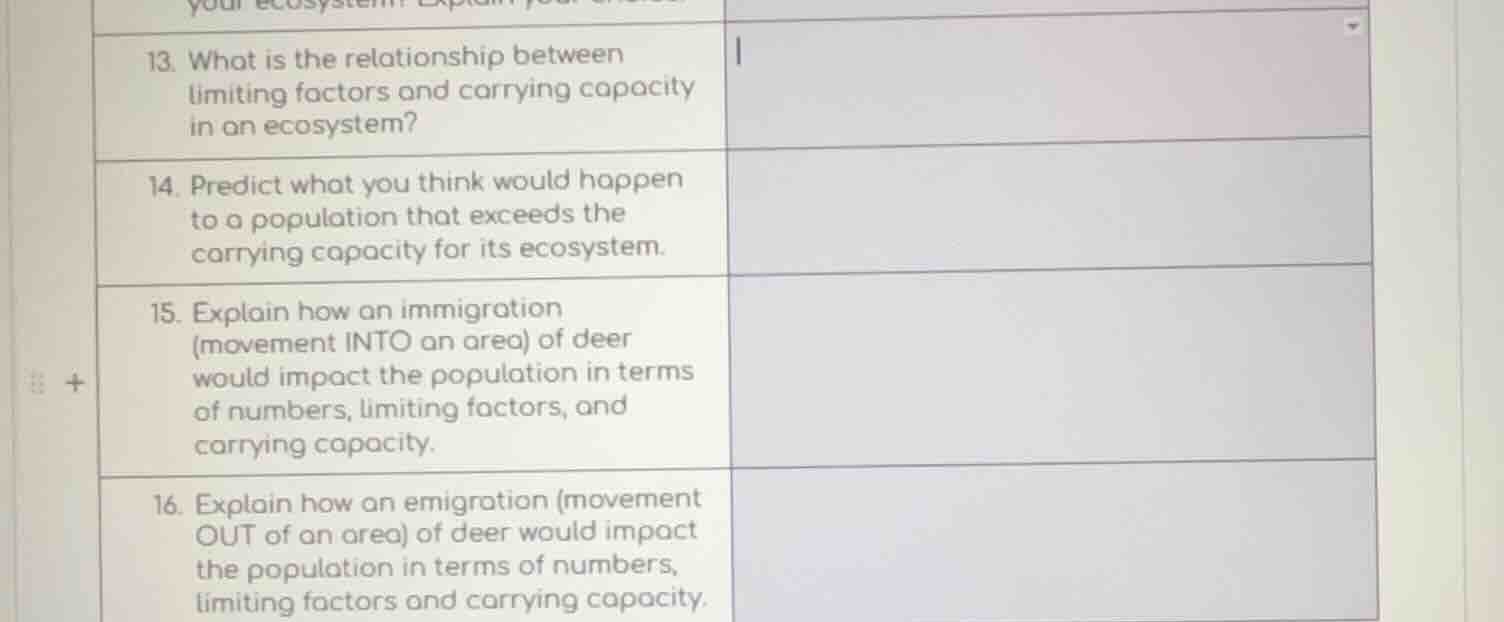
- what is the relationship between limiting factors and carrying capacity in an ecosystem?
- predict what you think would happen to a population that exceeds the carrying capacity for its ecosystem.
- explain how an immigration (movement into an area) of deer would impact the population in terms of numbers, limiting factors, and carrying capacity.
- explain how an emigration (movement out of an area) of deer would impact the population in terms of numbers, limiting factors and carrying capacity.
Brief Explanations
- For question 13: Limiting factors (like food, space, water) directly set the maximum sustainable population size, which is the carrying capacity. They constrain how large a population can grow in an ecosystem.
- For question 14: When a population surpasses carrying capacity, the available resources (limited factors) are insufficient. This leads to increased competition, starvation, disease, or higher mortality, causing the population to drop back to or below the carrying capacity.
- For question 15: Immigration increases deer population numbers immediately. This intensifies pressure on limiting factors (e.g., food, shelter) that define the ecosystem's carrying capacity. If the new total population exceeds the carrying capacity, the same population decline pressures (starvation, disease) will occur until the population aligns with the sustainable carrying capacity.
- For question 16: Emigration decreases deer population numbers. This reduces strain on the ecosystem's limiting factors, meaning the remaining population is more likely to stay at or below the carrying capacity, with less competition for resources.

Snap & solve any problem in the app
Get step-by-step solutions on Sovi AI
Photo-based solutions with guided steps
Explore more problems and detailed explanations
- Limiting factors are the biotic or abiotic resources that determine the maximum sustainable population size (carrying capacity) of an ecosystem; they directly restrict how large a population can grow.
- The population will experience a decline: increased competition for limited resources, higher rates of starvation, disease, or predation will reduce the population size back to a level that the ecosystem's carrying capacity can support.
- Immigration increases the deer population count right away. This puts greater stress on the ecosystem's limiting factors (such as food, water, and living space). If the new total population exceeds the ecosystem's carrying capacity, the population will face pressures like food scarcity and disease, leading to a decrease until it matches the sustainable carrying capacity.
- Emigration reduces the deer population count. This lessens the demand on the ecosystem's limiting factors, so the remaining population will be more likely to stay within the bounds of the ecosystem's carrying capacity, with reduced competition for available resources.