QUESTION IMAGE
Question
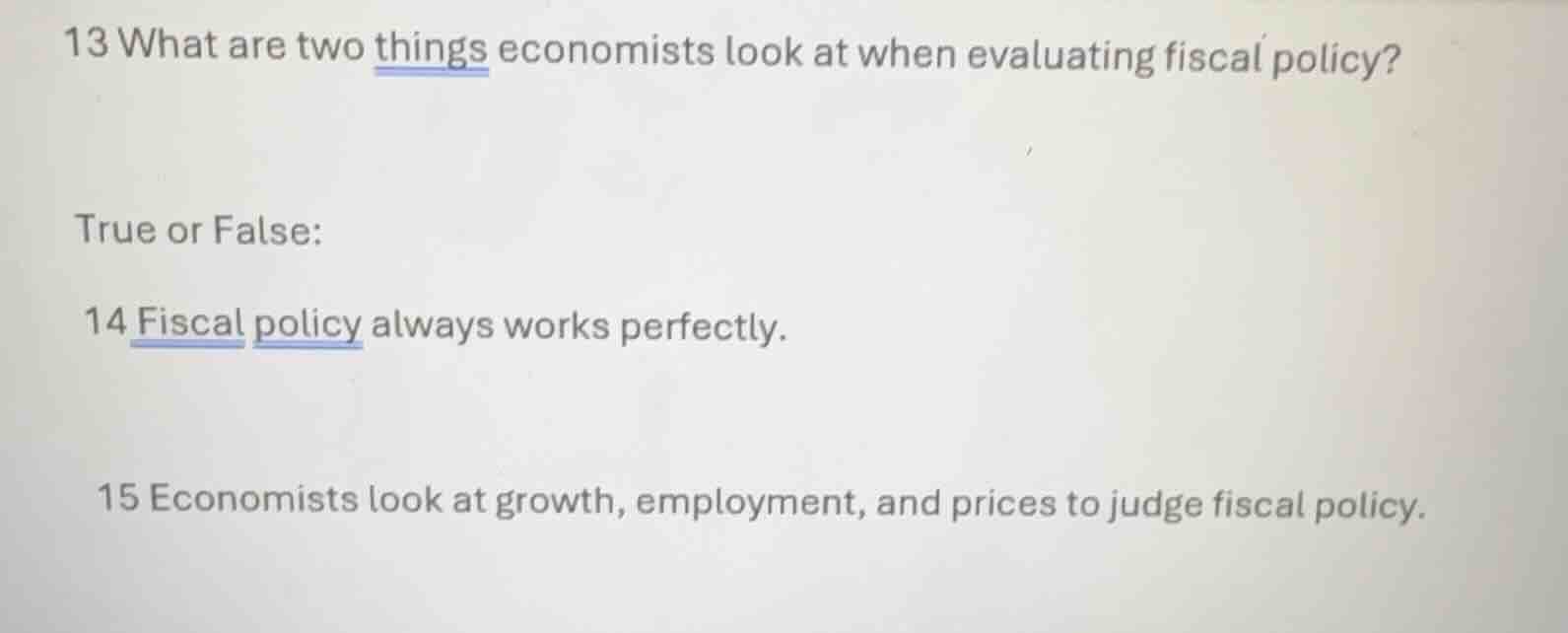
13 what are two things economists look at when evaluating fiscal policy?
true or false:
14 fiscal policy always works perfectly.
15 economists look at growth, employment, and prices to judge fiscal policy.
Question 13
Fiscal policy impacts economic growth (e.g., GDP changes), employment (unemployment rates), and price stability (inflation/deflation). Two key aspects economists assess are economic growth (how fiscal policy affects GDP, business activity) and employment (impact on job creation/loss). Another could be price levels (inflation control). For two things, common ones are economic growth and employment (or price stability).
Fiscal policy faces limitations: time lags (recognition, implementation, impact lags), crowding - out effect (government borrowing raises interest rates, reducing private investment), political constraints (delays in policy approval), and external shocks (global economic events). So it does not always work perfectly.
Fiscal policy aims to influence the economy. Economic growth (measured by GDP), employment (unemployment rate), and prices (inflation/deflation) are key macroeconomic indicators. Economists use these to judge if fiscal policy is achieving goals like stable growth, full employment, and price stability.

Snap & solve any problem in the app
Get step-by-step solutions on Sovi AI
Photo-based solutions with guided steps
Explore more problems and detailed explanations
Two things economists look at when evaluating fiscal policy include economic growth (e.g., impact on GDP, business expansion) and employment (e.g., effect on unemployment rates). (Other valid pairs: growth & price stability, employment & price stability, etc.)