QUESTION IMAGE
Question
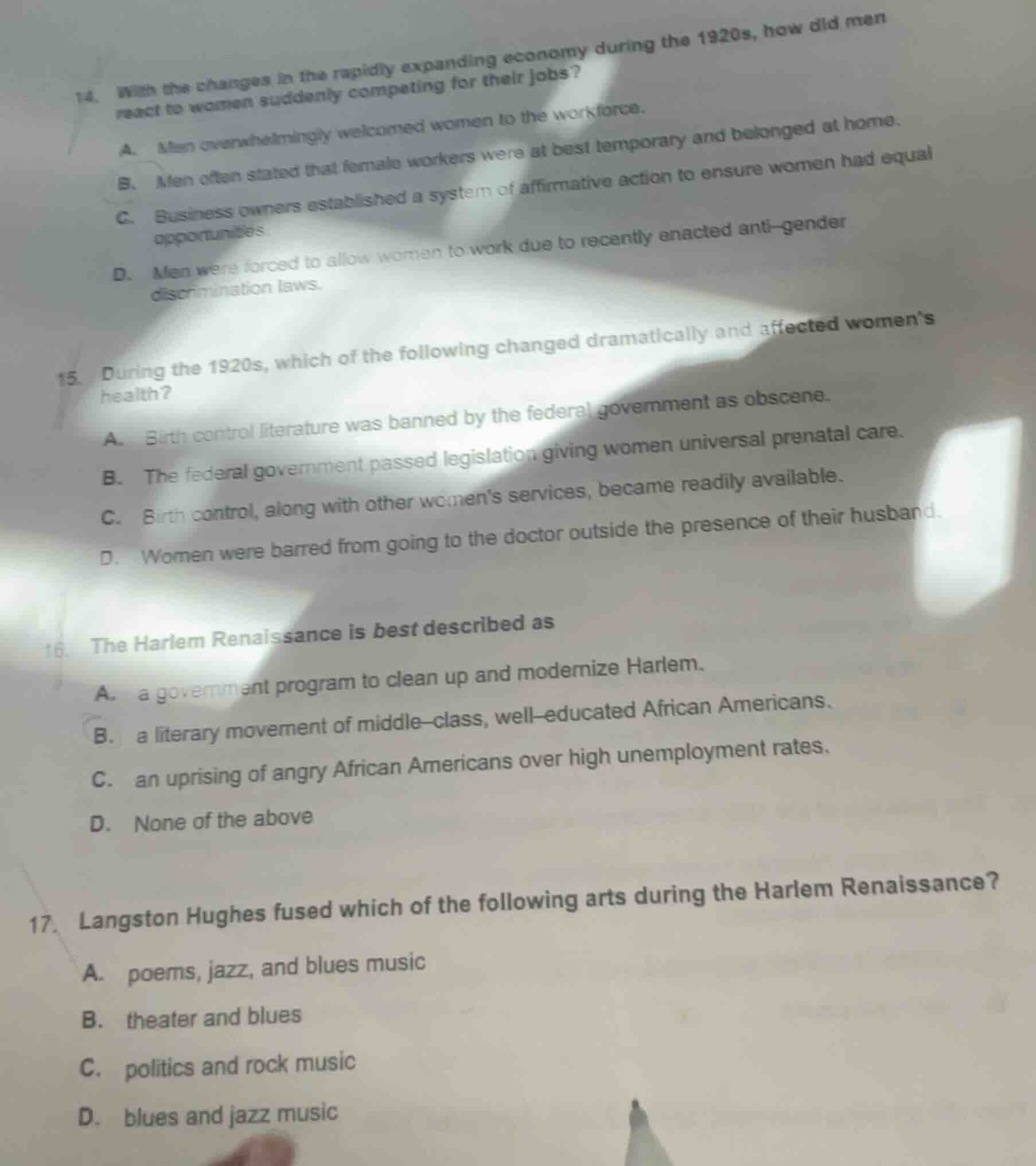
- with the changes in the rapidly expanding economy during the 1920s, how did men react to women suddenly competing for their jobs?
a. men overwhelmingly welcomed women to the workforce.
b. men often stated that female workers were at best temporary and belonged at home.
c. business owners established a system of affirmative action to ensure women had equal opportunities.
d. men were forced to allow women to work due to recently enacted anti - gender discrimination laws.
- during the 1920s, which of the following changed dramatically and affected womens health?
a. birth control literature was banned by the federal government as obscena.
b. the federal government passed legislation giving women universal prenatal care.
c. birth control, along with other womens services, became readily available.
d. women were barred from going to the doctor outside the presence of their husband.
- the harlem renaissance is best described as
a. a government program to clean up and modernize harlem.
b. a literary movement of middle - class, well - educated african americans.
c. an uprising of angry african americans over high unemployment rates.
d. none of the above
- langston hughes fused which of the following arts during the harlem renaissance?
a. poems, jazz, and blues music
b. theater and blues
c. politics and rock music
d. blues and jazz music
Question 14
To solve this, we analyze each option:
- Option A: In the 1920s, men generally did not overwhelmingly welcome women to the workforce as gender roles were traditional, so A is incorrect.
- Option B: Men often viewed female workers as temporary and believed women belonged at home, which aligns with the gender norms of the time.
- Option C: Affirmative action - style systems for women's equal opportunities were not established in the 1920s, so C is incorrect.
- Option D: There were no anti - gender discrimination laws forcing men to allow women to work in the 1920s, so D is incorrect.
We evaluate each option:
- Option A: Birth control literature was not banned as "obscene" in a way that relates to women's health change in the 1920s. In fact, the 1920s saw more access to birth control information.
- Option B: There was no federal legislation giving women universal prenatal care in the 1920s.
- Option C: In the 1920s, birth control and other women's services became more readily available, which had a dramatic impact on women's health (e.g., family planning).
- Option D: Women were not barred from seeing doctors without their husbands in the 1920s.
We analyze each option:
- Option A: The Harlem Renaissance was not a government program to clean up Harlem.
- Option B: The Harlem Renaissance was a literary and cultural movement of middle - class, well - educated African Americans, celebrating African - American culture.
- Option C: It was not an uprising over unemployment; it was a cultural movement.
- Option D: Since B is correct, D is incorrect.

Snap & solve any problem in the app
Get step-by-step solutions on Sovi AI
Photo-based solutions with guided steps
Explore more problems and detailed explanations
B. Men often stated that female workers were at best temporary and belonged at home.