QUESTION IMAGE
Question
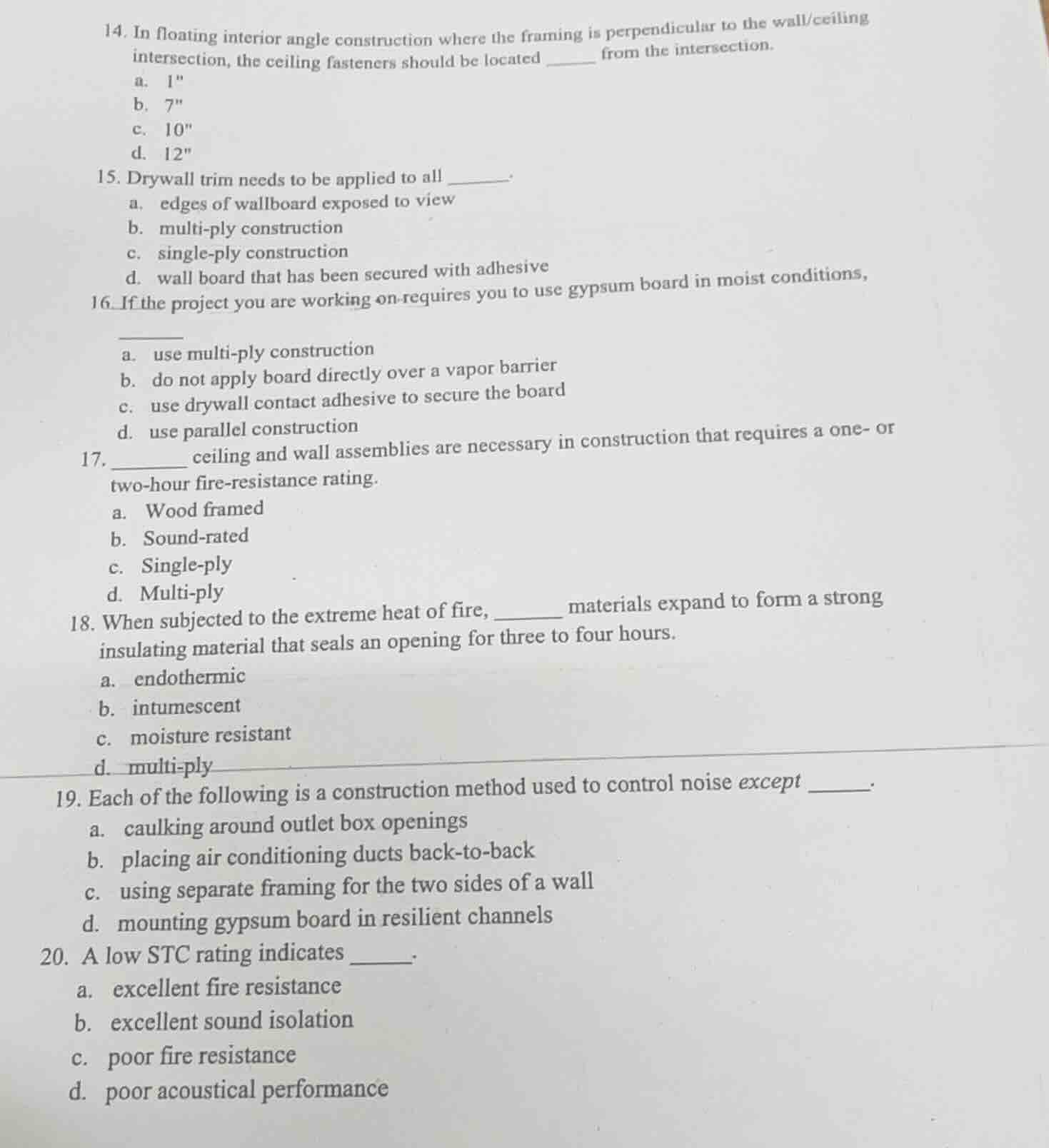
- in floating interior angle construction where the framing is perpendicular to the wall/ceiling intersection, the ceiling fasteners should be located ______ from the intersection.
a. 1\
b. 7\
c. 10\
d. 12\
- drywall trim needs to be applied to all ______.
a. edges of wallboard exposed to view
b. multi-ply construction
c. single-ply construction
d. wall board that has been secured with adhesive
- if the project you are working on requires you to use gypsum board in moist conditions,
______
a. use multi-ply construction
b. do not apply board directly over a vapor barrier
c. use drywall contact adhesive to secure the board
d. use parallel construction
- ______ ceiling and wall assemblies are necessary in construction that requires a one- or two-hour fire-resistance rating.
a. wood framed
b. sound-rated
c. single-ply
d. multi-ply
- when subjected to the extreme heat of fire, ______ materials expand to form a strong insulating material that seals an opening for three to four hours.
a. endothermic
b. intumescent
c. moisture resistant
d. multi-ply
- each of the following is a construction method used to control noise except ______.
a. caulking around outlet box openings
b. placing air conditioning ducts back-to-back
c. using separate framing for the two sides of a wall
d. mounting gypsum board in resilient channels
- a low stc rating indicates ______.
a. excellent fire resistance
b. excellent sound isolation
c. poor fire resistance
d. poor acoustical performance
- Standard construction guidelines specify that for floating interior angle framing perpendicular to the wall/ceiling, ceiling fasteners are placed 7 inches from the intersection to maintain the floating design.
- Drywall trim is used to finish and protect any visible edges of wallboard for a clean, professional appearance.
- In moist conditions, multi-ply gypsum board construction provides better moisture resistance and structural stability compared to single-ply.
- Multi-ply ceiling and wall assemblies add layers that slow the spread of fire, meeting 1-2 hour fire-resistance ratings.
- Intumescent materials are designed to expand when exposed to high heat, creating an insulating seal that blocks openings for extended periods.
- Placing HVAC ducts back-to-back can actually transfer noise between spaces, while the other methods are standard noise control techniques.
- STC (Sound Transmission Class) rates sound isolation; lower values mean less sound is blocked, indicating poor acoustical performance.

Snap & solve any problem in the app
Get step-by-step solutions on Sovi AI
Photo-based solutions with guided steps
Explore more problems and detailed explanations
- b. 7"
- a. edges of wallboard exposed to view
- a. use multi-ply construction
- d. Multi-ply
- b. intumescent
- b. placing air conditioning ducts back-to-back
- d. poor acoustical performance