QUESTION IMAGE
Question
14 frame of reference why is momentum defined for a particular frame of reference? explain.
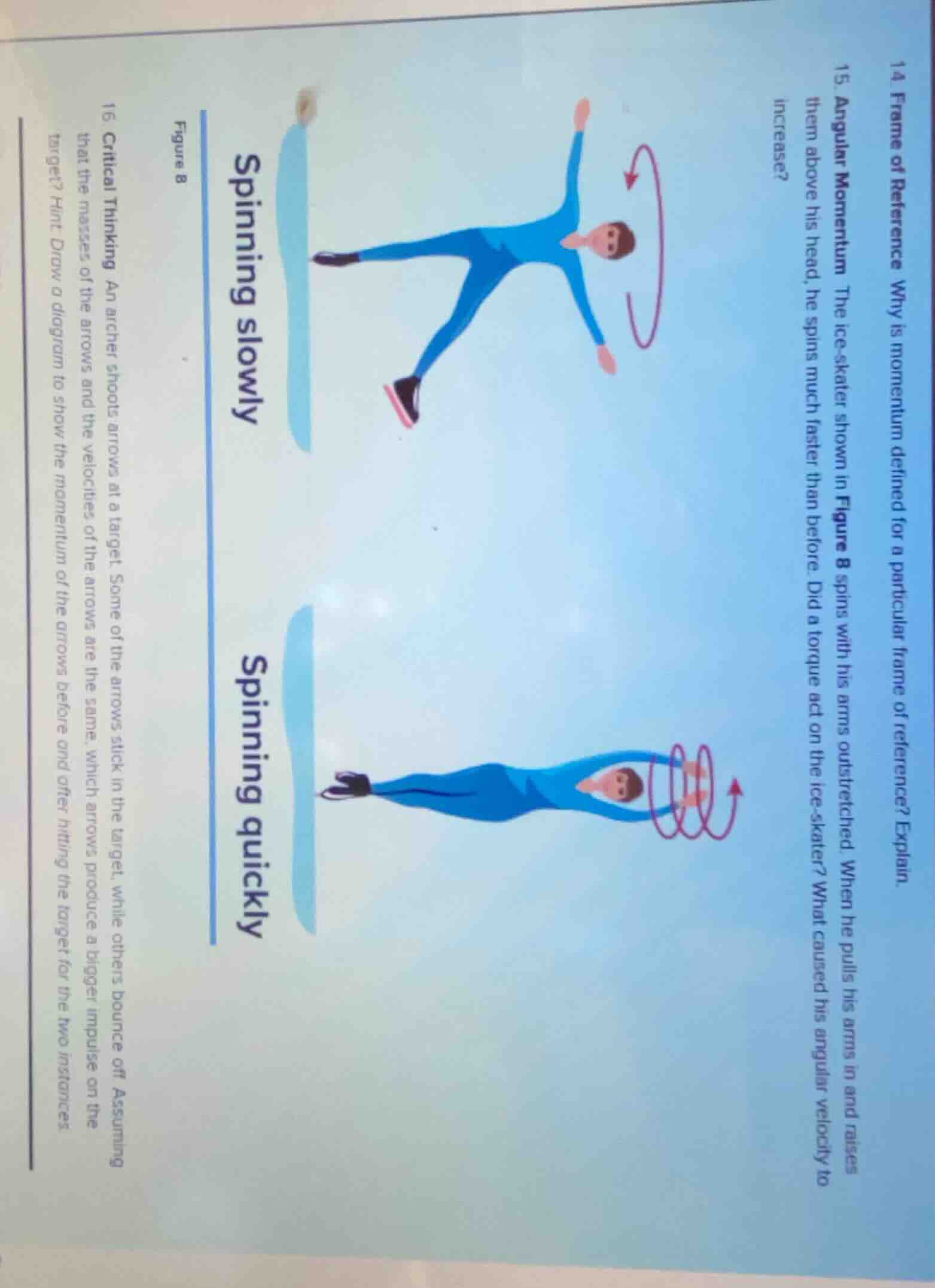
- angular momentum the ice - skater shown in figure 8 spins with his arms outstretched. when he pulls his arms in and raises them above his head, he spins much faster than before. did a torque act on the ice - skater? what caused his angular velocity to increase?
figure 8
spinning slowly
spinning quickly
16 critical thinking an archer shoots arrows at a target. some of the arrows stick in the target, while others bounce off. assuming that the masses of the arrows and the velocities of the arrows are the same, which arrows produce a bigger impulse on the target? hint: draw a diagram to show the momentum of the arrows before and after hitting the target for the two instances.
For Question 14:
Momentum depends on velocity, and velocity is measured relative to a chosen frame of reference. An object's velocity can differ across frames (e.g., a moving object has 0 velocity in its own rest frame but non-zero in a stationary frame). Since momentum $p=mv$, it must be defined relative to a specific frame to have a consistent, measurable value.
For Question 15:
No external torque acts on the ice-skater (ice provides negligible friction, and internal forces from pulling arms exert no net torque). This follows the conservation of angular momentum: $L = I\omega$, where $L$ is angular momentum, $I$ is moment of inertia, and $\omega$ is angular velocity. When the skater pulls in his arms, he reduces his moment of inertia ($I$ decreases, as mass moves closer to the axis of rotation). Since $L$ is conserved, $\omega$ must increase to keep $L$ constant, causing faster spinning.
For Question 16:
Impulse equals the change in momentum ($J = \Delta p = m\Delta v$). For arrows that bounce off, the velocity change is $\Delta v = v_f - v_i = (-v) - v = -2v$ (direction reverses). For arrows that stick, the velocity change is $\Delta v = 0 - v = -v$. Since mass $m$ is the same, the bouncing arrows have a larger magnitude of momentum change, so they produce a bigger impulse on the target.
(Diagram note: For bouncing arrows, draw incoming momentum vector $\vec{p}_{in} = m\vec{v}$ and outgoing vector $\vec{p}_{out} = -m\vec{v}$, with a large arrow for $\Delta \vec{p}$. For sticking arrows, draw $\vec{p}_{in} = m\vec{v}$ and final momentum $\vec{p}_{final}=0$, with a smaller arrow for $\Delta \vec{p}$.)

Snap & solve any problem in the app
Get step-by-step solutions on Sovi AI
Photo-based solutions with guided steps
Explore more problems and detailed explanations
- Momentum relies on velocity, which is frame-dependent. To have a definite, measurable momentum value, it must be defined relative to a specific frame of reference, as velocity (and thus momentum) changes when the observation frame changes.
- No external torque acts on the ice-skater. The increase in angular velocity is caused by the conservation of angular momentum: pulling his arms in reduces his moment of inertia, so his angular velocity increases to keep total angular momentum constant.
- The arrows that bounce off the target produce a bigger impulse. Bouncing arrows have a larger change in velocity (reversing direction, $\Delta v = -2v$) compared to sticking arrows ($\Delta v = -v$). Since impulse equals mass times change in velocity, bouncing arrows create a larger impulse.