QUESTION IMAGE
Question
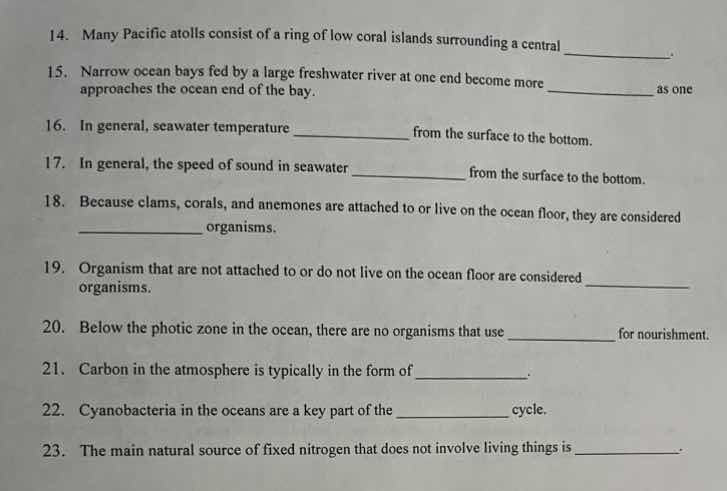
- many pacific atolls consist of a ring of low coral islands surrounding a central ________.
- narrow ocean bays fed by a large freshwater river at one end become more ________ as one approaches the ocean end of the bay.
- in general, seawater temperature ________ from the surface to the bottom.
- in general, the speed of sound in seawater ________ from the surface to the bottom.
- because clams, corals, and anemones are attached to or live on the ocean floor, they are considered ________ organisms.
- organism that are not attached to or do not live on the ocean floor are considered ________ organisms.
- below the photic zone in the ocean, there are no organisms that use ________ for nourishment.
- carbon in the atmosphere is typically in the form of ________.
- cyanobacteria in the oceans are a key part of the ________ cycle.
- the main natural source of fixed nitrogen that does not involve living things is ________.
Question 14
Pacific atolls typically have a ring of coral islands around a central lagoon. This is a key feature of atoll geography in oceanic environments.
A narrow bay fed by a freshwater river will have less salt (more brackish, but as we approach the ocean end, the salinity increases? Wait, no—wait, the bay is fed by a freshwater river at one end, so at the river end, it's fresh or brackish, and as we move toward the ocean end, the water becomes more saline (salty) because of the ocean's influence. Wait, but the question is "become more ______ as one approaches the ocean end of the bay". So the water at the ocean end is more saline (salty) than at the river end. So the answer is "saline" or "salty". But maybe "saline" is the term. Alternatively, maybe "turbid"? No, salinity is the key here. Wait, the bay is narrow, fed by a freshwater river (so low salinity at river end), and as we go toward the ocean, the ocean water mixes in, so salinity increases. So the blank is "saline" (or "salty").
In general, seawater temperature decreases from the surface to the bottom (the thermocline is where the temperature drops rapidly, but overall, from surface to deep, temperature decreases because the surface is heated by the sun, and deeper waters are colder).

Snap & solve any problem in the app
Get step-by-step solutions on Sovi AI
Photo-based solutions with guided steps
Explore more problems and detailed explanations
lagoon