QUESTION IMAGE
Question
- match the correct answers.
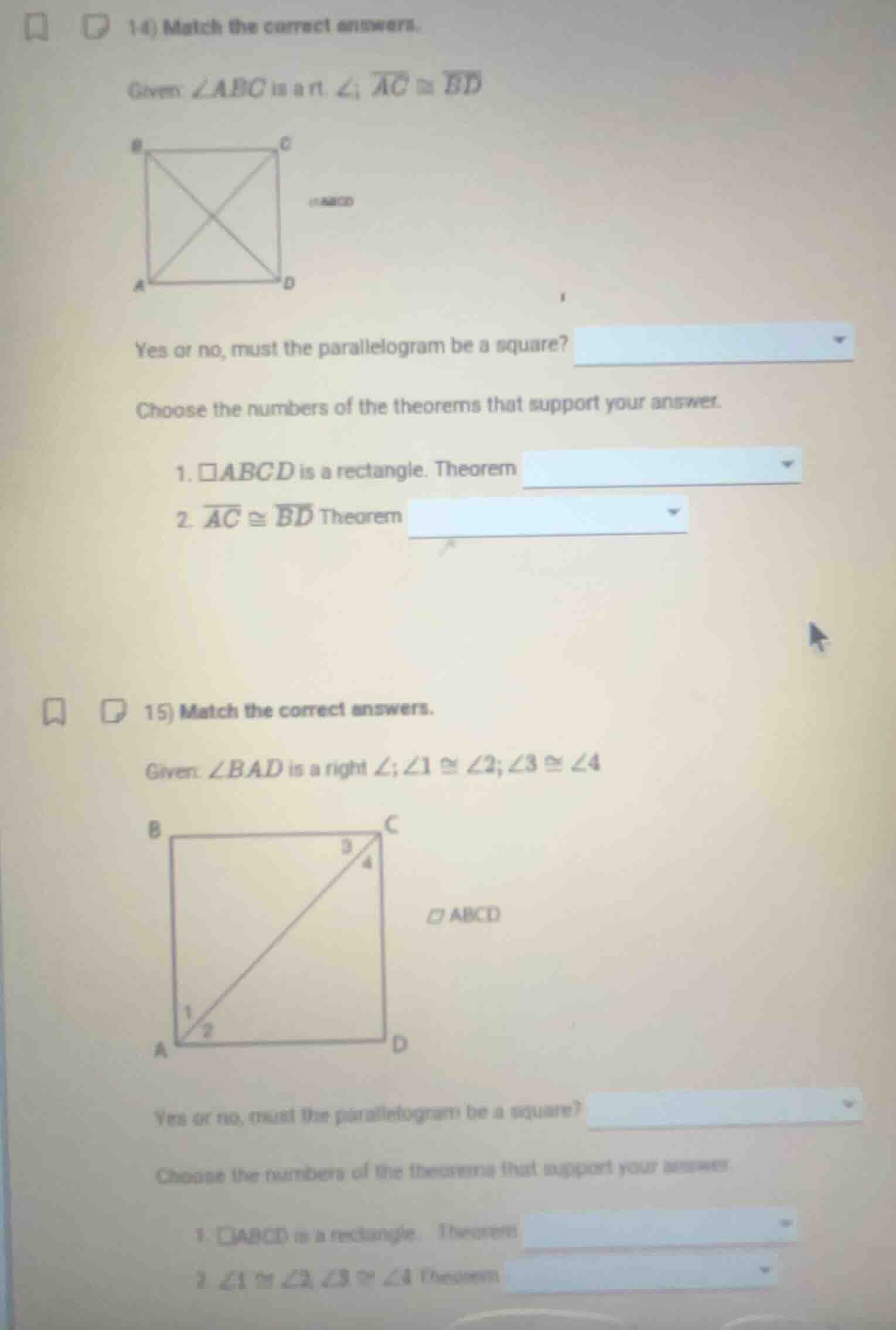
given: ∠abc is a rt. ∠; \\(overline{ac} \cong overline{bd}\\)
(figure of parallelogram abcd)
yes or no, must the parallelogram be a square?
choose the numbers of the theorems that support your answer.
- \\(\square abcd\\) is a rectangle. theorem
- \\(overline{ac} \cong overline{bd}\\) theorem
- match the correct answers.
given: ∠bad is a right ∠; ∠1 ≅ ∠2; ∠3 ≅ ∠4
(figure of parallelogram abcd with angle markings)
yes or no, must the parallelogram be a square?
choose the numbers of the theorems that support your answer.
- \\(\square abcd\\) is a rectangle. theorem
- ∠1 ≅ ∠2, ∠3 ≅ ∠4 theorem
Question 14
Step 1: Analyze the given parallelogram
We know that \( \angle ABC \) is a right angle, so by the theorem that a parallelogram with one right angle is a rectangle, \( ABCD \) is a rectangle. Also, \( \overline{AC} \cong \overline{BD} \), but in a rectangle, the diagonals are always congruent. For a rectangle to be a square, it needs to have all sides equal (or diagonals bisecting at 90 degrees, but here we only know it's a rectangle with congruent diagonals which is always true for rectangles). So having a right angle and congruent diagonals (which is true for all rectangles) doesn't force it to be a square. So the answer to "must the parallelogram be a square?" is No.
Step 2: Theorems support
- For \( \square ABCD \) is a rectangle: The theorem is "A parallelogram with one right angle is a rectangle."
- For \( \overline{AC} \cong \overline{BD} \): The theorem is "The diagonals of a rectangle are congruent." But since we already know it's a rectangle, this is a property of rectangles, not a reason to be a square.
Step 1: Analyze the given parallelogram
We know that \( \angle BAD \) is a right angle, so \( ABCD \) is a rectangle (by the theorem that a parallelogram with one right angle is a rectangle). Also, \( \angle 1 \cong \angle 2 \) and \( \angle 3 \cong \angle 4 \). In triangle \( ABC \) and \( ADC \), since \( \angle 1 \cong \angle 2 \) and \( \angle 3 \cong \angle 4 \), and \( AC \) is common, the triangles are congruent. Also, in a rectangle, if the angles formed by the diagonal are equal, then the sides are equal. Since \( \angle 1=\angle 2 \), triangle \( ABD \) is isosceles, so \( AB = AD \). In a rectangle, if adjacent sides are equal, then it's a square. So the parallelogram must be a square.
Step 2: Theorems support
- For \( \square ABCD \) is a rectangle: The theorem is "A parallelogram with one right angle is a rectangle."
- For \( \angle 1 \cong \angle 2, \angle 3 \cong \angle 4 \): The theorem is "If in a rectangle, the angles formed by a diagonal with the sides are equal, then the adjacent sides are equal, and thus the rectangle is a square" (or more precisely, in a right - angled triangle (since \( \angle BAD \) is right) with \( \angle 1=\angle 2 \), the triangle is isosceles, so \( AB = AD \), and in a rectangle with \( AB = AD \), it's a square).

Snap & solve any problem in the app
Get step-by-step solutions on Sovi AI
Photo-based solutions with guided steps
Explore more problems and detailed explanations
- Must the parallelogram be a square? No
- 1. Theorem: A parallelogram with one right angle is a rectangle.
- 2. Theorem: The diagonals of a rectangle are congruent.