QUESTION IMAGE
Question
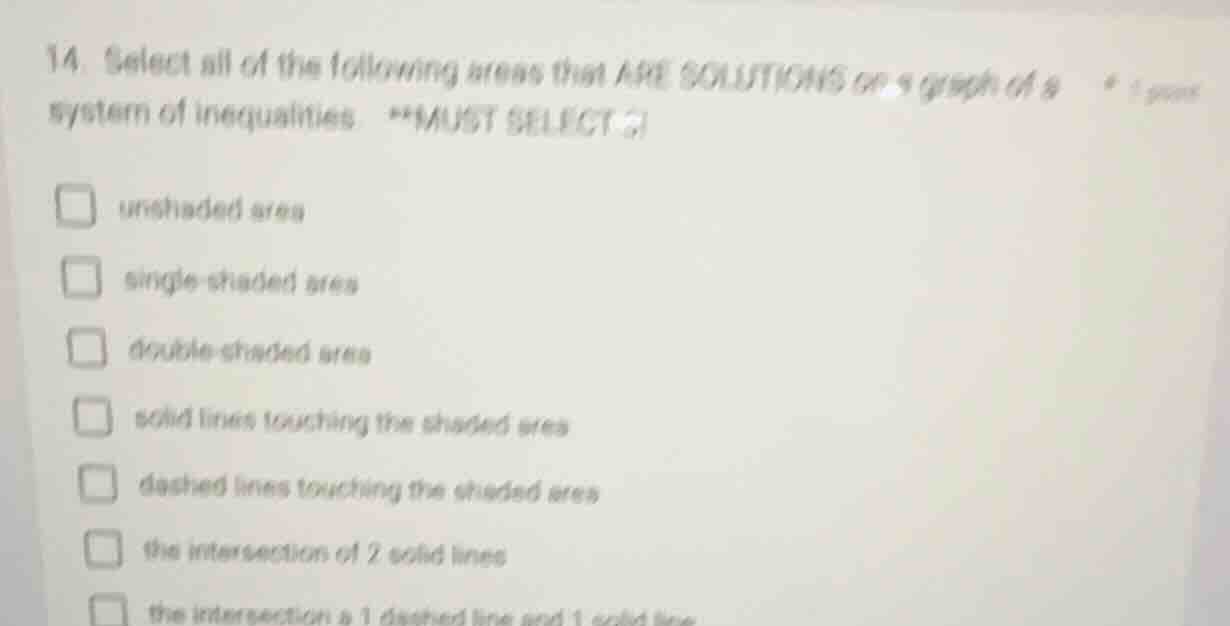
- select all of the following areas that are solutions on a graph of a system of inequalities. must select 3
- unshaded area
- single - shaded area
- double - shaded area
- solid lines touching the shaded area
- dashed lines touching the shaded area
- the intersection of 2 solid lines
- the intersection of 1 dashed line and 1 solid line
Brief Explanations
- Unshaded area: Not a solution as solutions for a system of inequalities are typically in shaded regions (unshaded is where the inequality does not hold).
- Single - shaded area: Represents the solution to one inequality, but for a system (multiple inequalities), the solution is the overlap (double - shaded) or regions that satisfy all. However, if we consider each inequality's solution, but the question is about the system. Wait, no—actually, when graphing a system, the solution is the region that satisfies all inequalities. But let's recall:
- Double - shaded area: This is the region that is shaded for all inequalities in the system, so it's a solution.
- Solid lines touching the shaded area: Solid lines mean the inequality is inclusive (≥ or ≤), so points on the solid line that are in the shaded region (or on the line if the inequality includes equality) are solutions.
- Dashed lines touching the shaded area: Dashed lines mean the inequality is strict (> or <), so points on the dashed line are not solutions (since the inequality doesn't include equality).
- The intersection of 2 solid lines: If the lines are solid, the intersection point is on both lines. If the shaded region includes that point (since the inequalities are inclusive), then it's a solution.
- The intersection of 1 dashed line and 1 solid line: The dashed line's points are not included (strict inequality), so the intersection point (on the dashed line) is not a solution.
- Wait, maybe I made a mistake earlier. Let's re - explain:
- For a system of inequalities, the solution set is the set of points that satisfy all inequalities.
- Double - shaded area: Shaded by all inequalities, so satisfies all—solution.
- Solid lines touching the shaded area: Since the line is solid, the inequality is ≥ or ≤, so points on the line that are part of the shaded region (or on the line) satisfy the inequality (because the inequality includes equality). So these are solutions.
- The intersection of 2 solid lines: The intersection point is on both solid lines. Since the lines are solid, the inequalities for those lines are inclusive (≥ or ≤), so the intersection point satisfies both inequalities (because it's on both lines, and the lines are part of the solution for their respective inequalities). So it's a solution.
- Single - shaded area: If we have a system with two inequalities, the single - shaded area might satisfy one but not the other. But maybe the question is considering that each inequality's solution is a shaded area, and the system's solution is the overlap. But the options given: let's check the correct ones.
- Wait, the problem says "MUST SELECT 3". Let's re - evaluate:
- Double - shaded area: Yes, because it's shaded by all inequalities in the system, so satisfies all—solution.
- Solid lines touching the shaded area: The solid line means the inequality is inclusive (e.g., y ≤ 2x + 1), so points on the solid line that are in the shaded region (or on the line) are solutions (since the inequality includes equality).
- The intersection of 2 solid lines: The intersection point is on both solid lines. Since the lines are solid, the inequalities for those lines are of the form ≥ or ≤, so the intersection point satisfies both inequalities (as it's on both lines, and the lines are part of the solution set for their respective inequalities).
- Now, let's check the other options:
- Unshaded area: Not a solution (doesn't satis…

Snap & solve any problem in the app
Get step-by-step solutions on Sovi AI
Photo-based solutions with guided steps
Explore more problems and detailed explanations
- Double - shaded area
- Solid lines touching the shaded area
- The intersection of 2 solid lines