QUESTION IMAGE
Question
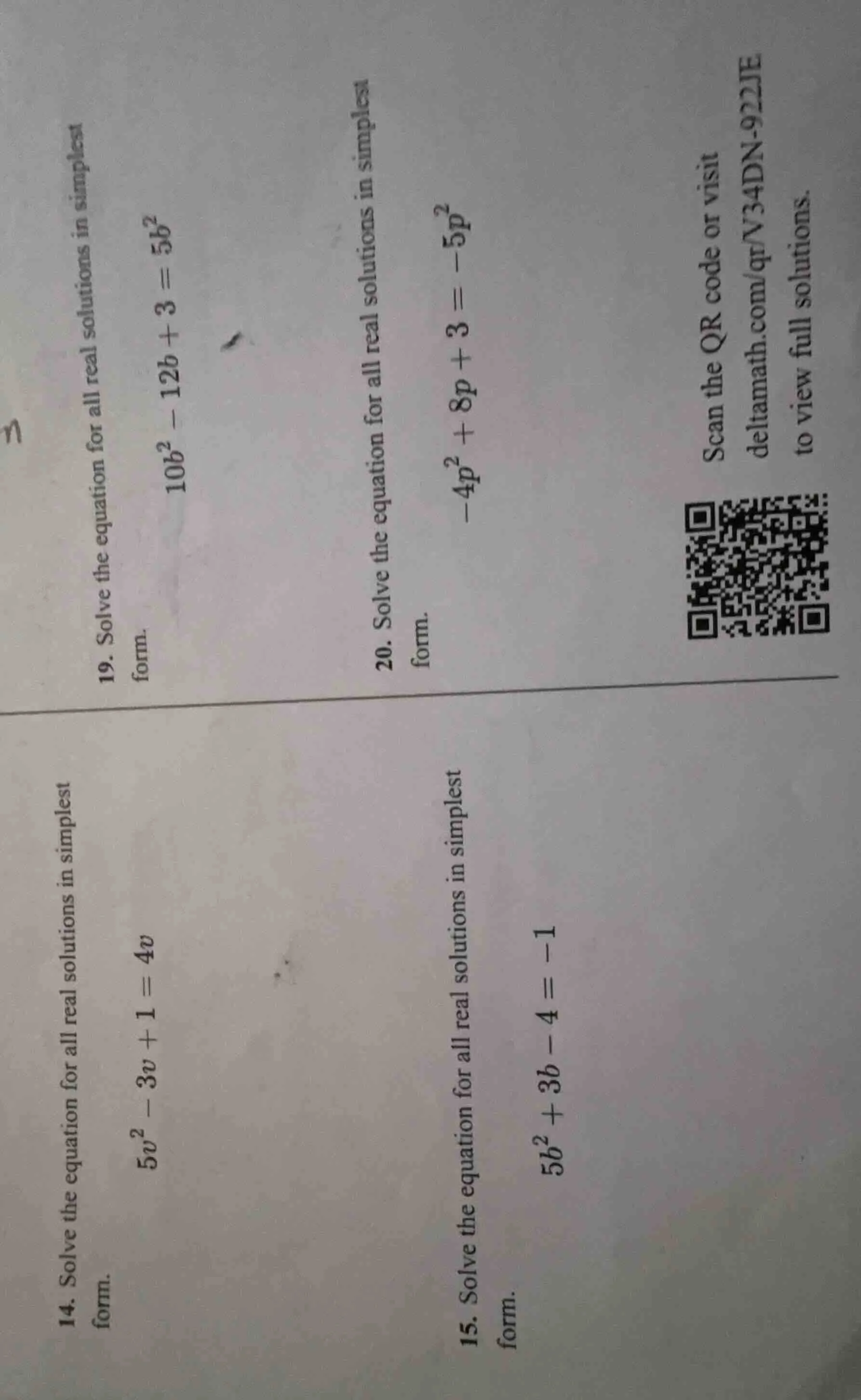
- solve the equation for all real solutions in simplest form.
$5v^2 - 3v + 1 = 4v$
- solve the equation for all real solutions in simplest form.
$5b^2 + 3b - 4 = -1$
- solve the equation for all real solutions in simplest form.
$10b^2 - 12b + 3 = 5b^2$
- solve the equation for all real solutions in simplest form.
$-4p^2 + 8p + 3 = -5p^2$
scan the qr code or visit
deltamath.com/qr/v34dn-9222je
to view full solutions.
Let's solve question 14: \( 5v^2 - 3v + 1 = 4v \)
Step 1: Rearrange the equation to standard quadratic form \( ax^2 + bx + c = 0 \)
Subtract \( 4v \) from both sides:
\( 5v^2 - 3v - 4v + 1 = 0 \)
Simplify the like terms:
\( 5v^2 - 7v + 1 = 0 \)
Step 2: Use the quadratic formula \( v = \frac{-b \pm \sqrt{b^2 - 4ac}}{2a} \)
Here, \( a = 5 \), \( b = -7 \), \( c = 1 \)
First, calculate the discriminant \( D = b^2 - 4ac \)
\( D = (-7)^2 - 4(5)(1) = 49 - 20 = 29 \)
Step 3: Substitute into the quadratic formula
\( v = \frac{-(-7) \pm \sqrt{29}}{2(5)} = \frac{7 \pm \sqrt{29}}{10} \)
Step 1: Rearrange the equation to standard quadratic form \( ax^2 + bx + c = 0 \)
Add \( 1 \) to both sides:
\( 5b^2 + 3b - 4 + 1 = 0 \)
Simplify the like terms:
\( 5b^2 + 3b - 3 = 0 \)
Step 2: Use the quadratic formula \( b = \frac{-b \pm \sqrt{b^2 - 4ac}}{2a} \)
Here, \( a = 5 \), \( b = 3 \), \( c = -3 \)
First, calculate the discriminant \( D = b^2 - 4ac \)
\( D = (3)^2 - 4(5)(-3) = 9 + 60 = 69 \)
Step 3: Substitute into the quadratic formula
\( b = \frac{-3 \pm \sqrt{69}}{2(5)} = \frac{-3 \pm \sqrt{69}}{10} \)
Step 1: Rearrange the equation to standard quadratic form \( ax^2 + bx + c = 0 \)
Subtract \( 5b^2 \) from both sides:
\( 10b^2 - 5b^2 - 12b + 3 = 0 \)
Simplify the like terms:
\( 5b^2 - 12b + 3 = 0 \)
Step 2: Use the quadratic formula \( b = \frac{-b \pm \sqrt{b^2 - 4ac}}{2a} \)
Here, \( a = 5 \), \( b = -12 \), \( c = 3 \)
First, calculate the discriminant \( D = b^2 - 4ac \)
\( D = (-12)^2 - 4(5)(3) = 144 - 60 = 84 \)
Simplify \( \sqrt{84} = 2\sqrt{21} \)
Step 3: Substitute into the quadratic formula
\( b = \frac{-(-12) \pm 2\sqrt{21}}{2(5)} = \frac{12 \pm 2\sqrt{21}}{10} = \frac{6 \pm \sqrt{21}}{5} \) (divided numerator and denominator by 2)

Snap & solve any problem in the app
Get step-by-step solutions on Sovi AI
Photo-based solutions with guided steps
Explore more problems and detailed explanations
The solutions are \( v = \frac{7 + \sqrt{29}}{10} \) and \( v = \frac{7 - \sqrt{29}}{10} \)
Let's solve question 15: \( 5b^2 + 3b - 4 = -1 \)