QUESTION IMAGE
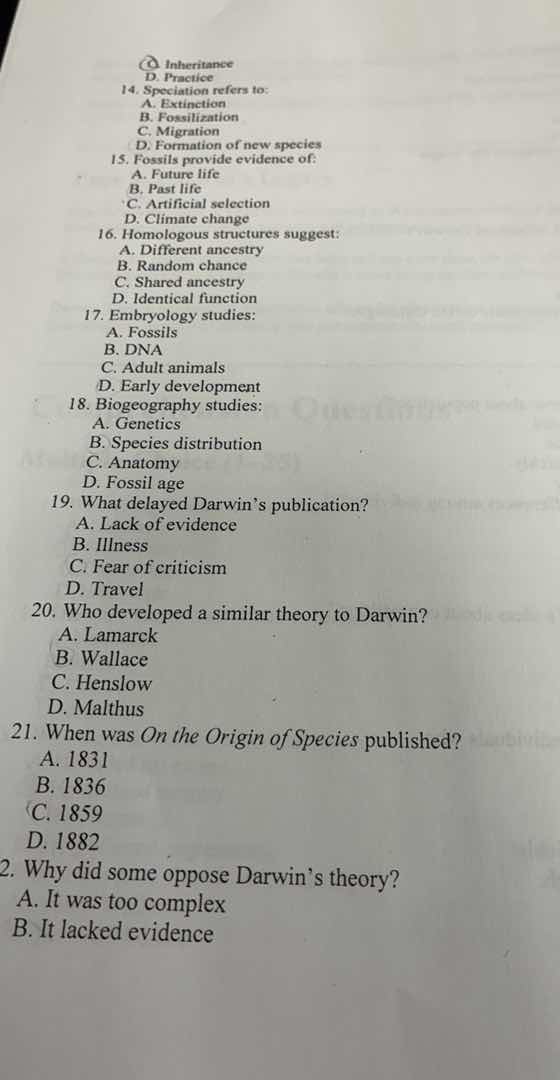
Question
- speciation refers to:
a. extinction
b. fossilization
c. migration
d. formation of new species
- fossils provide evidence of:
a. future life
b. past life
c. artificial selection
d. climate change
- homologous structures suggest:
a. different ancestry
b. random chance
c. shared ancestry
d. identical function
- embryology studies:
a. fossils
b. dna
c. adult animals
d. early development
- biogeography studies:
a. genetics
b. species distribution
c. anatomy
d. fossil age
- what delayed darwin’s publication?
a. lack of evidence
b. illness
c. fear of criticism
d. travel
- who developed a similar theory to darwin?
a. lamarck
b. wallace
c. henslow
d. malthus
- when was on the origin of species published?
a. 1831
b. 1836
c. 1859
d. 1882
- why did some oppose darwin’s theory?
a. it was too complex
b. it lacked evidence
Question 14
Speciation is defined as the process by which new biological species arise. Extinction is the end of a species, fossilization is the process of preserving organisms as fossils, and migration is movement of organisms. So speciation is formation of new species.
Fossils are the preserved remains or traces of organisms from the past. They do not show future life, artificial selection is human - driven selection, and fossils are not direct evidence of climate change (though they can sometimes be related indirectly). So fossils provide evidence of past life.
Homologous structures are structures in different species that are similar because of common ancestry. They do not suggest different ancestry (they suggest the opposite), random chance is not related, and they may have different functions (e.g., human arm and bat wing). So homologous structures suggest shared ancestry.

Snap & solve any problem in the app
Get step-by-step solutions on Sovi AI
Photo-based solutions with guided steps
Explore more problems and detailed explanations
D. Formation of new species