QUESTION IMAGE
Question
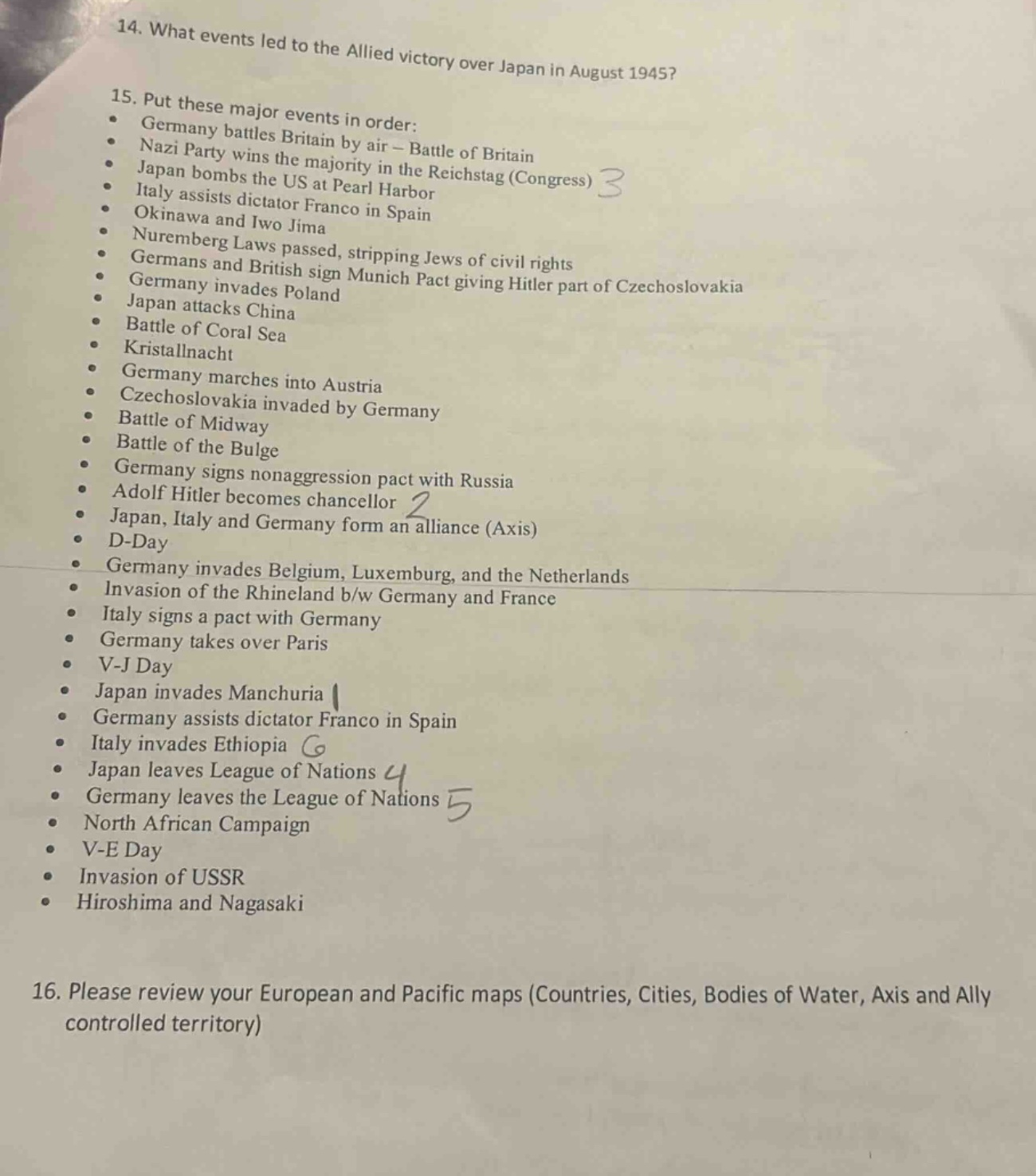
- what events led to the allied victory over japan in august 1945?15. put these major events in order:• germany battles britain by air – battle of britain• nazi party wins the majority in the reichstag (congress)• japan bombs the us at pearl harbor• italy assists dictator franco in spain• okinawa and iwo jima• nuremberg laws passed, stripping jews of civil rights• germans and british sign munich pact giving hitler part of czechoslovakia• germany invades poland• japan attacks china• battle of coral sea• kristallnacht• germany marches into austria• czechoslovakia invaded by germany• battle of midway• battle of the bulge• germany signs nonaggression pact with russia• adolf hitler becomes chancellor• japan, italy and germany form an alliance (axis)• d-day• germany invades belgium, luxemburg, and the netherlands• invasion of the rhineland b/w germany and france• italy signs a pact with germany• germany takes over paris• v-j day• japan invades manchuria• germany assists dictator franco in spain• italy invades ethiopia• japan leaves league of nations• germany leaves the league of nations• north african campaign• v-e day• invasion of ussr• hiroshima and nagasaki16. please review your european and pacific maps (countries, cities, bodies of water, axis and ally controlled territory)
Brief Explanations
For Question 14:
The Allied victory over Japan in August 1945 stemmed from three key interconnected events:
- The U.S. dropped atomic bombs on Hiroshima (August 6, 1945) and Nagasaki (August 9, 1945), inflicting catastrophic damage and demonstrating overwhelming destructive power.
- On August 8, 1945, the Soviet Union declared war on Japan and invaded Japanese-occupied Manchuria, quickly defeating Japan's Kwantung Army, removing a critical strategic buffer and military force for Japan.
- Years of sustained Allied naval blockades, island-hopping campaigns (like Okinawa and Iwo Jima), and aerial bombing of Japanese mainland industrial and civilian targets had already exhausted Japan's military and economic capacity to continue fighting.
For Question 15 (Chronological Order of Events):
Events are ordered by their historical occurrence date:
- Japan invades Manchuria
- Adolf Hitler becomes chancellor
- Nazi Party wins the majority in the Reichstag (Congress)
- Japan leaves League of Nations
- Germany leaves the League of Nations
- Invasion of the Rhineland b/w Germany and France
- Italy invades Ethiopia
- Germany marches into Austria
- Germany assists dictator Franco in Spain
- Italy assists dictator Franco in Spain
- Germans and British sign Munich Pact giving Hitler part of Czechoslovakia
- Nuremberg Laws passed, stripping Jews of civil rights
- Kristallnacht
- Czechoslovakia invaded by Germany
- Germany signs nonaggression pact with Russia
- Germany invades Poland
- Germany invades Belgium, Luxemburg, and the Netherlands
- Germany takes over Paris
- Germany battles Britain by air – Battle of Britain
- Italy signs a pact with Germany
- Japan attacks China
- Japan, Italy and Germany form an alliance (Axis)
- Japan bombs the US at Pearl Harbor
- Battle of Coral Sea
- Battle of Midway
- North African Campaign
- Invasion of USSR
- D-Day
- Battle of the Bulge
- Okinawa and Iwo Jima
- V-E Day
- Hiroshima and Nagasaki
- V-J Day
For Question 16:
This task requires reviewing labeled maps of Europe and the Pacific that mark:
- Key countries, major cities, and bodies of water in both theaters
- Territories controlled by Axis powers (Germany, Italy, Japan) and Allied powers (U.S., UK, USSR, China, etc.) at critical stages of World War II, to visualize military positioning and campaign progress.

Snap & solve any problem in the app
Get step-by-step solutions on Sovi AI
Photo-based solutions with guided steps
Explore more problems and detailed explanations
Question 14:
The key events leading to Allied victory over Japan in August 1945 were:
- The U.S. atomic bombings of Hiroshima (August 6, 1945) and Nagasaki (August 9, 1945)
- The Soviet Union's declaration of war on Japan and invasion of Manchuria (August 8, 1945)
- Years of crippling Allied military campaigns (island-hopping, naval blockades, strategic bombing) that exhausted Japan's ability to fight.
Question 15 (Ordered Events):
- Japan invades Manchuria
- Adolf Hitler becomes chancellor
- Nazi Party wins the majority in the Reichstag (Congress)
- Japan leaves League of Nations
- Germany leaves the League of Nations
- Invasion of the Rhineland b/w Germany and France
- Italy invades Ethiopia
- Germany marches into Austria
- Germany assists dictator Franco in Spain
- Italy assists dictator Franco in Spain
- Germans and British sign Munich Pact giving Hitler part of Czechoslovakia
- Nuremberg Laws passed, stripping Jews of civil rights
- Kristallnacht
- Czechoslovakia invaded by Germany
- Germany signs nonaggression pact with Russia
- Germany invades Poland
- Germany invades Belgium, Luxemburg, and the Netherlands
- Germany takes over Paris
- Germany battles Britain by air – Battle of Britain
- Italy signs a pact with Germany
- Japan attacks China
- Japan, Italy and Germany form an alliance (Axis)
- Japan bombs the US at Pearl Harbor
- Battle of Coral Sea
- Battle of Midway
- North African Campaign
- Invasion of USSR
- D-Day
- Battle of the Bulge
- Okinawa and Iwo Jima
- V-E Day
- Hiroshima and Nagasaki
- V-J Day
Question 16:
Complete this task by examining annotated World War II maps of Europe and the Pacific, identifying key geographic features and the control of territories by Axis and Allied forces during the war.