QUESTION IMAGE
Question
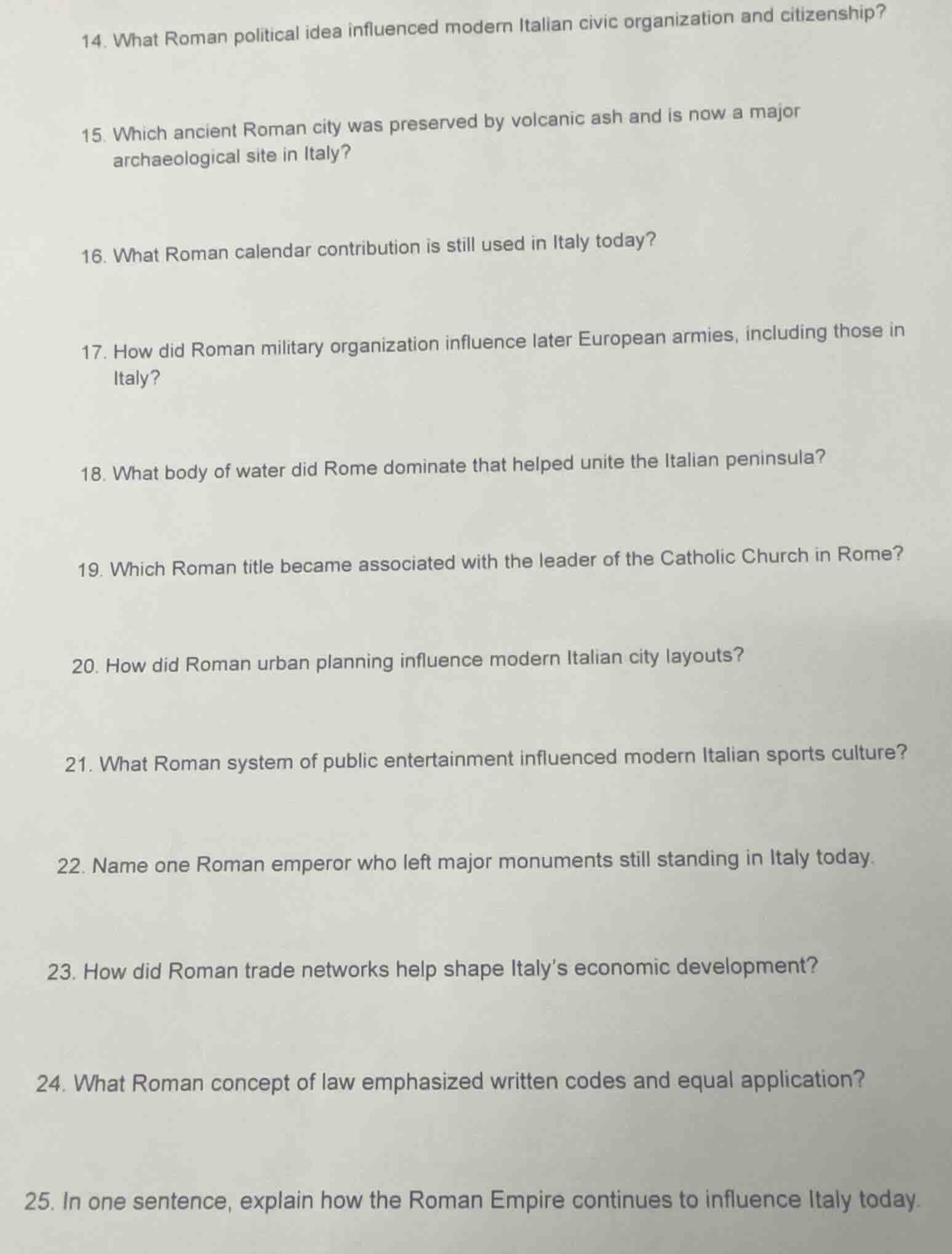
- what roman political idea influenced modern italian civic organization and citizenship?15. which ancient roman city was preserved by volcanic ash and is now a major archaeological site in italy?16. what roman calendar contribution is still used in italy today?17. how did roman military organization influence later european armies, including those in italy?18. what body of water did rome dominate that helped unite the italian peninsula?19. which roman title became associated with the leader of the catholic church in rome?20. how did roman urban planning influence modern italian city layouts?21. what roman system of public entertainment influenced modern italian sports culture?22. name one roman emperor who left major monuments still standing in italy today.23. how did roman trade networks help shape italys economic development?24. what roman concept of law emphasized written codes and equal application?25. in one sentence, explain how the roman empire continues to influence italy today.
Brief Explanations
- Identified the core Roman political concept tied to civic identity.
- Named the Italian archaeological site preserved by Mount Vesuvius.
- Noted the widely used calendar adapted from Roman systems.
- Outlined key Roman military structural influences.
- Identified the central water body for Roman Italian unification.
- Linked the papal title to Roman imperial terminology.
- Described Roman urban design features adopted today.
- Connected Roman public games to modern Italian sports culture.
- Named a Roman emperor with surviving Italian monuments.
- Explained Roman trade's foundational economic impact.
- Identified the Roman legal framework with written, equal codes.
- Summarized cross-cutting Roman influences on modern Italy.

Snap & solve any problem in the app
Get step-by-step solutions on Sovi AI
Photo-based solutions with guided steps
Explore more problems and detailed explanations
- The idea of civitas (citizen identity and self-governing civic communities) influenced modern Italian civic organization and citizenship.
- Pompeii
- The Julian (later Gregorian, adapted from Roman) calendar, including the month names and the 12-month, 365/366-day structure, is still used.
- Roman military organization introduced standardized hierarchical command structures, professional standing armies, and specialized unit formations, which became models for later European (including Italian) armies.
- The Tyrrhenian Sea
- The title "Pontifex Maximus" (High Priest)
- Roman urban planning's grid-based street layouts, central public forums, and infrastructure like aqueducts and public squares served as templates for modern Italian city designs.
- The Roman gladiatorial games and public amphitheater-based entertainment influenced modern Italian sports culture's focus on large, public spectator events and dedicated venues like stadiums.
- Augustus Caesar (or Trajan, Hadrian, etc. – Augustus is a common example for monuments like the Mausoleum of Augustus)
- Roman trade networks established key coastal ports, road connections, and trade routes that formed the foundational infrastructure for Italy's long-term commercial and economic development, linking it to Mediterranean and European markets.
- Roman Civil Law (Ius Civile), specifically the Twelve Tables and later codifications like the Corpus Juris Civilis, emphasized written legal codes and equal application of law to citizens.
- The Roman Empire continues to influence Italy today through its enduring architectural infrastructure, legal frameworks, civic identity models, and cultural traditions that shape modern Italian urban design, governance, and public life.