QUESTION IMAGE
Question
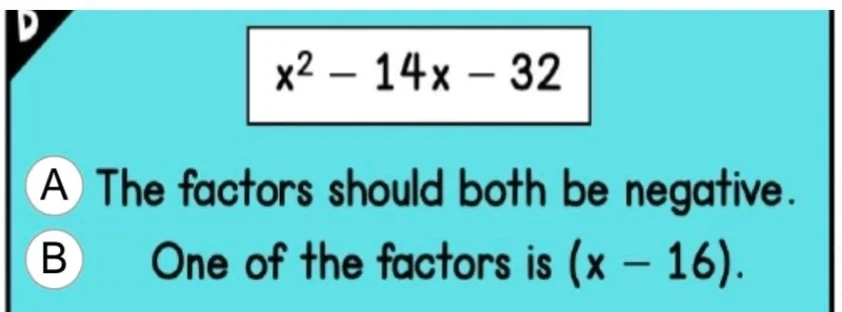
x² - 14x - 32
a the factors should both be negative.
b one of the factors is (x − 16).
To determine the correct option, we factor the quadratic expression \(x^{2}-14x - 32\).
Step 1: Find two numbers
We need two numbers that multiply to \(-32\) (the constant term) and add up to \(-14\) (the coefficient of the \(x\)-term).
Let's list the factor pairs of \(-32\):
- \(1\times(-32)=-32\) and \(1+(-32)=-31\)
- \(2\times(-16)=-32\) and \(2+(-16)=-14\)
Step 2: Factor the quadratic
Using the numbers \(2\) and \(-16\), we can rewrite the middle term:
\[
\]
Now let's analyze the options:
- Option A: The factors are \((x + 2)\) and \((x-16)\). One factor has a positive constant term and the other has a negative constant term. So the statement "The factors should both be negative" is incorrect.
- Option B: From the factored form \((x + 2)(x-16)\), we can see that one of the factors is \((x-16)\). This statement is correct.
For Option A: Incorrect.
For Option B: Correct.
So the answer is B. One of the factors is \((x - 16)\).

Snap & solve any problem in the app
Get step-by-step solutions on Sovi AI
Photo-based solutions with guided steps
Explore more problems and detailed explanations
To determine the correct option, we factor the quadratic expression \(x^{2}-14x - 32\).
Step 1: Find two numbers
We need two numbers that multiply to \(-32\) (the constant term) and add up to \(-14\) (the coefficient of the \(x\)-term).
Let's list the factor pairs of \(-32\):
- \(1\times(-32)=-32\) and \(1+(-32)=-31\)
- \(2\times(-16)=-32\) and \(2+(-16)=-14\)
Step 2: Factor the quadratic
Using the numbers \(2\) and \(-16\), we can rewrite the middle term:
\[
\]
Now let's analyze the options:
- Option A: The factors are \((x + 2)\) and \((x-16)\). One factor has a positive constant term and the other has a negative constant term. So the statement "The factors should both be negative" is incorrect.
- Option B: From the factored form \((x + 2)(x-16)\), we can see that one of the factors is \((x-16)\). This statement is correct.
For Option A: Incorrect.
For Option B: Correct.
So the answer is B. One of the factors is \((x - 16)\).