QUESTION IMAGE
Question
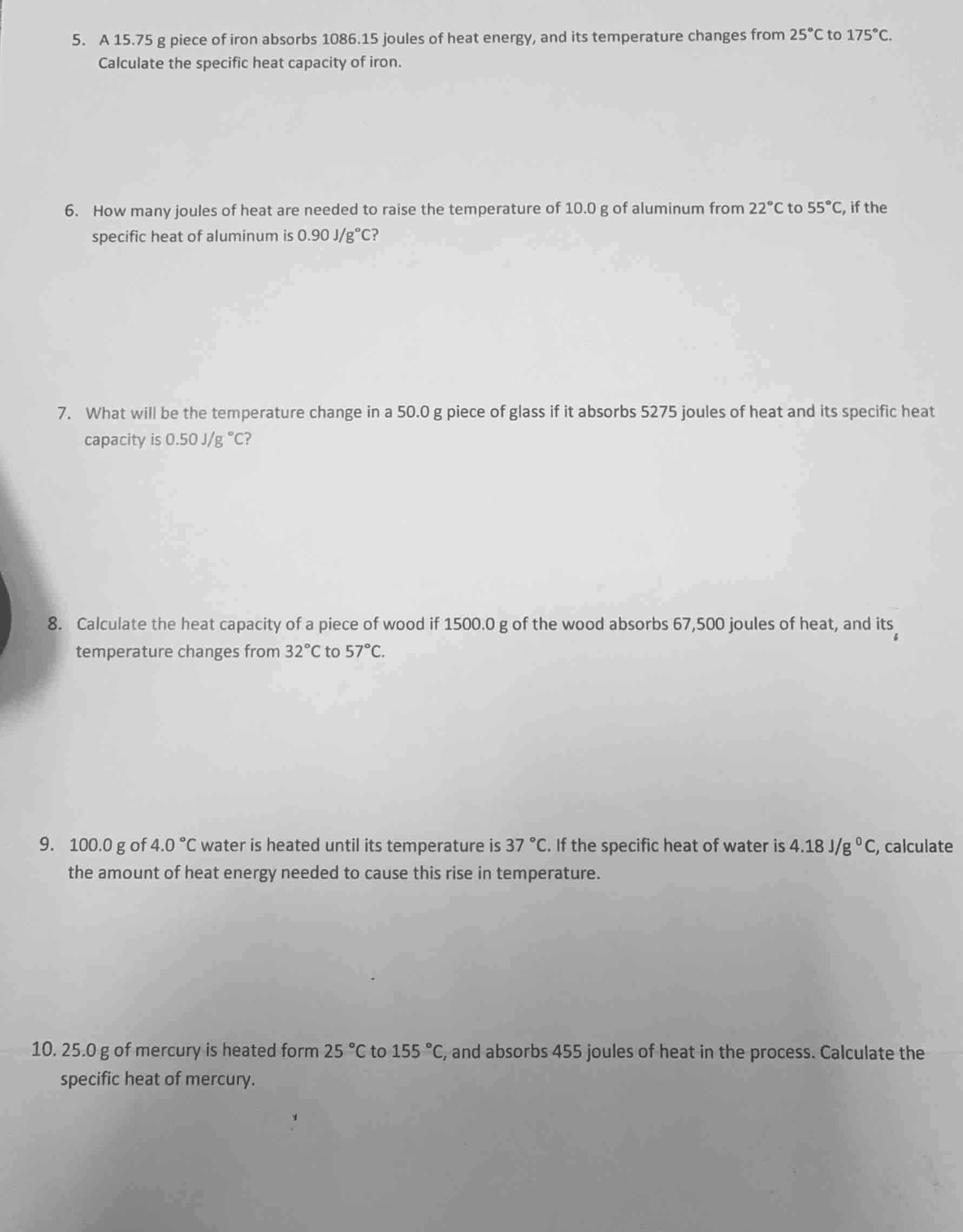
- a 15.75 g piece of iron absorbs 1086.15 joules of heat energy, and its temperature changes from 25°c to 175°c. calculate the specific heat capacity of iron.
- how many joules of heat are needed to raise the temperature of 10.0 g of aluminum from 22°c to 55°c, if the specific heat of aluminum is 0.90 j/g°c?
- what will be the temperature change in a 50.0 g piece of glass if it absorbs 5275 joules of heat and its specific heat capacity is 0.50 j/g °c?
- calculate the heat capacity of a piece of wood if 1500.0 g of the wood absorbs 67,500 joules of heat, and its temperature changes from 32°c to 57°c.
- 100.0 g of 4.0 °c water is heated until its temperature is 37 °c. if the specific heat of water is 4.18 j/g ⁰c, calculate the amount of heat energy needed to cause this rise in temperature.
- 25.0 g of mercury is heated form 25 °c to 155 °c, and absorbs 455 joules of heat in the process. calculate the specific heat of mercury.
Question 5
Step1: Recall the heat formula
The formula for heat energy is \( Q = mc\Delta T \), where \( Q \) is heat, \( m \) is mass, \( c \) is specific heat capacity, and \( \Delta T \) is the change in temperature. We need to solve for \( c \), so rearrange the formula to \( c=\frac{Q}{m\Delta T} \).
Step2: Calculate the temperature change
\( \Delta T = 175^{\circ}C - 25^{\circ}C = 150^{\circ}C \)
Step3: Substitute values into the formula
\( m = 15.75\ g \), \( Q = 1086.15\ J \), \( \Delta T = 150^{\circ}C \)
\( c=\frac{1086.15\ J}{15.75\ g\times150^{\circ}C} \)
First, calculate the denominator: \( 15.75\times150 = 2362.5 \)
Then, \( c=\frac{1086.15}{2362.5}=0.46\ J/g^{\circ}C \)
Step1: Recall the heat formula
The formula for heat energy is \( Q = mc\Delta T \), where \( Q \) is heat, \( m \) is mass, \( c \) is specific heat, and \( \Delta T \) is the change in temperature.
Step2: Calculate the temperature change
\( \Delta T = 55^{\circ}C - 22^{\circ}C = 33^{\circ}C \)
Step3: Substitute values into the formula
\( m = 10.0\ g \), \( c = 0.90\ J/g^{\circ}C \), \( \Delta T = 33^{\circ}C \)
\( Q = 10.0\ g\times0.90\ J/g^{\circ}C\times33^{\circ}C \)
First, multiply \( 10.0\times0.90 = 9.0 \)
Then, \( 9.0\times33 = 297\ J \)
Step1: Recall the heat formula
The formula for heat energy is \( Q = mc\Delta T \), we need to solve for \( \Delta T \), so rearrange the formula to \( \Delta T=\frac{Q}{mc} \)
Step2: Substitute values into the formula
\( Q = 5275\ J \), \( m = 50.0\ g \), \( c = 0.50\ J/g^{\circ}C \)
\( \Delta T=\frac{5275\ J}{50.0\ g\times0.50\ J/g^{\circ}C} \)
First, calculate the denominator: \( 50.0\times0.50 = 25 \)
Then, \( \Delta T=\frac{5275}{25}=211^{\circ}C \)

Snap & solve any problem in the app
Get step-by-step solutions on Sovi AI
Photo-based solutions with guided steps
Explore more problems and detailed explanations
The specific heat capacity of iron is \( 0.46\ J/g^{\circ}C \)