QUESTION IMAGE
Question
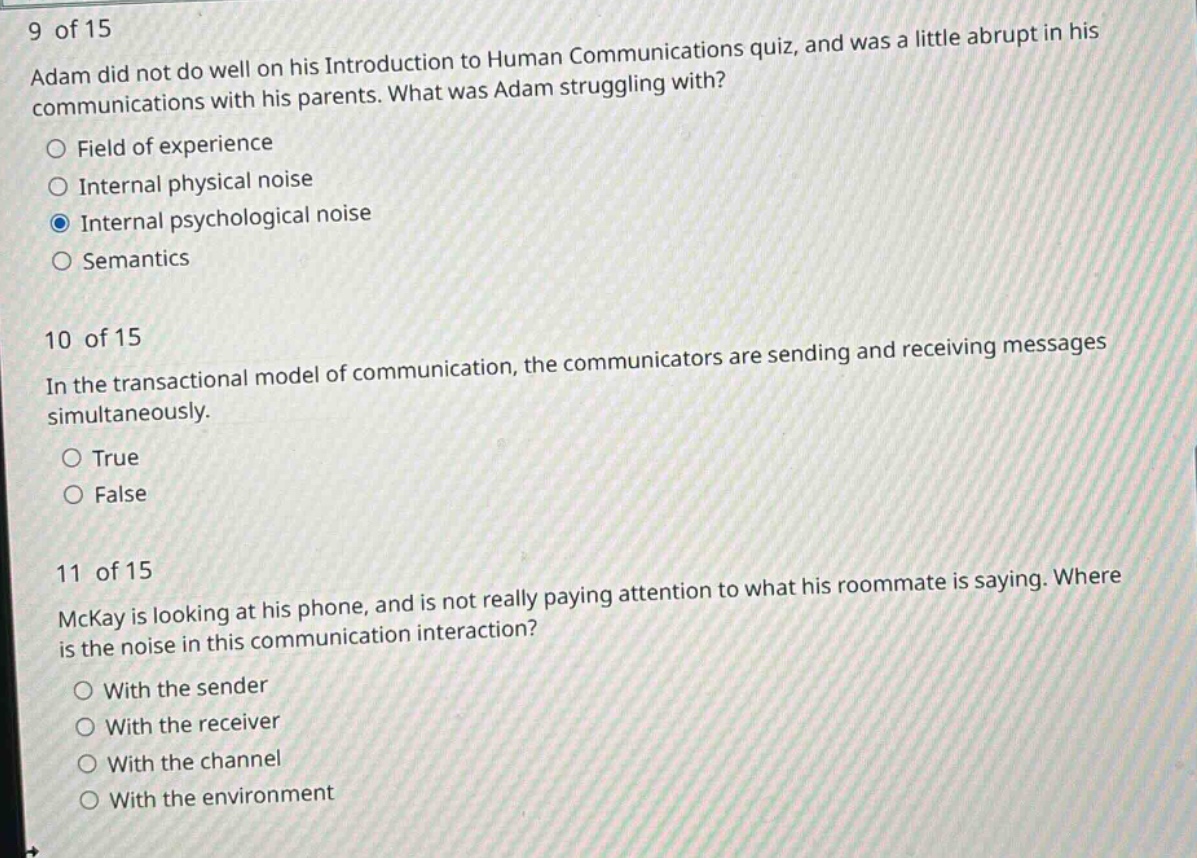
9 of 15
adam did not do well on his introduction to human communications quiz, and was a little abrupt in his communications with his parents. what was adam struggling with?
field of experience
internal physical noise
internal psychological noise
semantics
10 of 15
in the transactional model of communication, the communicators are sending and receiving messages simultaneously.
true
false
11 of 15
mckay is looking at his phone, and is not really paying attention to what his roommate is saying. where is the noise in this communication interaction?
with the sender
with the receiver
with the channel
with the environment
Question 9
Internal psychological noise refers to mental distractions (like stress, worry, or preoccupation) that interfere with communication. Adam’s poor quiz performance and abrupt communication suggest psychological factors (e.g., stress, frustration) affecting his interaction, fitting internal psychological noise. Field of experience relates to shared context, internal physical noise is physical (e.g., pain), and semantics is about meaning—none match as well.
The transactional model of communication emphasizes that communicators (senders and receivers) simultaneously send and receive messages, with feedback happening continuously. This contrasts with linear models. Thus, the statement is true.
McKay is the receiver (not paying attention to the roommate, the sender). Noise with the receiver means the receiver’s distractions (like phone use) interfere with decoding the message. The sender is speaking, the channel (e.g., air for sound) isn’t the issue, and the environment isn’t specified as noisy—so the noise is with the receiver.

Snap & solve any problem in the app
Get step-by-step solutions on Sovi AI
Photo-based solutions with guided steps
Explore more problems and detailed explanations
Internal psychological noise