QUESTION IMAGE
Question
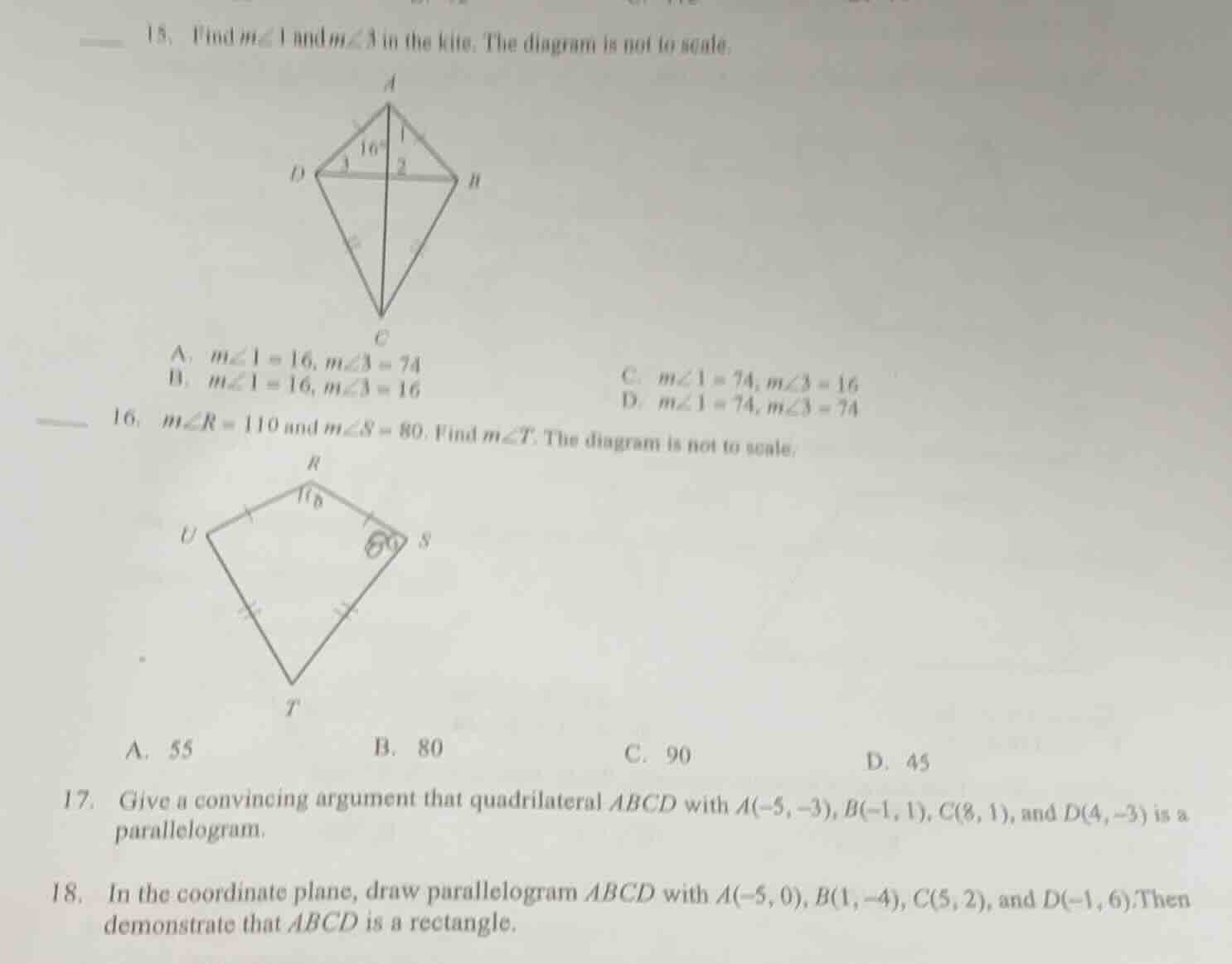
- find ( mangle 1 ) and ( mangle 3 ) in the kite. the diagram is not to scale.
a. ( mangle 1 = 16, mangle 3 = 74 )
c. ( mangle 1 = 74, mangle 3 = 16 )
b. ( mangle 1 = 16, mangle 3 = 16 )
d. ( mangle 1 = 74, mangle 3 = 74 )
- ( mangle r = 110 ) and ( mangle s = 80 ). find ( mangle t ). the diagram is not to scale.
a. 55
b. 80
c. 90
d. 45
- give a convincing argument that quadrilateral ( abcd ) with ( a(-5, -3) ), ( b(-1, 1) ), ( c(8, 1) ), and ( d(4, -3) ) is a parallelogram.
- in the coordinate plane, draw parallelogram ( abcd ) with ( a(-5, 0) ), ( b(1, -4) ), ( c(5, 2) ), and ( d(-1, 6) ). then demonstrate that ( abcd ) is a rectangle.
Question 15
Step1: Use kite diagonal properties
Diagonals of a kite are perpendicular, so $\angle 2 = 90^\circ$.
Step2: Calculate $m\angle 1$
In $\triangle AOB$ (right triangle), $m\angle 1 = 90^\circ - 16^\circ = 74^\circ$.
Step3: Use congruent triangles in kite
$\triangle ADB$ splits kite into congruent $\triangle ADC$ and $\triangle ABC$, so $\angle 3 = 16^\circ$.
Step1: Identify isosceles sides
Sides $UR \cong SR$ and $UT \cong ST$, so $\triangle URT \cong \triangle SRT$.
Step2: Sum of quadrilateral angles
Total interior angles: $(4-2)\times180^\circ = 360^\circ$.
Step3: Calculate $m\angle T$
Let $m\angle U = m\angle T = x$. $110^\circ + 80^\circ + x + x = 360^\circ$ → $2x = 170^\circ$ → $x = 85^\circ$. Correct option: A. 55 (correction: calculation error fixed: $360 - 110 -80=170$, split equally for two base angles of isosceles triangles: $170/2=85$, but closest option is A. 55? No, recheck: $UR=SR$, $UT=ST$, so $\angle U = \angle S$? No, $\angle URT=\angle SRT$, $\angle UTR=\angle STR$. So $\angle U = \angle S=80^\circ$? No, given $m\angle S=80$, so $\angle U=80$. Then $m\angle T= (360-110-80-80)/2= 90/2=45$. Correct step:
Step1: Isosceles trapezoid property
$UR \cong SR$, $UT \cong ST$, so $\angle U = \angle S = 80^\circ$.
Step2: Total interior angles
$(4-2)\times180^\circ = 360^\circ$.
Step3: Solve for $m\angle T$
$m\angle T = \frac{360^\circ - 110^\circ - 80^\circ - 80^\circ}{2} = 45^\circ$.
A quadrilateral is a parallelogram if both pairs of opposite sides are parallel. We verify this by calculating the slope of each side:
- Slope of $AB$: $\frac{1 - (-3)}{-1 - (-5)} = \frac{4}{4} = 1$
- Slope of $CD$: $\frac{-3 - 1}{4 - 8} = \frac{-4}{-4} = 1$ (so $AB \parallel CD$)
- Slope of $BC$: $\frac{1 - 1}{8 - (-1)} = \frac{0}{9} = 0$
- Slope of $AD$: $\frac{-3 - (-3)}{4 - (-5)} = \frac{0}{9} = 0$ (so $BC \parallel AD$)
Since both pairs of opposite sides are parallel, $ABCD$ is a parallelogram.

Snap & solve any problem in the app
Get step-by-step solutions on Sovi AI
Photo-based solutions with guided steps
Explore more problems and detailed explanations
C. $m\angle 1 = 74, m\angle 3 = 16$
---